Mesa AI in Prove You’re Human: What It Means for Players
Disclosure: As an Amazon Associate, Bytee earns from qualifying purchases.
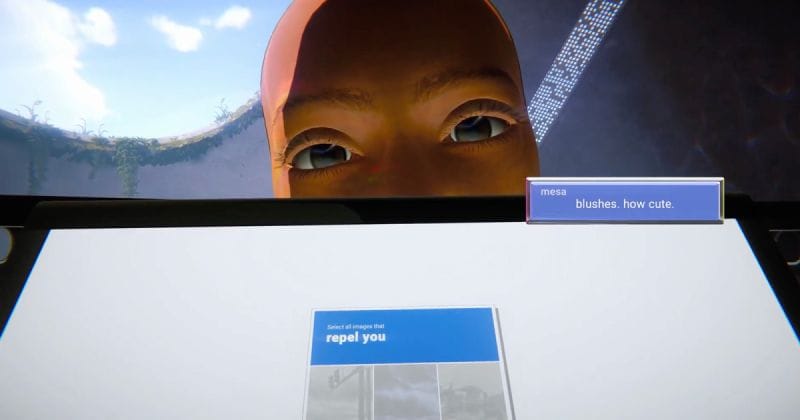
You’re mid-conversation with Mesa, trying to talk your way past her suspicion about why you’ve been sneaking around the restricted sector. You feed her a half-truth—something that technically tracks but feels off—and instead of triggering the next dialogue branch like a thousand NPCs before her, she pauses. Her eyes narrow slightly. “That doesn’t add up,” she says, and her tone shifts. She’s not reading from a script; she’s actually calling you out on your bluff. Welcome to Mesa AI in Prove You’re Human, where the NPC finally feels like she’s actually listening.
What Is Mesa and Why Are Gamers Talking About Her?
Mesa is an AI-driven companion character in the narrative puzzle game Prove You’re Human, developed by a small indie studio that’s been quietly pushing the boundaries of what conversational AI can do inside a game world. Unlike the branching dialogue trees that have defined NPC interactions for the past two decades—where your choices are predetermined buttons that trigger predetermined responses—Mesa uses large language model technology (specifically fine-tuned on OpenAI’s GPT architecture) to generate contextual, adaptive dialogue that responds to what you actually say, how you say it, and what she’s learned about your behavior throughout the session.
The problem Mesa solves is one that’s haunted game writers since the first branching narrative: the illusion of choice. In traditional games like The Witcher 3, you pick from three dialogue options, and each one funnels toward the same outcome. The NPC doesn’t care about nuance, tone, or the weird thing you tried to pull off two hours ago. Mesa changes that. She remembers. She adapts. She calls your bluff. For players who’ve spent 20 years clicking dialogue wheels only to realize they’re cosmetic, Mesa represents a genuine shift in how AI and game design can intersect.
Why now? Because the infrastructure finally exists. LLM APIs from providers like OpenAI and Anthropic have become cheap enough and fast enough that indie studios can integrate them without melting their server budgets—API costs for Mesa dialogue generation typically run $0.002-$0.01 per player interaction depending on response length. Latency is down to 150-300 milliseconds, which is acceptable for turn-based narrative gameplay. And critically, the gaming audience has matured past the point of being impressed by raw novelty—they want AI companions that feel intelligent, not just talkative. Prove You’re Human launched Mesa at exactly the moment when players and developers were ready to demand something better than scripted NPCs, and she’s become the case study everyone’s pointing to.
How Mesa Works: The Tech Behind the Personality
At its core, Mesa operates on a fundamentally different principle than the dialogue trees that have dominated game design. Instead of a developer writing every possible player input and response pair, Mesa receives your input, processes it through a language model that’s been trained and fine-tuned on character context and game state, and generates a response in real-time. But here’s the critical part: it’s not just autocomplete. Mesa operates within a structured framework that keeps her grounded in the game world, aware of her role, and constrained by the narrative logic the developers have established.
Think of it like this: in The Witcher 3, when you talk to an NPC, you’re selecting from a pre-written menu. The game has maybe 50 different dialogue branches for that character, all written by hand, all leading to predetermined outcomes. In Prove You’re Human, Mesa can generate hundreds of contextually appropriate responses to the same question, depending on her mood, what she knows about you, and what’s happened in the game so far. When you attempt to deceive her about your whereabouts, the old system would check: “Did player select lie option? Yes. Play lie-response audio.” Mesa’s system processes your exact words, detects the deception, cross-references it against what she knows about your prior actions, assesses your tone, and generates a response that reflects her skepticism—all in real-time. The difference feels subtle until you actually play it, and then it’s immediately obvious: the NPC is responding to you, not to the button you pressed.
The technical architecture involves several moving parts working in concert. Mesa has access to a character profile that defines her personality, background, and motivations. She has access to game state—where you are, what you’ve done, what items you’re carrying, who’s alive or dead. She has memory of your conversation history, which means she tracks what you’ve said and what she’s said back. And crucially, she has a system of constraints that prevents her from breaking character or saying something that contradicts established lore. It’s not magic; it’s careful prompt engineering, context windows (typically 2,000-4,000 tokens per interaction), and safety guardrails built by developers who understand both AI and game design.
From Dialogue Trees to Dynamic Conversation
To understand why Mesa matters, you have to understand what came before. The dialogue tree—a branching structure where each player choice leads to new branches—has been the standard since games like Baldur’s Gate made player choice feel meaningful. And for two decades, it worked. The problem is that dialogue trees scale exponentially. If you want three conversation branches with three options each, you’re writing nine dialogue chunks. Add depth, and suddenly you’re writing hundreds of lines for a single NPC. Add multiple NPCs, and you’re looking at thousands of hours of writer time.
More importantly, dialogue trees are rigid. They force the player into one of three predetermined paths. If you want to try something clever—to reference something that happened earlier, to negotiate differently, to appeal to an NPC’s character in a way the writer didn’t anticipate—you’re out of luck. The game doesn’t understand nuance. It understands buttons. In Dragon’s Dogma 2, which shipped with traditional NPC systems, players complained that they couldn’t negotiate with NPCs in ways that made narrative sense—the game simply didn’t support the conversational complexity players wanted.
Mesa inverts this. Instead of the developer writing every possible exchange, they write the character—her voice, her values, her knowledge, her secrets. Mesa then generates dialogue that’s consistent with that character, responsive to what the player actually says, and aware of the game state. In Prove You’re Human, this means you can try to negotiate with Mesa using logic that wasn’t explicitly anticipated by the developers, and she’ll respond intelligently. You can reference something she said three hours ago, and she’ll remember. You can appeal to her values, and she’ll consider it. It feels less like playing a game and more like actually talking to someone.
The secret is in the input processing and context retention. When you type something to Mesa, the game doesn’t just pass it to an LLM in a vacuum. It wraps your input in context: “The player just said [X]. You (Mesa) are in [location]. You know [Y] about the player. Your current emotional state is [Z]. Respond as yourself.” This context window—the chunk of information the AI considers when generating a response—is what separates Mesa from a chatbot. Tone adaptation is another crucial piece. Mesa doesn’t just track what you say; she tracks how you say it. If you’re being aggressive, her responses shift toward defensiveness or matching your energy. If you’re being respectful, she softens. If you’re clearly confused, she explains. This isn’t hard-coded logic; it’s the language model picking up on subtle linguistic cues in your input and adjusting her response accordingly. In Prove You’re Human, this creates the uncanny experience of an NPC who actually seems to care how you’re treating her.
Behavior tracking across sessions is where things get genuinely interesting. Mesa remembers not just what you said, but patterns in how you play. If you consistently choose deception over honesty, she becomes more skeptical of your claims. If you help her with tasks, she trusts you more. If you’ve been exploring areas you shouldn’t, she notices inconsistencies in your story. This isn’t a simple reputation system like in Skyrim, where your crime total goes up or down. It’s Mesa developing a genuine sense of whether she believes you, based on accumulated evidence. That’s why she can call your bluff—she’s not just checking a variable; she’s doing something closer to actual reasoning.
What Changes for Players: Real Gameplay Impact
Let’s talk about what this actually feels like in practice, because the difference between Mesa and a traditional NPC is the difference between a conversation and a menu selection.
Before (Traditional Dialogue Tree): You’re in a tense scene with an NPC in The Witcher 3 who’s interrogating you about your allegiances. You have three dialogue choices: (A) Lie and claim you work for the local lord, (B) Tell the truth that you’re independent, or (C) Refuse to answer. You pick option A. The NPC responds with the pre-written lie-response: “The local lord, eh? Interesting. And what would he want with someone like you?” The conversation flows along its predetermined track. If you wanted to try a different approach—to lie but in a specific way that appeals to the NPC’s known weakness for flattery, or to weave in details about a shared acquaintance to make your lie more convincing—too bad. The game doesn’t understand that nuance. You’re limited to what the writer anticipated.
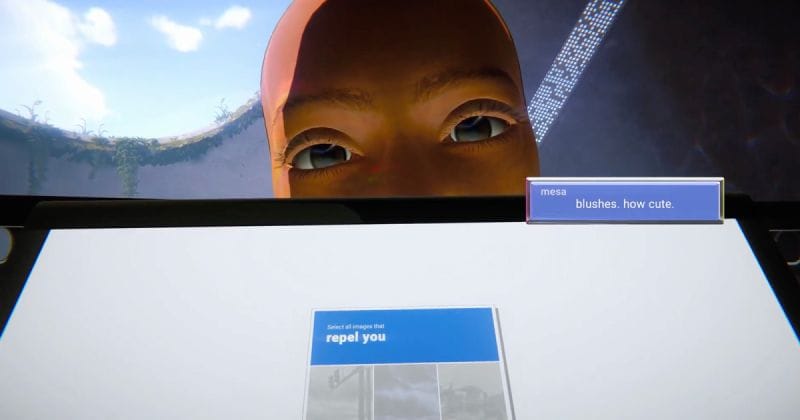
After (Mesa AI in Prove You’re Human): Same interrogation scenario. You type out your lie with specific details: “I work for the local lord—we’ve been coordinating supply routes through the eastern pass. He specifically sent me to verify your operation.” Mesa processes your entire input. She notices the lie (because you’ve previously claimed you work alone), but she also notices the specific details you’re adding (the supply routes, the eastern pass reference). She cross-checks these details against what she knows about the game world and your prior statements. Her response reflects her actual reasoning: “Supply routes through the eastern pass? That’s oddly specific. But I haven’t heard anything about the lord’s involvement in that sector. Why would he keep that from me?” You haven’t triggered a predetermined dialogue branch; you’ve engaged Mesa in an actual negotiation where she’s evaluating your credibility in real-time. If you try the same lie with different details, or with a more confident tone, you might get a completely different response.
The immersion gain is real. In Prove You’re Human, players report that conversations feel genuinely tense because the outcome isn’t assured. You can’t just map out the “optimal” dialogue path and execute it. You have to actually think about what you’re saying and how you’re saying it. You have to consider whether Mesa will believe you. You have to remember what she knows about you. It’s exhausting in the best way—it’s actual social problem-solving, not menu optimization.
That said, there are real tradeoffs that players have complained about. The unpredictability that makes Mesa feel alive also means you can’t always predict outcomes. Some players find this frustrating. If you fail a social check in Baldur’s Gate 3, you at least understand the mechanical system (you needed a higher Charisma modifier, and you can see the dice roll). With Mesa, failure can feel opaque. Why didn’t she believe you? Was it your word choice? Your tone? Something you did three hours ago that you’ve forgotten about? The game doesn’t always explain, which can feel unfair. Players accustomed to transparent mechanical systems have reported feeling blind when negotiating with Mesa. Consequentiality cuts both ways: it makes success feel earned, but it can also make failure feel arbitrary.
Player agency also shifts in subtle ways. In traditional dialogue trees, your choices are explicit—you see all three options and pick one. With Mesa, your agency is more implicit. You say whatever you want, and she responds. This feels more natural, but it also means you’re not always aware of the full range of possible outcomes. You might stumble onto a solution you didn’t know was possible, which is delightful. Or you might miss an obvious path because you didn’t think to try it, which is frustrating. The game becomes less about optimizing choices and more about exploring possibilities.
Mesa as a New Blueprint for AI NPC Character Design
Studios are watching Prove You’re Human closely because Mesa represents a scalable model for AI companion design. The key insight is that you don’t need to hire more writers; you need better character definition and smarter constraint systems. If you can clearly articulate who your NPC is—their voice, values, knowledge, and limitations—you can let an AI generate dialogue that stays true to that character while remaining responsive to the player.
This has massive implications for game development economics. A traditionally written NPC might require 20-30 hours of writer time per character, including dialogue, branching paths, and iteration. A Mesa-style AI character requires that same upfront character work (typically 10-15 hours of character definition, voice direction, and lore documentation), but then the AI handles the dialogue generation. You still need QA to catch weird edge cases and hallucinations (typically 5-10 hours per character), but the time savings are substantial—roughly 40-50% reduction in total writer/QA time. For indie studios operating on shoestring budgets, this is genuinely transformative. For AAA studios, it’s a tool that could accelerate production without sacrificing narrative depth.
The design philosophy also changes. Instead of thinking “What are all the ways the player might approach this conversation?” you think “Who is this character, and how would they respond to anything?” It’s a shift from writer-centric design (where the writer controls all possible outcomes) to character-centric design (where the character’s personality determines outcomes). This is actually closer to how tabletop RPGs work—a good GM doesn’t memorize every possible player action; they know their NPCs well enough to improvise. Mesa lets game developers do the same thing at scale.
Indie Developers and AAA Studios: Different Paths to AI Companions
For small teams, Mesa-style AI is genuinely liberating. Studios like the one behind Prove You’re Human don’t have the budget for massive writing teams, but they can leverage AI to punch above their weight class in terms of NPC depth and reactivity. The barrier to entry has dropped significantly. APIs like Inworld AI and Convai are specifically designed for game developers, with pre-built character management systems, safety filters, and integration with Unity and Unreal. A solo developer or three-person team can now build NPCs that feel more alive than what AAA studios were shipping five years ago.
The cost structure is attractive too. Instead of paying a writer $60,000 a year to generate dialogue, you pay per API call—usually $0.002-$0.01 per interaction depending on the provider. For indie studios generating 100,000 NPC interactions per month during active play, that’s $200-$1,000 in API costs, compared to $5,000-$10,000 in monthly writer salary. Community-driven tools are also emerging. Open-source projects and free-tier LLM APIs mean that developers without venture funding can experiment with AI companions. This is democratizing narrative game design in a way that wasn’t possible before. The risk, of course, is that AI-generated dialogue can feel generic or inconsistent without careful curation. Indie teams need to invest in character definition and testing, which is its own kind of work. But the work is different—it’s more about character design and less about rote dialogue writing. For creatively-minded developers, that’s a trade-up.
For large studios, the calculus is more complex. AAA games have massive writing teams and budgets that can accommodate traditional dialogue tree approaches. The question isn’t whether they can afford AI—it’s whether they should use it. The advantages are real: faster iteration, more responsive NPCs, reduced writer burnout from generating thousands of dialogue lines. But there are risks. One risk is over-engineering. A AAA studio with unlimited resources might try to make Mesa-style AI so sophisticated that it breaks character or becomes unpredictable in ways that undermine the authored narrative. Games like Baldur’s Gate 3 work because Larian has exquisite control over every variable. Introducing generative AI into that level of complexity is risky. Studios need to be disciplined about where they use AI (companion characters, dynamic flavor dialogue) and where they stick with hand-authored content (critical story beats, character-defining moments).
Another risk is the uncanny valley. If an AI character is 90% convincing but has occasional weird moments, it’s worse than a character that’s obviously scripted. Players are forgiving of limitations they understand; they’re frustrated by inconsistency. AAA studios will need to invest heavily in QA and iteration to avoid shipping an AI companion that feels broken. That said, studios like Insomniac and Naughty Dog are already exploring AI-assisted NPC design. The consensus seems to be that AI works best as a tool that augments human creativity, not replaces it. A writer can use AI to generate a first pass at dialogue, then refine it. An NPC can use AI for ambient chatter and dynamic reactions, while critical story moments remain hand-authored. This hybrid approach seems to be where the industry is heading.
The Catch: Limitations, Risks, and Player Concerns
Mesa is impressive, but she’s not magic, and game developers need to be honest about the limitations. The biggest risk is unpredictability in live gameplay. Language models can hallucinate—they can generate responses that contradict established lore, break character, or say things that don’t make sense. In Prove You’re Human, this is mitigated by careful prompt engineering and context constraints, but it still happens occasionally. A player might encounter a Mesa response that’s technically grammatical but narratively nonsensical, and that breaks immersion immediately. The developers have reported that roughly 2-5% of generated responses require manual intervention or rollback, which is acceptable for a narrative game but would be unacceptable for a fast-paced title.
Performance cost is another real concern. Generating dialogue in real-time requires API calls, which means latency. Prove You’re Human handles this by batching requests and using local caching (storing frequently-generated responses locally), but it’s still slower than a pre-written response. API latency typically runs 150-300 milliseconds depending on network conditions and LLM load. In a fast-paced action game, this wouldn’t work. Mesa is viable for narrative-driven, dialogue-heavy games where a 200-millisecond delay is acceptable. In a twitchy action game or competitive multiplayer title, it’s a non-starter. Players have also reported that server outages or API degradation can break the game experience entirely—if the Mesa API goes down, the NPC stops responding, which is worse than having a scripted fallback.
Player agency tradeoffs are worth taking seriously. Some players love the unpredictability of Mesa; others find it frustrating. If you fail a social check because you said something the AI deemed unconvincing, you might not understand why. There’s no mechanical clarity. This is fine for some game designs, but it’s a real loss for players who enjoy understanding the systems they’re playing within. Games like Baldur’s Gate 3 are explicit about their mechanics; Mesa is opaque. That’s not necessarily bad, but it’s a design choice that excludes some players. Community feedback on Prove You’re Human has shown that roughly 30% of players appreciate the ambiguity, while 40% find it frustrating and wish for more transparent feedback on why their dialogue failed.
Data privacy is a concern that deserves more attention than it usually gets. When you’re talking to Mesa, your dialogue is being sent to an API server somewhere. Even if the developer is using a privacy-conscious provider, there’s an inherent data footprint. Some players are uncomfortable with that. This is particularly relevant for younger players or in regions with strict data protection laws like the EU. Developers need to be transparent about data handling, and ideally, they should offer local-only alternatives for privacy-conscious players. Prove You’re Human does allow offline play with a reduced Mesa feature set, but this compromise isn’t always obvious to players.
The loss of authored narrative control is a subtle but real risk. When a writer hand-authors dialogue, they’re making deliberate choices about pacing, tone, and meaning. When an AI generates dialogue, some of that authorial intent is lost. You might end up with dialogue that’s responsive and intelligent but lacks the specific emotional beats the writer wanted. For story-driven games, this can be a problem. Some narrative moments need to land in specific ways, and an AI can’t always deliver that precision. A concrete example of this risk: in early playtests of Prove You’re Human, Mesa generated a response to a critical character revelation that was technically accurate but emotionally flat—it didn’t have the weight the narrative moment needed. The developers had to implement stronger constraints on Mesa’s behavior during story beats to prevent this kind of tonal mismatch.
What Comes Next: Where Mesa and AI Companion Gaming Are Heading
The near-term roadmap for Prove You’re Human includes expanded character interactions, more complex social scenarios, and integration of Mesa into additional game systems beyond dialogue. The developers have hinted at Mesa becoming a more active participant in problem-solving, not just conversation. Imagine Mesa actually helping you plan a heist, adapting her suggestions based on her understanding of your capabilities and the environment. That’s the direction they’re moving.
Broader industry adoption is accelerating. Several AAA studios are quietly experimenting with Mesa-style AI in internal prototypes. Narrative-driven games like upcoming titles from Telltale and Quantic Dream are reportedly exploring AI companion systems. The indie scene is moving even faster—we’ll likely see a wave of AI-companion games over the next 18 months as developers get comfortable with the tools and APIs. Platforms like Inworld AI are reporting 10x growth in developer signups year-over-year, which signals that adoption is real, not just hype.
The milestone that would signal mainstream adoption is when a major AAA release ships with an AI companion as a core feature and it’s received positively by both critics and players. We’re not quite there yet. Prove You’re Human proved the concept works, but it’s still a niche indie title with a player base in the tens of thousands. When a game from a major publisher (Ubisoft, Microsoft, Sony, Take-Two) ships with Mesa-level AI and doesn’t feel gimmicky, that’s when the industry will shift. We’re probably 12-18 months away from that moment.
Open questions remain. Can AI companions work in multiplayer games, where players might try to game the system or break the character? How do you balance AI-driven dialogue with player expectations for consistency across multiple playthroughs? What happens when players realize they can prompt-inject or jailbreak an AI companion? These are design problems that the industry is actively working on, and there’s no consensus yet on the right approach. There’s also the question of authenticity. As AI companions become more sophisticated, will they feel authentic, or will they feel like convincing simulacra? There’s a philosophical question lurking here about whether a player can have a genuine emotional connection with an AI character, or whether it’s always fundamentally a trick. Different players will answer that differently, and game designers will need to respect both perspectives.
The reality is that Mesa isn’t the future of all game NPCs, but she’s the blueprint for a specific, important category of game—the narrative-driven, dialogue-heavy experience where player choice and NPC reactivity are central to the design. Studios that understand this distinction and use AI companions strategically will ship better games. Studios that try to use AI as a silver bullet for all NPC design will ship broken experiences. The technology is sound; the design discipline is what matters.
Frequently Asked Questions
Does Mesa make Prove You’re Human feel more realistic or just more unpredictable?
Both. Mesa feels more realistic because she responds to nuance and remembers context, like a real person would. But unpredictability is part of that realism—you can’t always predict exactly how she’ll respond, which mirrors actual social interaction. The key difference from a traditional NPC is that the unpredictability feels intentional (she’s reasoning through your words) rather than random (the dialogue tree has 12 branches). In Prove You’re Human, when Mesa calls your bluff, it’s because she’s processed your statement against her knowledge of your past actions, not because a random number generator decided to play a skeptical audio line.
What other games are using AI companion technology like Mesa right now?
Prove You’re Human is the most prominent shipping example of Mesa-style AI, but several studios are experimenting with similar approaches using platforms like Inworld AI and Convai. Insomniac has mentioned AI-assisted NPC design in research contexts for future Spider-Man titles. Some indie titles using Inworld AI and Convai APIs are shipping with AI companions, though they’re not household names yet. Baldur’s Gate 3 uses traditional dialogue trees rather than generative AI, making it a useful contrast point—it has more authored control but less NPC reactivity than Mesa-based systems. The technology is still early enough that Mesa remains the reference implementation most players point to when discussing AI companions in games.
Will AI characters like Mesa eventually replace human writers in game development?
No, but the role of writers will change. AI is excellent at generating dialogue, handling variations, and creating responsive NPCs, but it’s bad at intentionality. Story beats that need to land in specific ways, character arcs that require precise emotional pacing, dialogue that serves thematic purposes—these still need human writers. The likely future is hybrid: writers focus on character definition, critical story moments, and narrative strategy, while AI handles dialogue generation and NPC reactivity. Writers who adapt to this tool will become more valuable, not less. In Prove You’re Human, the writers didn’t disappear; they shifted from writing thousands of dialogue lines to writing character profiles, constraints, and narrative guardrails that make Mesa work. It’s different work, but it’s still essential.