Real-Time AI Voice Transformation: What It Means for Players
Disclosure: As an Amazon Associate, Bytee earns from qualifying purchases.
Picture this: you’re deep in a VRChat social hub, your avatar is a seven-foot armored knight, and then you open your mouth — and out comes your completely unmodified, tired Tuesday-evening voice, shattering every inch of that immersion in one syllable. For years, that’s been the reality for anyone trying to embody a character in multiplayer spaces. But real-time AI voice transformation is about to change that equation entirely. Instead of sounding like a robot with a pitch slider cranked up, your voice could genuinely sound like your knight character — maintaining your tone, your emotion, your personality, just filtered through an entirely different vocal identity. This isn’t the helium-voice nonsense from 2015. This is neural voice synthesis happening live, sub-50 milliseconds, powered by transformer models that have learned what human speech actually sounds like at a granular level. And it’s moving from indie tools into mainstream gaming platforms faster than most players realize.
What Is Real-Time AI Voice Transformation and Why Are Gamers Talking About It?
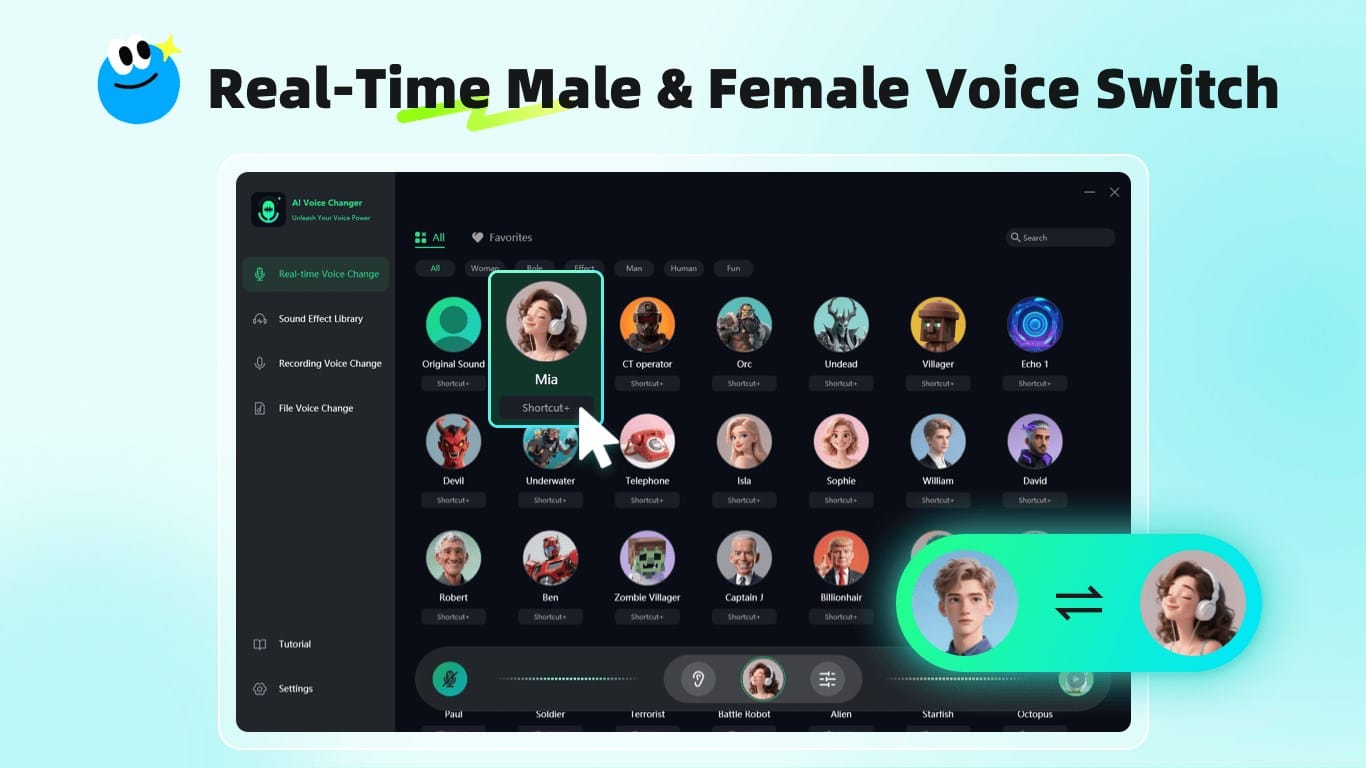
Real-time AI voice transformation is the ability to take your live voice input and synthesize it into a completely different voice — different gender, age, accent, timbre, emotional tone — all while you’re actively speaking, with virtually no perceptible delay. It’s fundamentally different from the pitch-shift voice changers that have existed since the early 2000s. Those old tools were crude: they’d boost your frequencies, lower your frequencies, maybe add some reverb, and call it a day. The result sounded like you’d sucked on helium or gargled gravel. It was fun for five minutes in a Discord call, then unbearable.
Real-time AI voice transformation solves a core problem that’s been festering in multiplayer gaming for a decade: the disconnect between who you are and who you want to be. In VRChat, you might spend three hours crafting a photorealistic anime character, a dragon furry, a sci-fi cyborg — and then you speak, and your actual human voice breaks the entire fantasy. In Valorant, players have long wanted voice lines that matched their agent’s character, not their own vocal characteristics. In Among Us, the social deception game became even more deceptive when players could make their voice match their claimed identity. The technology makes this possible now because neural voice models — specifically transformer-based architectures trained on thousands of hours of human speech — have reached a threshold where they can capture the nuances of actual voice: the micro-tremors, the breath patterns, the emotional undertones that make speech feel human and not like a text-to-speech robot.
Five years ago, this required processing power that lived on a server farm. Today, edge inference — running the model locally on your GPU or even your CPU — makes it feasible to do this in real-time on consumer hardware. That shift is what’s unlocked the conversation. It’s why you’re seeing startups like Voicemod AI and ElevenLabs pivoting to real-time gaming APIs, why Riot Games has been quietly investing in voice safety infrastructure, and why indie devs are suddenly treating voice synthesis like another asset pipeline, the same way they treat character models or sound effects.
How It Works: The Tech Behind the Magic
If you’re familiar with how modern GPUs handle shaders — taking raw geometry data and transforming it pixel-by-pixel in parallel — think of AI voice transformation the same way, except the “pixels” are audio samples and the “shader” is a neural network. Your voice comes in as a raw audio stream (typically 16-bit, 48 kHz sample rate in gaming contexts). The model doesn’t just pitch-shift it; it tokenizes it, breaks it down into meaningful units of speech, processes those units through multiple layers of a transformer architecture, and reconstructs them as entirely new audio that maintains your speech patterns but uses the target voice’s characteristics.
The magic happens in the latency budget. Most multiplayer games need voice chat to feel natural, which means under 150 milliseconds of total round-trip delay. Real-time voice transformation adds another processing step into that pipeline. A state-of-the-art model needs to handle this in under 50 milliseconds — ideally 20-30 — to feel transparent to the player. That’s where techniques like streaming inference come in: instead of waiting for you to finish a sentence, the model processes your voice in tiny chunks (maybe 10-20 milliseconds at a time) and outputs transformed audio with minimal buffering. It’s a constant, rolling transformation, not a batch operation.
Training data matters enormously here. These models are typically trained on large, diverse voice datasets — thousands of speakers, multiple languages, various emotional contexts. The more diverse the training data, the better the model generalizes to new speakers and new target voices. Voicemod AI and ElevenLabs have both invested heavily in data collection and curation. The trade-off is that models trained on narrower datasets (say, just English male voices, or just anime character voices) can sound more convincing in those specific domains but fail when pushed outside their training distribution. This is why some AI voice tools sound eerily perfect in one context and completely uncanny in another — the model is extrapolating beyond what it’s seen.
In terms of actual middleware, game developers have a few established options. Voicemod AI offers a real-time API that can be integrated into game engines. ElevenLabs launched a real-time voice synthesis API specifically designed for gaming, with sub-50ms latency. Convai focuses on conversational AI with voice synthesis baked in. And platforms like Inworld AI let developers bind voice transformations to specific NPCs or characters, so your dialogue sounds consistent across a session. For engine-level support, Unity has been experimenting with real-time voice processing through plugins, and Unreal Engine’s MetaHuman system is beginning to integrate voice synthesis as part of the character pipeline.
Latency: The Hidden Boss Fight for Voice AI
Latency is the invisible killer of voice immersion. If you’re speaking and hearing yourself back 200 milliseconds later, your brain registers it as “wrong” — you start overcompensating, speaking slower, trailing off. It’s the same uncanny feeling you get when you watch a video call with bad sync. For voice transformation, the latency budget is even tighter because you’re adding processing on top of existing network delays.
Here’s what sub-50ms feels like in practice: you’re in a Valorant match, you use your ability and call it out. Your voice comes in, gets transformed to match your agent’s vocal profile, and reaches your teammates almost instantaneously. They hear a consistent voice throughout the match. Compare that to a system with 200ms latency: you call out the ability, there’s a noticeable gap, then the transformed voice arrives. Your teammate’s brain registers the delay as “artificial,” and immersion cracks. This is why edge inference — running the model on your local machine rather than sending audio to a server — is becoming standard. It cuts network round-trip out of the equation entirely.
The technical challenge is that edge inference requires enough GPU or CPU resources to run a transformer model without dropping frames in your game. This is solvable on modern hardware (even mid-range GPUs can handle it), but it’s not free. There’s a CPU cost, there’s a power cost, and there’s a complexity cost for game developers who now have to ship and maintain a neural network alongside their game engine. Some studios are betting that the immersion gain justifies that cost. Others are taking a hybrid approach: lightweight local processing for latency-sensitive voice transformation, with optional server-side processing for higher-quality results when latency isn’t critical.
What Changes for Players: Real Gameplay Impact
Let’s ground this in a before-and-after. You’re playing VRChat with a friend. In the old system (2023 and earlier), you’d use Voicemod’s pitch-shift engine or a basic voice modulator. Your friend hears you speak, and it sounds like a chipmunk, or a demon, or a robot — something distinctly artificial that doesn’t match the immersion of your avatar. The effect wears off fast because your brain is constantly reminded that there’s a person behind that fake voice. The audio quality is compressed, the emotional nuance is stripped out, and any long conversation becomes exhausting because of the cognitive dissonance.
In the new system (2024-onward), you use an AI voice transformation tool like ElevenLabs’ real-time API or Voicemod AI tied to your avatar. Your voice comes in, the model recognizes your speech patterns, and outputs audio that sounds like your avatar character would sound — same gender, age, accent, but still clearly you speaking. Your friend hears emotional inflection, breath, pauses, all the subtle human elements that make speech feel real. When you laugh, the transformed voice laughs. When you get excited, the voice rises. The immersion doesn’t break because the voice feels genuinely embodied, not like a filter applied to a robot.
The gameplay impact is subtle but profound. In social games like VRChat, players report significantly higher immersion and longer engagement in character. In deception games like Among Us, voice transformation makes social engineering easier — you can claim to be a different player and your voice supports that claim, making the game’s core mechanic of social trust even more fragile and interesting. In competitive games, it opens up possibilities for agent-specific voice lines in games like Valorant or Overwatch, where your character’s voice can now authentically match your chosen identity without requiring a full VO cast.
There’s an accessibility angle here that’s worth highlighting. Players with speech disabilities, voice dysphoria, or anxiety around voice chat now have a tool that lets them participate in voice-enabled games without exposing themselves. A trans player can use a voice transformation that matches their identity. A player with a stutter can use a model trained on fluent speech to communicate without the social friction of their disability. A player with vocal strain can use a synthetic voice that doesn’t require them to strain their actual voice. These aren’t edge cases — these are real players, real accessibility needs, and real reasons to care about this technology beyond just “cool voice effects.”
The tradeoff, though, is trust. If everyone can sound like anyone, how do you verify who you’re actually talking to? This is where the technology creates new social friction. In competitive games, players might demand voice verification to prevent smurfing or account-sharing. In social games, the ease of impersonation could lead to harassment. And in games where voice is part of the trust economy — like Among Us, where your voice is supposed to be genuinely you — voice transformation could fundamentally change the game’s balance.
What Game Studios and Tool Makers Are Building With This
Riot Games has been the most public about investing in voice infrastructure. While they haven’t officially launched a consumer voice transformation tool for Valorant, they’ve filed patents and spoken at GDC 2024 about voice identity pipelines — essentially, systems that let players maintain a consistent voice identity across agents and across matches. The implication is clear: they’re building toward a future where your chosen agent has a voice that’s consistently you, transformed to match the character.
VRChat has been the testing ground for player-driven voice transformation. The platform’s community has been experimenting with real-time voice tools for years, and VRChat’s official stance has shifted toward supporting these tools as long as they’re opt-in and transparent. Players can now use third-party voice transformation tools like Voicemod AI within VRChat, and the platform is beginning to explore native integration with ElevenLabs’ real-time API.
Inworld AI, a startup focused on conversational AI for games, has been building voice transformation into their character framework. If you’re creating an NPC in their system, you can now bind a voice transformation to that character, so the NPC’s dialogue is synthesized in a consistent voice that matches the character’s design. This is a game-changer for indie developers who can’t afford to hire voice actors for branching dialogue.
ElevenLabs launched their real-time voice API specifically for gaming in 2024, positioning it as the infrastructure layer for games that want to add voice transformation without building it from scratch. They’re targeting both AAA studios and indie developers, with pricing that scales based on usage.
On the engine side, both Unity and Unreal are quietly building voice processing capabilities into their core offerings. Unity’s audio system has been updated to support real-time neural audio processing. Unreal’s MetaHuman Animator is beginning to integrate voice synthesis as part of the character creation pipeline, so a developer can design a character’s face and have the voice generation follow automatically.
The developer tooling landscape is becoming clearer. Here are the key platforms game makers are using:
- Voicemod AI — Real-time voice transformation API with low-latency processing, designed for gaming integration. Supports real-time voice cloning and character voice matching.
- ElevenLabs Real-Time API — High-quality voice synthesis with sub-50ms latency, supports custom voice cloning. Officially positioned for gaming use cases, with integration guides for Unity and Unreal.
- Inworld AI — Conversational AI platform with integrated voice transformation for NPCs and characters. Allows developers to bind consistent voices to character identities.
- Convai — Voice-first conversational AI, emphasizing natural dialogue with voice synthesis. Focuses on real-time dialogue systems for games.
Indie Developers: The Unexpected Early Adopters
Indie devs are moving faster on this than AAA studios, and it makes sense: they don’t have the budget to hire voice actors, but they do have the flexibility to experiment with new tools. A small team making a narrative-driven game with branching dialogue can now use AI voice synthesis to generate thousands of voice lines in multiple character voices without paying for studio time or talent fees. The barrier to entry has dropped dramatically.
One concrete example: indie developers making dialogue-heavy games in tools like Godot or custom engines are using ElevenLabs’ API to generate NPC voice lines on-the-fly. Instead of recording a VO cast, they write dialogue, feed it to the API with a target character voice, and get back synthesized audio that sounds natural and emotionally appropriate. The quality has reached a point where players don’t immediately notice it’s synthetic, especially in games where the visual style is already stylized (pixel art, low-poly, etc.). This approach has been adopted by indie studios working on games like narrative adventure titles and tactical RPGs where dialogue volume would otherwise require massive VO budgets.
Another trend: indie multiplayer games are using voice transformation as a core mechanic, not just a feature. Imagine a social deception game where every player can transform their voice, and part of the game is figuring out who’s who based on gameplay patterns, not voice recognition. Or a cooperative game where voice transformation is used to represent player characters’ emotional states — as stress increases, the voice synthesis shifts to reflect that. These are the kinds of experimental uses that indie devs are exploring because they have less institutional risk than AAA studios.
The cost advantage is real. A full VO cast for a mid-sized game (20-30 characters, hundreds of lines) can run $50,000-$200,000. Using AI voice synthesis through ElevenLabs or Voicemod AI, that same game can generate voice content for a few thousand dollars in API costs, plus the time to refine and QA the output. For indie teams with $100,000-$500,000 budgets, that’s a game-changing difference.
The Catch: Limitations, Risks, and Player Concerns
Real-time AI voice transformation is not a solved problem, and there are real limitations that developers and players need to understand. First, there’s the performance cost. Running a neural network in real-time on a player’s GPU or CPU is not free. Depending on the model size and the hardware, you’re looking at 5-15% of GPU resources during active voice transformation. For a competitive game running at 240 FPS on high-end hardware, that’s manageable. For a player on a mid-range GPU or playing on console, that’s a noticeable performance hit. This is why some studios are considering server-side processing, which trades latency for performance — a classic engineering tradeoff.
Second, there are voice hallucination artifacts. Sometimes the model will generate audio that doesn’t quite match what you said. You might say “I’m going left,” and the synthesis comes out as “I’m going… left?” with a weird inflection that breaks immersion. Or there are brief moments of robotic speech where the model fails to capture emotional nuance. These artifacts are rare with modern models like those from ElevenLabs or Voicemod AI, but they happen, and in a competitive game where voice communication is critical, even rare failures are unacceptable. Players have reported these issues in beta testing of voice transformation features, noting that they occur roughly 2-3% of the time in real gameplay conditions.
Third, and most serious, is the deepfake harassment and voice spoofing risk. If real-time voice transformation becomes mainstream, what’s to stop a player from cloning another player’s voice using ElevenLabs’ voice cloning feature and impersonating them in a lobby? Or using voice transformation to harass players by mimicking them and saying offensive things? This is not hypothetical — it’s already happened in niche communities. In 2023, several Discord servers experienced harassment incidents where players used voice cloning tools to impersonate others. The gaming industry has no standardized response to this yet. Some games might require voice verification (a one-time recording that becomes your “voice ID”), but that introduces privacy concerns. Others might ban voice transformation entirely, which cuts off legitimate use cases.
Data privacy is another major concern. Training voice models requires collecting and storing voice biometric data. Even if a company says they’re not storing your voice, the fact that they’re processing it through their servers creates a privacy surface. What if that data is breached? What if a government agency requests access? What if the company is acquired by a less scrupulous entity? These aren’t paranoid scenarios — they’re standard privacy risks that apply to any biometric data collection. Players are right to be skeptical.
There’s also a moderation blind spot. Voice-based moderation systems (detecting hate speech, slurs, etc.) are already imperfect. If voices are being transformed in real-time using tools like ElevenLabs, moderation becomes even harder. How do you detect a slur if the voice is being synthesized? How do you identify a toxic player if their voice is constantly changing? This could create a scenario where bad actors use voice transformation to evade moderation systems. Some studios might respond by banning voice transformation in competitive modes, but that’s a blunt instrument that hurts legitimate players.
Finally, there’s a skepticism worth noting from recent gaming history. Remember when Nvidia launched DLSS (Deep Learning Super Sampling) for gaming? It promised to double your FPS with no quality loss. In practice, early versions had serious artifacts, looked worse than native rendering in many cases, and created a fragmented ecosystem where some games looked great with DLSS and others looked terrible. The technology has improved dramatically, but the lesson is: just because a technology is theoretically sound doesn’t mean the first-generation implementations are good. Voice transformation is in a similar phase now. The tech works in demos and controlled environments, but real-world deployment in shipped games is going to reveal problems that researchers haven’t anticipated.
What Comes Next: Where Real-Time AI Voice Transformation Is Heading
The near-term roadmap (next 12-24 months) is fairly clear. We’ll see more games experimenting with opt-in voice transformation in social spaces. VRChat, Rec Room, and similar social games will likely offer native integration with real-time voice tools like ElevenLabs’ real-time API or Voicemod AI. We’ll see indie games shipping with AI-synthesized NPC voices becoming more common. And we’ll see the first mainstream competitive game — probably from Riot, Valve, or Blizzard — officially supporting voice transformation as part of their agent or character system.
The mid-term evolution (2-5 years) is more speculative but likely includes persistent voice identities tied to cross-game avatars. Imagine you create a voice identity in one game using ElevenLabs or Voicemod AI, and it follows you to other games that support the same standard. This would require some kind of industry standard for voice identity (similar to how OAuth works for account authentication), which is a big infrastructure lift but would unlock incredible interoperability. We’ll also see emotion-reactive voice modulation — the model doesn’t just transform your voice, it modulates it based on in-game stress, excitement, or other emotional states. Your character’s voice gets higher and faster when you’re panicked, deeper and slower when you’re calm. This level of integration would make voice transformation feel less like a filter and more like a core part of character expression.
The open question is what milestone signals mainstream adoption. Is it console-native support? (Sony or Microsoft officially integrating voice transformation into PlayStation or Xbox). Is it a major esports league using voice transformation? (Valorant Champions featuring players with agent-matched voices). Or is it something simpler — just the first AAA game shipping with this feature that doesn’t feel like a gimmick, that players genuinely prefer over traditional voice chat. We’re probably 18-36 months away from that moment.
There’s also the question of standardization. Right now, every tool uses different models, different latency characteristics, different voice libraries. If the industry doesn’t converge on some standards, we’ll end up with a fragmented ecosystem where your voice identity in one game doesn’t transfer to another, and different games have vastly different quality. The gaming industry has a mixed track record on standardization — we got DirectX and Vulkan for graphics APIs, but we still don’t have a unified voice chat standard across platforms. This time could be different if there’s enough industry pressure, but don’t count on it.
The trajectory is clear: real-time AI voice transformation will become a standard feature in multiplayer games within 3-5 years, not because it’s revolutionary, but because it solves a basic problem that players have complained about for a decade, and the technology has finally caught up to the demand.
Frequently Asked Questions
Does real-time AI voice transformation make multiplayer feel more immersive or does it just make everyone sound fake?
Modern neural voice models from ElevenLabs and Voicemod AI preserve emotional nuance, breath patterns, and speech characteristics in ways that old pitch-shift tools never could. In VRChat and other social games, players report significantly higher immersion when their voice matches their avatar. The key is that the transformation feels embodied, not like a filter — you’re still recognizable as yourself, just filtered through a different vocal identity. The risk is that low-quality implementations or hallucination artifacts can break immersion, so quality of the underlying model matters enormously.
Which games and platforms are actually using AI voice transformation right now?
VRChat has the most mature real-time voice transformation ecosystem, with players using third-party tools like Voicemod AI and ElevenLabs’ real-time API. ElevenLabs launched a real-time API in 2024 specifically for gaming. Inworld AI is integrating voice transformation into their conversational AI platform for NPCs. Riot Games has been publicly exploring voice identity systems for Valorant, though they haven’t officially launched a consumer feature yet. Indie developers are the most aggressive early adopters, using these tools like ElevenLabs and Voicemod AI to generate NPC dialogue without hiring voice actors.
Could AI voice tools be used to harass or impersonate players in online lobbies?
Yes, and this is a legitimate concern that the gaming industry is still figuring out how to address. Voice cloning through tools like ElevenLabs and impersonation have already happened in niche communities. In 2023, several Discord servers experienced harassment incidents where players used voice cloning tools to impersonate others. The risk includes harassment by mimicking players, account fraud through voice spoofing, and evasion of voice-based moderation systems. Studios are exploring solutions like voice verification systems (one-time voice ID recordings), but these introduce their own privacy concerns. Right now, the best approach is transparency and opt-in systems that let players control whether voice transformation is enabled in their games.
What’s the GPU or CPU requirement to run real-time voice transformation locally?
Most modern consumer GPUs can handle real-time voice transformation from tools like ElevenLabs or Voicemod AI, consuming 5-15% of GPU resources depending on model size and hardware. For edge inference, a mid-range GPU (RTX 3060 or equivalent) is sufficient. CPU-only inference is possible but slower and more power-intensive. The exact requirements depend on the model — smaller, quantized models used by Voicemod AI are lighter than full-precision models from ElevenLabs. Console implementations would require optimization work from platform holders.