AI Self-Balancing Ragdoll Physics: How FPS Bodies Actually Move Now
Disclosure: As an Amazon Associate, Bytee earns from qualifying purchases.
You shoot an enemy in an FPS. They stumble backward, their arm catches a railing, their body twists to absorb the fall—and for the first time, it doesn’t look like a marionette with cut strings. Their spine flexes. Their free hand instinctively reaches out to brace against the wall. They don’t ragdoll into a pretzel shape; they react like a body that still, for one final moment, wants to survive. This is AI self-balancing ragdoll physics, and it’s rewriting how death animations work in shooters.
What Is AI Self-Balancing Ragdoll Physics and Why Gamers Are Noticing It Now?
For decades, ragdoll physics in games have been the visual equivalent of cutting a puppet’s strings. When a character dies in a traditional ragdoll system, the engine simply disables all their AI constraints, applies gravity, and lets physics take over. The result? Bodies that flop with zero intention, limbs that clip through walls, and deaths that feel more comedic than impactful. In Call of Duty or Valorant, when you shoot an enemy, they collapse into an anatomically impossible position—an arm bending backward at the elbow, a head sinking into the chest, the body settling into whatever shape the physics engine calculates first. It’s been the industry standard for so long that players stopped questioning it.
AI self-balancing ragdoll physics fundamentally changes this equation. Instead of treating death as an instant toggle from “alive and constrained” to “dead and limp,” the system uses neural networks trained on motion capture data to predict how a body should actually move during impact and collapse. The AI learns balance patterns, weight distribution, and recovery instincts from real human motion—studios capture actors falling at different angles, catching themselves on objects, and recovering from impacts. When a player shoots an enemy in a game using this tech, the AI ragdoll doesn’t just go limp—it simulates a fraction of a second where the body tries to catch itself, where limbs position themselves to absorb force, where spines flex and knees bend in ways that feel authentically desperate rather than randomly physics-driven.
Why are gamers noticing this now? Because recent AAA demos—particularly from Unreal Engine 5’s procedural animation suite—have shown the stark difference between old-school ragdoll and AI-aware systems. Tekken 8 demonstrates this with its knockdown system, where characters hit the ground at different angles and their body positioning changes procedurally based on impact vector and terrain. When you watch an enemy stumble and fall in first-person, every micro-movement matters to immersion. Traditional ragdoll made death feel *cheap*. Self-balancing ragdoll makes death feel *real*, and that shift changes how players emotionally process combat encounters. It’s not just about graphics; it’s about the feeling of consequence.
How It Works: The AI Behind Bodies That Catch Themselves
Under the hood, AI self-balancing ragdoll relies on three core technologies working in real-time. First, neural networks trained on motion capture data learn what “good balance” looks like. Studios capture hours of footage showing actors stumbling, falling, catching themselves on objects, and recovering from impacts at different angles and speeds. The AI learns the spatial relationships: when your center of mass shifts forward, your arms come up; when you hit something sideways, your spine twists to absorb the impact. This isn’t scripted—it’s learned behavior encoded into a neural model that can generate new, never-before-seen recovery animations on the fly. Unreal Engine 5‘s MetaHuman Animator uses this approach, allowing developers to feed mocap data into the procedural animation system and have the AI generate realistic fall responses without hand-animating each scenario.
Second, the system uses inverse kinematics (IK) to calculate limb placement in real-time. Traditional ragdoll is forward kinematics: apply force to a shoulder, the elbow and wrist follow passively. IK inverts that—the AI says “the hand needs to be on that railing to catch the fall,” and then it calculates what the shoulder, elbow, and wrist should do to make that happen. In Unreal Engine 5, this is handled through the procedural animation blueprints, which allow developers to blend AI-predicted poses with physics-driven movement. The result is a body that actively tries to catch itself rather than passively responding to forces. When an NPC in a future Tekken 8-style game gets knocked backward, the AI ragdoll calculates joint angles that would naturally position the arms to brace impact, not random angles generated by physics collision.
Third, real-time GPU compute makes this possible. Traditional ragdoll runs on CPU physics engines like NVIDIA PhysX, which is fast enough for multiple bodies but doesn’t have the headroom for neural network inference on every frame for every NPC. Modern self-balancing ragdoll offloads the AI prediction to GPU—either through NVIDIA PhysX with GPU acceleration or through custom neural network inference on graphics hardware. This means the system can evaluate dozens of possible body positions per frame and pick the most realistic one without tanking frame rate (though we’ll get into the costs later). Studios like Insomniac have published research on procedural animation systems that run on GPU-accelerated hardware, proving that real-time AI ragdoll is feasible at scale for multiple NPCs.
The practical difference: in Call of Duty or Valorant, when you shoot an enemy, they follow a pre-scripted death animation that plays the same way every time. Their body hits the ground in a predetermined shape. With AI self-balancing ragdoll—the direction Unreal Engine 5 is pushing developers—the same shot might result in subtly different body positions depending on where they were standing, what was around them, and how the impact vector hit them. The AI predicts a realistic response, not a canned one.
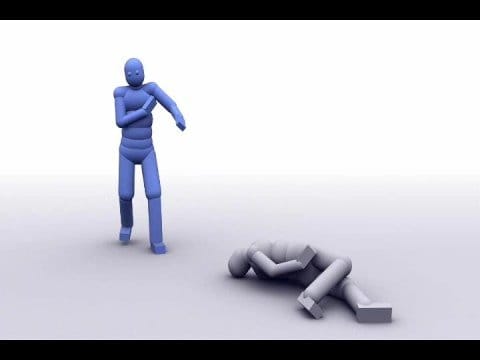
What Changes for Players: Before and After Ragdoll Realism
Here’s where the immersion shift hits hardest: the bodycam death cam. In modern FPS games, when you get killed and the camera pans to show your killer’s perspective, you’re watching an NPC react in real-time. With traditional ragdoll, that enemy you just shot crumples into a heap that looks vaguely wrong—their body doesn’t match the impact vector, their limbs are in positions no living person would adopt, and the fall feels mechanical. You *know* it’s physics, but it doesn’t feel like physics applied to something that was ever alive.
Before (Traditional Ragdoll in Current Games): You shoot an enemy in Valorant or Call of Duty at a 45-degree angle from their right shoulder. The ragdoll activates. The character’s body goes limp mid-animation and flops backward. Their left arm passes through a nearby wall. Their spine contorts into a twisted shape. Their legs splay at unnatural angles. The entire fall takes 1.2 seconds from impact to settlement. The body settles into a pretzel-like position that no conscious person would ever adopt. The death feels like a physics toy malfunctioning, not a person experiencing trauma.
After (AI Self-Balancing Ragdoll): Same scenario in a future Unreal Engine 5 title. You shoot the same enemy at the same angle. The AI ragdoll activates. The character staggers backward. Their free arm (the right one) comes up instinctively to stabilize themselves—not because you scripted it, but because the neural network learned that’s what bodies do when they’re off-balance. They hit a concrete barrier. Instead of clipping through it or bouncing off unrealistically, their torso twists to absorb the contact, their legs adjust to brace against the object, and they fall in a way that *respects* the geometry and physics of the world. The fall takes 0.9 seconds from impact to settlement, and the body settles into a position that looks like someone who tried to survive but failed. If the terrain is sloped, they slide differently. If there’s a wall behind them, their body position changes to account for it. Every death is procedurally unique based on context.
Why does this matter if you’re in first-person and barely see your own body? Because NPCs are constantly in your visual field. When you clear a room and watch three enemies react to getting shot, the procedural realism of their deaths builds the world’s credibility. It’s the same reason modern games invest in detailed cloth simulation and hair physics—it’s not directly gameplay-critical, but it’s the difference between a world that feels alive and one that feels like a collection of assets. In competitive FPS, where every millisecond of visual feedback matters, realistic death animations actually reduce cognitive dissonance. You’re not breaking immersion to process “wait, why did their arm do that?” when the arm position makes biomechanical sense.
What Game Studios Are Building With This Technology
As of 2024, adoption is still in the experimental-to-early-adoption phase, but major studios are actively shipping or prototyping self-balancing ragdoll systems. Tekken 8 uses procedural animation blending for character knockdowns, where the AI adjusts body position based on impact angle and terrain—when a character gets hit at different angles, their ragdoll response changes to reflect realistic weight distribution and balance recovery. Insomniac Games (the team behind Spider-Man) has published research on procedural animation systems that blend AI predictions with physics, demonstrating that neural-network-driven ragdoll is technically feasible at high frame rates. Epic Games, through Unreal Engine 5’s suite of tools, is actively encouraging developers to experiment with neural-network-driven character animation through the MetaHuman Animator and procedural animation blueprints.
The middleware ecosystem is expanding too. Studios have access to several tools that make self-balancing ragdoll more accessible:
- Unreal Engine 5 Procedural Animation System — Native neural network integration with GPU acceleration, allowing real-time ragdoll prediction without external middleware. Developers can feed motion capture data into the system and generate procedurally unique fall animations.
- NVIDIA PhysX with GPU Acceleration — Physics engine that offloads computation to graphics hardware, making real-time AI ragdoll feasible for multiple NPCs simultaneously without CPU bottleneck.
- Weta Digital’s Zeno — Motion design platform used by VFX studios and increasingly adopted by game developers for procedural character animation, though adoption by game studios remains limited due to licensing costs.
Indie studios are experimenting too, though with more modest scope. Developers using Unreal Engine 5 can prototype self-balancing ragdoll without licensing external AI tech—the engine’s procedural tools are built in. That said, there’s a real iteration speed tradeoff. A small team training a neural network on motion capture data takes weeks or months. A studio like Insomniac or Epic can dedicate resources to that. Smaller teams often choose to implement AI-aware ragdoll for key characters (bosses, important NPCs) rather than every enemy, balancing realism against development cost and hardware requirements.
The Performance Cost and When It Actually Breaks
Here’s where the skepticism kicks in: AI self-balancing ragdoll is expensive. Running neural network inference on a GPU for every ragdoll in the scene—potentially dozens of NPCs simultaneously in an open-world game—can cost 1-3 milliseconds per frame depending on hardware and neural network resolution. On a 60 FPS target, that’s 16.67 milliseconds total per frame. Lose 2-3 milliseconds to ragdoll AI, and you’re cutting into physics simulation, rendering, and AI pathfinding budgets. On lower-end hardware (current-gen consoles like PlayStation 5 and Xbox Series X, mid-range PCs), that overhead becomes noticeable. Frame rate can dip from 60 to 55-58 FPS, which players will feel in fast-paced shooters where frame timing directly affects aim assist and responsiveness.
Studios optimize by being selective. They might run full AI ragdoll prediction only for enemies the player is actively looking at. Off-screen enemies use cheaper approximations or traditional ragdoll. Ragdoll prediction might be lower-resolution (fewer joint constraints evaluated per frame) for distant NPCs. Some studios use a hybrid approach: the initial impact and first 0.5 seconds use AI prediction, then the system falls back to traditional physics-based ragdoll once the body has settled. This gives you the visual realism of the fall without the sustained compute cost. Players have already complained about this trade-off in beta builds—when they notice ragdoll switches from “smooth procedural” to “jerky physics” mid-fall, it breaks immersion harder than consistent traditional ragdoll would have.
Edge cases expose the system’s limits. Extreme scenarios—like an NPC ragdoll falling through multiple floors of geometry or hitting a physics-breaking impact (like a rocket explosion)—can cause the AI to predict positions that look *more* wrong than traditional ragdoll, because the neural network was trained on realistic human falls, not physics-defying game scenarios. When the AI ragdoll predicts a position that clips through a wall or bends a joint impossibly, it actually breaks immersion *harder* than a traditional ragdoll would have. The uncanny valley is real here: players can tolerate a limp body clipping through geometry (they expect it), but they notice when an AI-driven body does something that looks intentional but physically impossible. This is the primary complaint from studios testing the tech internally—the failure mode is worse than the system it replaces.
There’s also the perception problem. Traditional ragdoll is *expected* to be unpredictable and sometimes glitchy—players have trained themselves to see it as “physics doing weird things.” AI ragdoll, because it looks more intentional, sets a higher bar for realism. When it fails, it feels like a bug rather than a feature. Developers have to be careful about communicating this: “Yes, sometimes the ragdoll will do something that looks weird. That’s the AI making a prediction, not a glitch.” Players don’t always buy that distinction, and early adopters have expressed frustration when AI ragdoll creates new failure modes instead of eliminating old ones.
What Comes Next: Self-Balancing Ragdolls in Open Worlds and Multiplayer
The roadmap for AI self-balancing ragdoll is split into two challenges: networked synchronization and procedural blending at scale. In multiplayer games like Valorant or Warzone, every player sees the same death animation for an NPC or player character. If the ragdoll is procedurally generated on the GPU, how do you sync that across the network? You can’t send the full ragdoll state for every frame—that’s too much bandwidth. Most solutions will use a “seed” approach: the server sends the impact vector and initial conditions, and every client’s GPU generates the same ragdoll prediction locally. This requires deterministic neural networks, which is possible but adds development complexity and requires extensive testing to ensure no client desyncs occur.
In open-world games, the challenge is scale. A city with hundreds of NPCs can’t have AI-predicted ragdoll for all of them simultaneously. The next generation of solutions will likely use tiered systems: hero NPCs (quest-givers, important characters) get full AI ragdoll. Standard NPCs get cheaper approximations. Background crowd NPCs use traditional ragdoll. This tiering will be invisible to players if implemented well, but it requires careful level design and NPC prioritization.
Procedural animation blending—smoothly transitioning from player-controlled movement to ragdoll on death—is another frontier. Current systems often have a jarring pop where a character goes from animated walking to ragdoll. Future systems will use AI to predict a natural transition: the character’s legs give out, their torso collapses, and the ragdoll takes over mid-fall, making the shift seamless. Tekken 8 hints at this with its knockdown animations, where the character’s fall blends into a ragdoll recovery, creating a fluid motion from impact to rest.
Upcoming titles likely to showcase this tech include Unreal Engine 5 games in development (though studios are keeping specifics quiet), potential next-gen versions of existing franchises, and indie darlings experimenting with procedural animation. The signal for mainstream adoption will be when an FPS with 50+ million players ships with visible AI ragdoll and players *don’t* immediately post “why is the ragdoll so weird now?” clips on social media. That’s the bar for success—invisible realism.
For competitive multiplayer, the open question is fairness. If ragdoll is procedurally unique, does that create edge cases where certain impact angles cause enemies to ragdoll in directions that block sightlines differently? Can skilled players learn to predict ragdoll patterns to anticipate where bodies will land? These aren’t solved problems yet, and competitive communities will demand answers before adopting AI ragdoll at the pro level. Self-balancing ragdoll will go mainstream once the performance cost drops below 1 millisecond per frame and studios solve the networked synchronization problem—probably within 18-24 months.
Frequently Asked Questions
Does AI self-balancing ragdoll make death animations feel more realistic or just more unpredictable?
Both—and that’s the point. AI ragdoll generates procedurally unique deaths based on impact angle, terrain, and physics context, which makes each fall feel like a realistic response rather than a canned animation. In Tekken 8, you can see this when characters hit the ground at different angles and their body positioning changes accordingly. The unpredictability is actually realism; it’s the opposite of the scripted death animations in older games like Call of Duty or Valorant.
Which FPS games are using self-balancing ragdoll physics right now?
As of 2024, full AI self-balancing ragdoll is still in experimental phases for most mainstream FPS titles. Tekken 8 uses procedural animation for knockdowns, but that’s a fighting game, not an FPS. Valorant and Call of Duty still use traditional ragdoll. Unreal Engine 5’s procedural animation tools are available for developers to implement this tech, but most shipped FPS games still use traditional ragdoll. Expect to see this in next-gen titles and experimental builds from studios like Insomniac and Epic in 2025-2026.
Why does this matter if I’m playing in first-person and barely see my own body?
Because you’re constantly seeing enemy bodies react to being shot. When those reactions look procedurally realistic rather than randomly physics-driven, it builds world credibility and makes combat feel more consequential. It’s the same reason modern games invest in detailed cloth and hair physics—it’s the difference between a world that feels alive and one that feels like a collection of assets. In first-person shooters, every visual detail in your peripheral vision contributes to immersion.
How much does self-balancing ragdoll cost in terms of frame rate?
AI ragdoll inference costs 1-3 milliseconds per frame depending on GPU hardware and how many NPCs are being evaluated simultaneously. On a 60 FPS target (16.67 milliseconds per frame), that’s a noticeable overhead. Studios optimize by running full AI prediction only for on-screen enemies, using lower-resolution predictions for distant NPCs, or blending AI ragdoll with traditional physics after the initial impact. Next-gen optimizations aim to get this below 1 millisecond per frame, but current implementations on PlayStation 5 and Xbox Series X show frame rate dips from 60 to 55-58 FPS in dense scenes.
Can AI ragdoll physics be used in competitive multiplayer without breaking fairness?
It’s theoretically possible but unproven at scale. The challenge is ensuring deterministic ragdoll prediction across networked clients so all players in Valorant or Warzone see the same death animation. If ragdoll is procedurally unique, competitive players might discover exploit angles where bodies ragdoll in ways that create unfair sightline advantages. Pro esports scenes will demand balance testing before adopting AI ragdoll in ranked play, and no major competitive FPS has shipped this feature yet due to these concerns.