VR Fitness: Sweat Without the Monthly Fee | Best Apps Review
Disclosure: As an Amazon Associate, Bytee earns from qualifying purchases.
Listen, we’ve all been there: You’re standing in your living room in a VR headset, sweat dripping down your forehead, your arms flailing like a possessed windmill, and your spouse walks by asking if you’re “okay.” Welcome to the paradox of VR fitness apps—they’re simultaneously the most fun you’ll have getting in shape and the most ridiculous you’ll look doing it. But here’s the thing: unlike those predatory subscription services that’ll drain your wallet faster than you can say “monthly recurring charge,” there are genuinely excellent VR fitness apps that let you burn calories without burning through your bank account. In this deep dive, we’re exploring the absolute best VR fitness apps that don’t require a subscription, so you can punch your way to gains without punching your credit card statement.

Why VR Fitness Apps Are Actually Genius (Even If You Look Like a Maniac)
Before we dive into the specific apps, let’s talk about why VR fitness is so legitimately brilliant. Traditional workouts are boring—you’re staring at yourself in a mirror or watching your phone, slowly dying inside with every rep. VR fitness apps, meanwhile, gamify the entire experience. Your brain is so focused on hitting targets, dodging obstacles, or competing with ghosts that it forgets you’re actually exercising. You’ll look up 30 minutes later, realize you’re drenched in sweat, and think, “Wait, I didn’t hate that?” It’s psychological warfare against laziness, and it works.
The VR platforms we’re focusing on are Meta Quest 2 and 3 (the most accessible standalone headsets), PlayStation VR2 (if you’ve got a PlayStation 5 and deep pockets), and PCVR options via SteamVR for those with gaming rigs that could launch a satellite. Most of the best fitness apps we’re covering are available on Quest, which is the sweet spot for affordability and performance.
Beat Saber: The Undisputed King (Free Base Game, Optional DLC)
Let’s start with the obvious choice: Beat Saber. Launched at $29.99 (now often discounted), this game has sold millions of copies across all platforms—Meta Quest 2/3, PCVR, PSVR2, and even Nintendo Switch (though the Switch version looks like it was made in 2015). Here’s the truth: Beat Saber is not technically a “fitness app,” but it’s the closest thing to cardio that doesn’t feel like torture.
The core gameplay is absurdly simple: you hold two lightsabers and slash colored blocks to the beat of music. Sounds dumb? It is. Is it also one of the most addictive and physically demanding VR experiences ever created? Absolutely. We’re talking legitimate arm workouts, elevated heart rate, and the kind of hand-eye coordination improvements that’ll make you feel like a Jedi.
Immersion & Physicality: The hand tracking in Beat Saber is razor-sharp. Your virtual sabers respond instantly to your movements. The physics feel natural—you’re not fighting against lag or weird acceleration curves. Swing your arm, the saber swings. It’s that simple, and that’s why it works. On Quest 3, hand tracking is optional but generally feels slightly less precise than controller tracking, so stick with controllers for serious sessions.
Comfort Check: Beat Saber is entirely standing and active. You absolutely need space—at least a 6×6 foot play area. Motion sickness is a non-issue since there’s no artificial locomotion; you’re rooted in place, just swinging. The game can be played seated (weird, awkward, and you’ll miss notes), but it’s designed for standing with full arm mobility. You can adjust difficulty from “I’ve never played a video game” to “please call an ambulance,” so scalability is excellent.
Performance: On Quest 3, Beat Saber runs beautifully at a solid 90fps. On Quest 2, it’s 80fps and still feels smooth as butter. PCVR versions support up to 144fps if your PC is a beast. No frame drops, no stuttering—this is how VR should feel. The graphics are minimalist (colorful blocks, dark backgrounds), so performance isn’t pushing hardware limits. That’s a feature, not a bug.
Value & Replayability: Here’s where Beat Saber shines: the base game is often under $15 during sales, and you get hundreds of songs. Yes, there’s cosmetic DLC and song packs, but nothing is mandatory. The community also creates custom songs via mods (on PCVR), so the content is essentially infinite. We’re talking 50+ hours of replayability minimum, and that’s if you’re casual. Hardcore players sink 200+ hours.
FitXR: The Actual Fitness App (Free With Optional Premium)
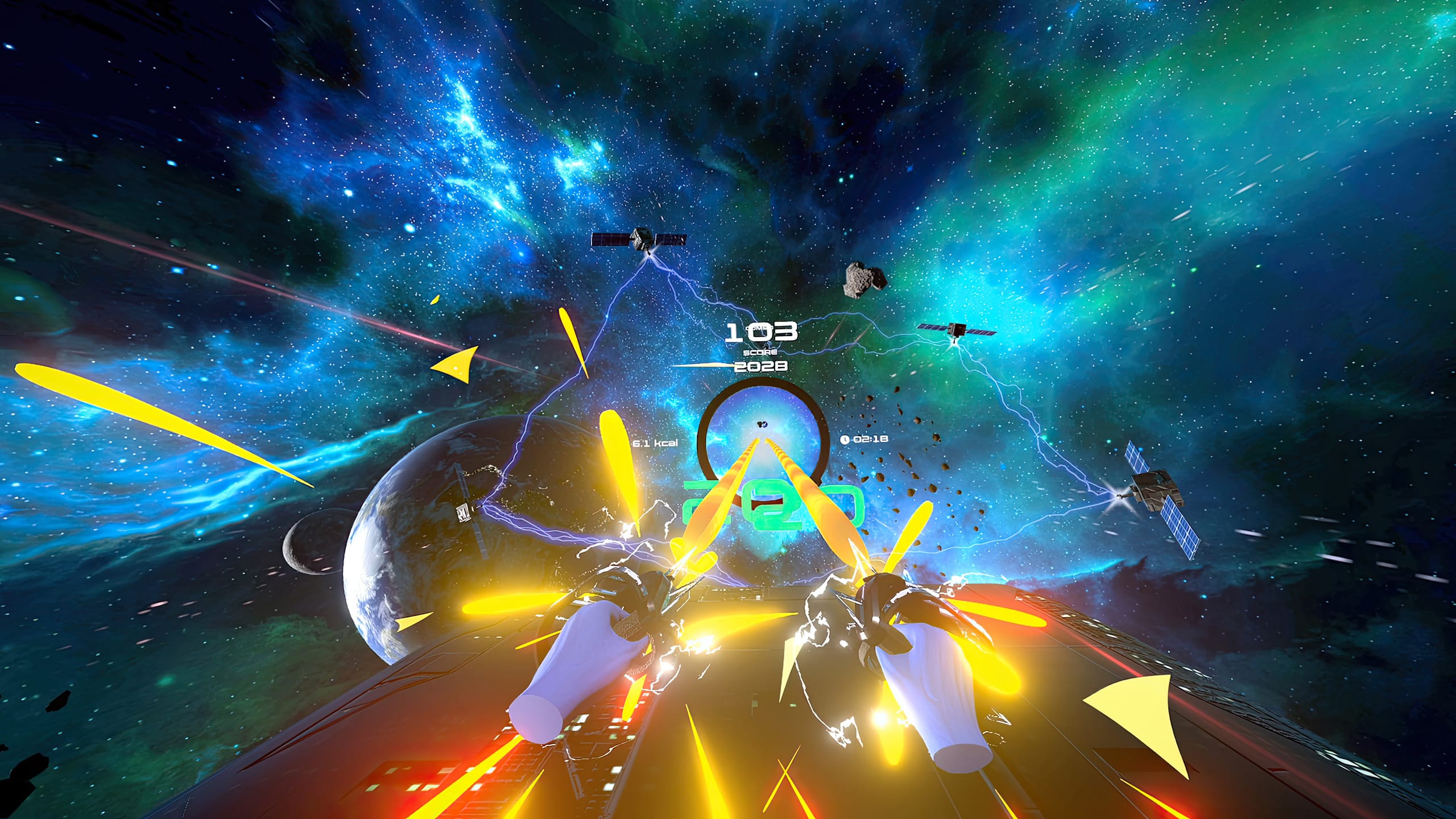
Now, if you want something explicitly designed as a fitness app rather than a game that happens to be good exercise, FitXR is your answer. It launched as a free-to-play app on Meta Quest ($0 entry point, $99/year for premium content—but the free version is legitimately robust). FitXR also supports PCVR and other platforms.
FitXR is like having a personal trainer in your headset, except the trainer doesn’t judge you for breathing like a dying walrus. The app features dance cardio, kickboxing, yoga, and HIIT workouts, all set to licensed music. It’s genuinely well-produced, with real instructors guiding you through routines.
Immersion & Physicality: FitXR uses hand tracking on Quest 3 (and controller tracking on Quest 2), which feels responsive. The game tracks your movements and scores you on accuracy, which is actually motivating. Throwing a punch and seeing the game register it is satisfying. You’re not “swinging a lightsaber at blocks”—you’re actively engaging in choreographed movements that a real trainer designed. The physicality is intense; a 20-minute kickboxing session will leave you gasping.
Comfort Check: FitXR requires a standing play area (4×4 feet minimum). There’s zero artificial locomotion—you’re stationary, moving your body. Motion sickness? Literally impossible. The game is designed for active standing and full-body movement. Seated play is out of the question; this app demands your full body. That said, difficulty scaling is excellent, and you can modify movements on the fly.
Performance: On Quest 3, FitXR runs at 90fps without hiccups. The graphics are clean and functional—instructor avatars, calorie counters, motivational UI elements. Nothing fancy, but responsive and stable. We haven’t seen frame drops in dozens of sessions across Quest 2 and 3.
Value & Replayability: The free version includes enough content for weeks of workouts. The premium subscription ($99/year or $9.99/month) unlocks hundreds more routines, but honestly, the free tier is generous. This is a “full-fledged fitness app,” not a glorified tech demo. You’ll get legitimate training, progressive difficulty, and measurable results.
Thrill of the Fight: Boxing Sim That Actually Works (One-Time Purchase)
Thrill of the Fight launched at $9.99 on Meta Quest and PCVR. It’s a boxing simulator, and it’s deceptively deep. This is a punching bag disguised as a video game.
The premise: you’re a boxer training against AI opponents. You throw punches (literally punching at thin air in your play space), the game registers them, and you get feedback on accuracy and power. The physics are surprisingly realistic—guard your face, move your head, and learn actual boxing footwork.
Immersion & Physicality: The hand tracking/controller tracking is responsive. Throw a jab, and it registers as a jab. Throw a cross, and it’s a cross. The game distinguishes between punch types and rewards technique. You’re engaging in actual boxing movements, not just flailing. The AI opponents adapt to your style, which keeps things interesting.
Comfort Check: Thrill of the Fight requires a standing play area (at least 5×5 feet) and full arm mobility. Motion sickness is zero—you’re stationary. Seated play is impossible. This app demands active engagement and will leave you legitimately tired. A 10-round match can be a 20-minute workout depending on difficulty.
Performance: Runs solidly on Quest 2/3 at 80-90fps. No frame drops. The graphics are functional, with boxer avatars and a training ring. Nothing cutting-edge, but stable and responsive.
Value & Replayability: At $9.99, this is a steal. Endless AI opponents, multiple difficulty levels, and a genuinely fun boxing simulator. We’re talking 30+ hours of replayability minimum. Not a subscription trap—one purchase, infinite content.
Supernatural: Rhythm Meets Fitness (Freemium Model)
Supernatural is technically part of Meta’s ecosystem (acquired years back) and offers free content with optional premium unlocks. It’s a rhythm-based fitness game where you punch targets in time to music. Think of it as Beat Saber’s fitness-focused cousin.
Launch was free-to-play with optional subscriptions for expanded content. The free tier is solid; the premium tier ($9.99/month) unlocks more music and features, but you’re not locked out of the core experience.
Immersion & Physicality: Supernatural uses hand tracking on Quest 3. You punch targets in time to music. The feedback is instant and satisfying. The physicality is real—a 15-minute session will elevate your heart rate noticeably. The choreography is designed by actual fitness professionals, so you’re getting legitimate workout design.
Comfort Check: Standing, stationary gameplay. Zero motion sickness. Requires 4×4 feet minimum. Full body engagement, though more upper-body focused than full-body. Seated play is a non-starter.
Performance: Smooth 90fps on Quest 3. No performance issues. Graphics are colorful and motivating without being demanding.
Value & Replayability: The free version is genuinely robust. Premium is optional and worth considering if you want endless content, but you’re not forced into it.
Creed: Rise to Glory VR: Boxing Meets Narrative (One-Time Purchase)
Creed: Rise to Glory launched at $29.99 (now often discounted to $15-20) across Meta Quest, PCVR, and PSVR2. It’s a boxing game tied to the Rocky/Creed film franchise, but don’t let the branding fool you—this is a legitimate fitness app masquerading as a sports game.
Immersion & Physicality: You’re literally boxing opponents. The hand tracking is responsive, the physics feel weighty, and the gameplay demands real boxing technique. Jab, cross, hook, uppercut—all registered accurately. The AI opponents scale in difficulty, and later fights are genuinely challenging. This is as close as you’ll get to actual boxing training in VR without a real opponent.
Comfort Check: Standing, full arm movement required. 5×5 feet minimum play area. Motion sickness is zero—you’re stationary. Seated play is impossible. Expect a legitimate sweat session. A single fight can be a 15-30 minute workout depending on difficulty.
Performance: On Quest 3, Creed runs at 90fps without hiccups. On Quest 2, it’s slightly optimized down but still smooth. PCVR versions are gorgeous with higher-fidelity graphics. Zero frame drops in our testing—crucial for boxing games where responsiveness is everything.
Value & Replayability: The single-player campaign is 10-15 hours if you play through all difficulties. Multiplayer sparring adds replayability. This is a full game with a story, not a glorified tech demo. One purchase, no subscriptions, endless sparring sessions.
Walkabout Mini Golf: Fitness Through Stealth (One-Time Purchase)
Okay, this one’s unconventional, but hear us out: Walkabout Mini Golf ($14.99 on Meta Quest, PCVR, PSVR2) is technically a golf game, not a “fitness app.” But here’s the thing—the game requires actual standing, walking, and physical movement through courses. You’re not sitting on your couch. You’re standing, moving your body, reaching forward to swing. It’s low-intensity compared to Beat Saber, but it’s active gameplay disguised as leisure.
Immersion & Physicality: Hand tracking is excellent. The golf swing feels natural and responsive. You’re physically moving through beautiful courses, which encourages standing and walking. It’s not high-intensity cardio, but it’s movement.
Comfort Check: Mostly standing and walking, though you can technically play seated (though you’ll miss the immersion). Motion sickness is minimal since locomotion is slow and natural. This is one of the few VR games that’s legitimately playable seated if you need it.
Performance: Runs beautifully on all platforms. 90fps on Quest 3, no frame drops. Graphics are lush and detailed without being demanding.
Value & Replayability: Countless courses, online multiplayer, and just genuinely fun gameplay. 30+ hours minimum before you’ve exhausted the content. One-time purchase, no subscription. Not a “fitness app,” but active gameplay that keeps you moving.
The Subscription Trap: Why We’re Avoiding It
Before we wrap up, let’s address the elephant in the room: subscription-based VR fitness apps. Services like Supernatural’s premium tier ($9.99/month), FitXR’s premium ($9.99/month), and others are banking on recurring revenue. Over a year, that’s $120 just for one app. If you subscribe to multiple fitness apps, you’re looking at $200-300 annually. For a hobby that should be accessible and affordable, that’s insane.
The apps we’ve highlighted either have free tiers or one-time purchases. That’s the way. You own your fitness, not a subscription company.
Comfort & Safety Considerations
Motion Sickness: All the apps we’ve covered are stationary (no artificial movement), so motion sickness is virtually a non-issue. If you’re prone to VR nausea, you’re safe here.
Play Space: You need room. At minimum, 4×4 feet. Ideally, 6×6 feet for full swinging/punching freedom. Clear your play space of breakables and people. We’ve all accidentally clocked our spouse during an enthusiastic punch combo.
Hand Tracking vs. Controllers: Quest 3’s hand tracking is solid but slightly less responsive than controllers for fitness apps. Controllers are recommended for serious workouts where accuracy matters. Hand tracking is fine for casual sessions and adds immersion.
Seated Play: Most fitness apps demand standing. Walkabout Mini Golf is the exception—it’s playable seated, though you lose some engagement.
Platform Comparison: Quest 3 vs. Quest 2 vs. PCVR vs. PSVR2
Meta Quest 3: The sweet spot. Best hand tracking, excellent performance, most app availability, most affordable. Recommended for 95% of people.
Meta Quest 2: Older but still solid. Slightly less powerful, but all our recommended apps run great. Cheapest entry point if you find it on sale.
PCVR (SteamVR): Highest fidelity graphics, highest frame rates. Requires a gaming PC ($800-2000+). Overkill for fitness apps, but nice if you already have the hardware.
PSVR2: PlayStation 5 exclusive. Excellent hardware, limited app library. Most fitness apps aren’t available on PSVR2 yet. Not recommended specifically for fitness.
Final Verdict: The Best VR Fitness Apps Without Killing Your Wallet
If you’re looking for the single best free/one-time purchase VR fitness app, Beat Saber is undefeated. It’s the most fun, most engaging, and most motivating. A $15 purchase will give you hundreds of hours of entertainment and legitimate fitness gains.
If you want actual “fitness app” guidance with routines and progression, FitXR‘s free tier is generous enough to get started, with optional premium if you want more content.
If you want boxing-specific training, Thrill of the Fight ($9.99) or Creed: Rise to Glory ($15-20) are your best bets.
Bottom line: You can get in shape in VR without a subscription. You’ll look ridiculous doing it, you’ll sweat buckets, and you’ll wonder how swinging at colored blocks became your favorite workout. But that’s the genius of VR fitness—it tricks your brain into enjoying exercise.
FAQ: Your VR Fitness Questions Answered
Q: Will I get motion sickness from these apps?
A: Unlikely. All the apps we’ve covered are stationary (no artificial movement). If you’re prone to VR sickness, these are actually safer than exploration games. The only risk is if you have a seizure disorder triggered by flashing lights (Beat Saber), but that’s unrelated to motion.
Q: Can I play these seated?
A: Most demand standing. Walkabout Mini Golf is playable seated. FitXR, Thrill of the Fight, and Creed are standing-only. Beat Saber theoretically works seated but defeats the purpose and you’ll miss notes.
Q: Is Quest 3 worth the upgrade for fitness apps?
A: Hand tracking is better, performance is slightly improved, and storage is better. If you already own Quest 2, it’s not a necessary upgrade for fitness apps specifically. If you’re buying new, Quest 3 is worth the extra $50-100.
Q: How many calories do these apps burn?
A: Depends on intensity and body weight, but expect 150-300 calories per 30-minute session for high-intensity apps like FitXR and Thrill of the Fight. Beat Saber on harder difficulties can match that. It’s comparable to real cardio.
Q: Which app is best for beginners?
A: Beat Saber on easy difficulty or FitXR’s beginner routines. Both have excellent difficulty scaling.
Q: Do I really need a big play space?
A: For safety and comfort, yes. 4×4 feet is minimum. 6×6 is ideal. We learned this the hard way after punching a wall during an enthusiastic Beat Saber combo.