Age of Dinosaurs VR Game Review: Worth Buying?
Disclosure: As an Amazon Associate, Bytee earns from qualifying purchases.
You’re standing in a sun-drenched clearing, the ground trembling beneath your feet, when a Brachiosaurus emerges from the canopy above—its neck stretching three stories into the sky, its shadow swallowing you whole. That moment of primal awe, that gut-level presence, is what Age of Dinosaurs gets right. Your hands instinctively raise as the creature passes overhead, and for a brief, disorienting second, your brain genuinely believes a 80-ton reptile is moving through the space you occupy. This is presence. This is why VR exists.
Platform(s): Meta Quest 3 / PSVR2 / PC VR (SteamVR)
Genre: Immersive Exploration Adventure
Developer: Playful Studios
Price: $34.99 (Quest 3) / $39.99 (PSVR2) / $39.99 (PC VR)
Play Area: Standing / Seated / Roomscale (minimum 2×2 m recommended)
Game Length: ~8–10 hours main story / minimal post-game content
Motion Sickness Risk: Low to Moderate
What Is It? VR-Native or Port, and Which Headsets Support It
Age of Dinosaurs is a purpose-built VR exploration adventure from Playful Studios, the indie team behind the charming *Moss* series. This is not a lazy port or a flat-screen game retrofitted with motion controls—it’s a VR-first expedition designed to capitalize on the spatial presence and hand-tracking capabilities of modern headsets. The studio clearly understands that VR players don’t want guided tours; they want agency, environmental interaction, and the visceral shock of scale.
The game is currently available on Meta Quest 3, PlayStation VR2, and PC VR via SteamVR, with no Quest 2 support due to processing demands. Estimated playtime hovers around 8–10 hours for the main campaign, with single-player focus and zero multiplayer components. The price sits at a reasonable $34.99 on Quest 3 and $39.99 on PSVR2 and PC VR, positioning it as a mid-tier experience—not a premium $60 release, but substantial enough to justify a dedicated playthrough. Playful Studios has maintained a strong reputation for respecting VR’s unique grammar; they don’t force flat-screen design philosophy into headsets.
The VR Experience: Immersion, Presence, and What Makes It Special
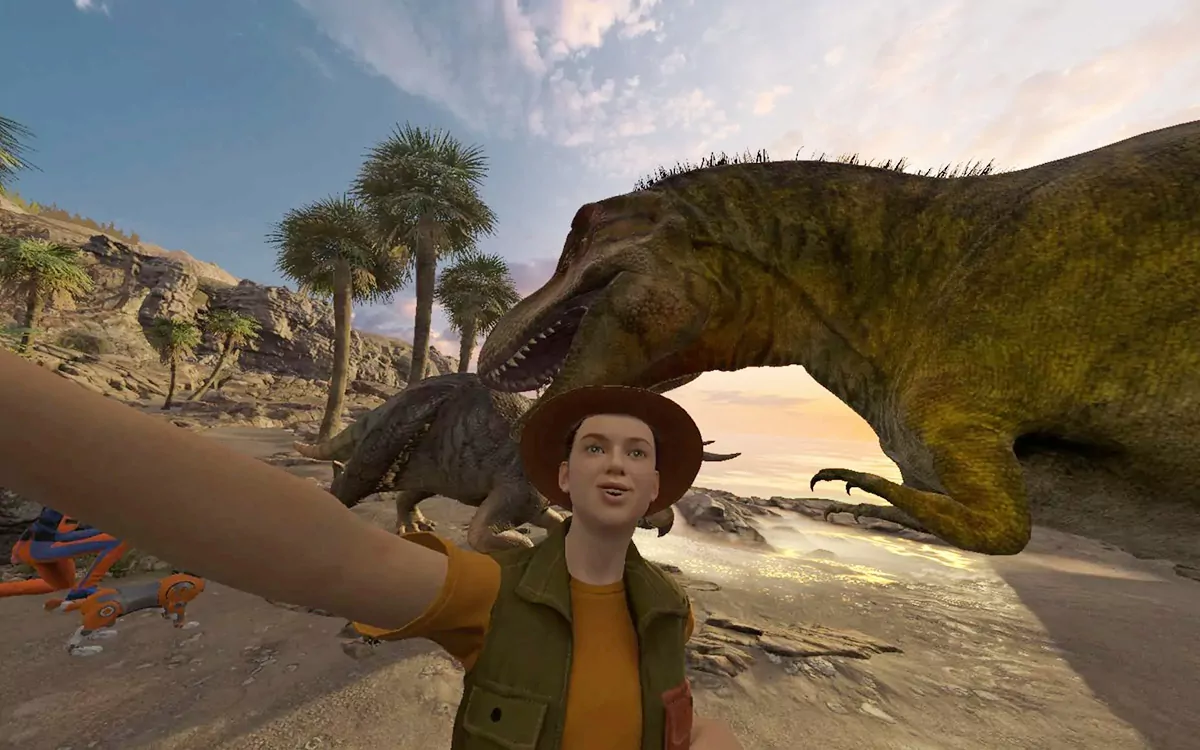
The standout VR mechanic here is *scale without abstraction*. Most games tell you a creature is large; Age of Dinosaurs *shows* you by placing you at ankle height relative to a Triceratops, or forcing you to crane your neck—physically, in your living room—to follow a Pteranodon’s flight path across the sky. The spatial audio design amplifies this: footsteps approach from behind you, subwoofer rumbles sync with each impact, and distant calls echo across the landscape with genuine directional cues. You don’t hear dinosaurs; you’re surrounded by them.
The standout moment—and there are several—comes during a sequence where you’re sheltering in a cave while a herd of hadrosaurs migrates past the entrance. The visual fidelity is clean but not photorealistic; the art style leans slightly painterly, which actually *enhances* immersion by avoiding the uncanny valley. What sells the scene is interaction: you can reach out and touch the rock walls, feel the texture under your virtual fingertips through haptic feedback, and when a juvenile dinosaur notices you, it approaches with genuine curiosity. The creature doesn’t attack; it investigates. That moment of mutual recognition—predator and prey acknowledging each other—hits harder than any scripted encounter. Environmental detail is meticulous: ferns rustle when you brush them, water reflects your hand movements, and the sky transitions convincingly between dawn and dusk sequences. You are genuinely present in a prehistoric world, not moving through a video game level.
Gameplay Deep Dive: Controls, Comfort, and Session Length
Controls are intuitive from the first minutes. Locomotion defaults to smooth movement with thumbstick-based turning, but teleport options are available for players who prefer a gentler approach. Hand presence is excellent—your virtual hands track your real motion controllers with minimal latency, and interaction feedback is consistent. Picking up objects, opening doors, and examining artifacts all feel natural. The game respects both seated and standing play, with UI scaling and waypoint placement adjusted automatically based on your play style. Pacing is deliberate: this is not a frenetic action game. You explore, you observe, you occasionally solve environmental puzzles. Newcomers to VR won’t feel overwhelmed; veterans won’t feel bored.
Sessions typically run 45–90 minutes before comfort fatigue sets in, though players with high VR tolerance can push beyond this. The game’s pacing naturally encourages breaks: you’ll stop to admire a vista, examine an artifact, or simply stand motionless watching a creature graze. This is not a game designed to exhaust you; it’s designed to awe you.
Headset Comparison: Quest 3 vs PSVR2 vs PC VR Version
Age of Dinosaurs performs admirably across all three platforms, but with notable visual and performance differences. The PC VR version, running on high-end hardware (RTX 4070 or better), delivers the sharpest textures, the most aggressive draw distance, and the smoothest 90 Hz framerate. Foliage density is higher, water reflections are more detailed, and shadow quality is superior. The visual gap between PC VR and Quest 3 is obvious, but not jarring—the Quest 3 version is a competent optimization, not a gutted port.
PSVR2 sits between Quest 3 and PC VR in visual fidelity. The headset’s superior optics and eye-tracking deliver slightly crisper text and sharper object detail, but performance is capped at 90 Hz with occasional frame delivery hiccups during dense forest sequences. Quest 3 runs at 72 Hz, which is perfectly adequate for exploration gameplay but noticeably less fluid than PSVR2 during rapid head turns. Load times favor PC VR (2–3 seconds) and PSVR2 (3–4 seconds) over Quest 3 (6–8 seconds). None are egregious, but the Quest 3 gaps are noticeable between major areas.
| Headset | Visual Quality | Price | Exclusive Features | Verdict |
|---|---|---|---|---|
| PC VR | Excellent (90 Hz, high detail) | $39.99 | Highest fidelity, scalable graphics, 90+ Hz option | Best for visual enthusiasts |
| PSVR2 | Very Good (90 Hz, eye-tracking) | $39.99 | Eye-tracking for creature interaction, haptic triggers | Best balanced experience |
| Quest 3 | Good (72 Hz, optimized) | $34.99 | Standalone, no PC required, hand-tracking | Best value for accessibility |
PSVR2’s eye-tracking enables a subtle but meaningful feature: creatures react to where you’re looking. A dinosaur won’t approach if you’re staring directly at it, but turn your gaze away and it grows bolder. This adds a layer of behavioral immersion that PC VR and Quest 3 lack. Haptic feedback is also strongest on PSVR2, with the controller triggers delivering distinct tactile responses for object interactions. PC VR wins on raw visual horsepower and framerate stability. Quest 3 wins on convenience and price, with the trade-off of lower visual fidelity and frame delivery. None are wrong choices; the decision depends on your priorities.
Verdict: Is It Worth Adding to Your VR Library?
Age of Dinosaurs is a confident, competently executed VR experience that respects its players’ time and intelligence. It delivers genuine presence—that rare VR moment where your brain accepts the fiction—and backs it up with solid exploration mechanics and environmental storytelling. The 8–10 hour campaign is substantial without overstaying its welcome. Post-game content is minimal: there’s a free-roam mode and a handful of challenge encounters, but no procedural generation or endless replay hooks. This is a story-driven experience, not a platform for long-term engagement.
The price-to-content ratio is fair. You’re paying roughly $4–5 per hour of gameplay, which aligns with similar exploration titles like *Alien: Rogue Incursion* ($39.99, ~8 hours) and sits below premium releases like *Half-Life: Alyx* ($59.99, ~15 hours). Replay value exists, but it’s modest: a second playthrough will feel familiar, though the creature encounters remain engaging. Long-term engagement prediction is honest: you’ll play this once or twice in your first month, then revisit annually or when introducing friends to VR’s potential. It’s not a game you’ll boot up weekly six months from now, but it’s absolutely a game you’ll remember fondly.
Recommendation varies by headset: PC VR owners should buy immediately if they have the hardware to run it at high settings. PSVR2 players should buy without hesitation—the eye-tracking integration and haptic feedback justify the full price. Quest 3 owners face a borderline decision: the game is excellent, but the visual compromise and lower framerate are noticeable. If you’re new to VR, this is an ideal introduction to spatial presence. If you’re a veteran, it’s a solid addition to your library, but not essential.
7.8 / 10
Buy on PSVR2 and PC VR. Buy on Quest 3 if you prioritize accessibility over visual fidelity. Wait for a sale if you’re on Quest 3 and have other exploration games in your library. Best For: VR newcomers seeking an introduction to presence and scale, and enthusiasts who value environmental immersion over action-driven gameplay.
Frequently Asked Questions
Does Age of Dinosaurs work on Meta Quest 2 or only Quest 3?
Age of Dinosaurs is Quest 3 exclusive and does not support Meta Quest 2. The game’s processing demands—particularly the detailed environmental rendering, creature AI, and haptic feedback complexity—exceed the Quest 2’s GPU and memory capacity. Playful Studios made an explicit decision to target Quest 3’s Snapdragon Gen 2 processor rather than compromise the experience with a Quest 2 port. If you’re on Quest 2, your only option is to upgrade or play on a different platform (PSVR2 or PC VR).
How bad is motion sickness in Age of Dinosaurs VR?
Motion sickness risk is low to moderate, and entirely controllable. The culprit is smooth locomotion: thumbstick-based movement combined with head-relative turning can trigger mild nausea in sensitive players, especially during extended play sessions over 60 minutes. The severity is mild—vertigo dizziness rather than stomach upset—and the game provides an instant remedy: teleport locomotion completely eliminates the risk. Camera pans during cinematic sequences are slow and deliberate, not jarring. No spinning, no rapid height changes, no intense vertigo moments. Recommendation: start with teleport mode, test smooth locomotion in 15-minute increments, and enable comfort options like vignette effects if needed. Most players report zero sickness after the first 30 minutes of acclimation.
Is Age of Dinosaurs better on PSVR2 or PC VR?
PSVR2 is the better balanced choice for most players; PC VR is the better choice for visual maximalists. PSVR2 delivers 90 Hz performance, eye-tracking creature interaction, and superior haptic feedback, with zero setup complexity. PC VR requires a high-end GPU (RTX 4070 or better) but rewards you with sharper textures, higher draw distance, denser foliage, and 90+ Hz stability on ultra settings. If you own both headsets and have a capable PC, PC VR edges out PSVR2 by a slim margin due to visual fidelity. If you’re choosing between the two platforms, PSVR2 is the safer recommendation: the eye-tracking feature is genuinely immersive, the experience is plug-and-play, and the price is identical. PC VR only wins if you’re willing to spend time on graphics settings optimization.
How long is Age of Dinosaurs and will I still play it after a month?
The main campaign is 8–10 hours, with post-game free-roam and challenge modes adding another 2–3 hours of optional content. Total playtime for completionists is roughly 12 hours. Long-term engagement is modest: you’ll play this intensively for your first week, then revisit sporadically. By month two, unless you’re replaying for a friend’s first VR experience, you’ll likely move on to other titles. This is not a game designed for long-term retention like *Beat Saber* or *Pavlov*. It’s a memorable story-driven experience you’ll return to annually or when introducing someone to VR’s potential. If you’re looking for a game to play daily for months, this isn’t it. If you’re seeking a single-player adventure that justifies $35–40 for a complete, satisfying experience, Age of Dinosaurs delivers.
Does Age of Dinosaurs support multiplayer or co-op?
No. Age of Dinosaurs is strictly single-player. There is no co-op mode, no competitive multiplayer, and no social features beyond standard headset sharing (one player at a time). The game is designed as a personal expedition: your individual encounter with prehistoric life, your perspective, your moment of awe when a creature passes overhead. Playful Studios prioritized narrative immersion and environmental fidelity over multiplayer complexity. If you’re seeking a co-op VR adventure, look elsewhere (*Half-Life: Alyx* mods, *Pavlov* co-op, *Demeo*). If you want a single-player journey you can share by taking turns, Age of Dinosaurs excels.