Morrowind RTX Remix: How NVIDIA AI Remasters Classic RPGs
Disclosure: As an Amazon Associate, Bytee earns from qualifying purchases.
Stepping off the prison ship into Seyda Neen no longer means staring at muddy 256×256 textures and painted-on ambient lighting. For over two decades, modding Bethesda’s 2002 masterpiece meant wrestling with engine limits, hacks like MGE XE, and manual texture packs that took artists years to compile. Today, that entire paradigm is shifting. The emergence of the NVIDIA RTX Remix Morrowind AI pipeline is rewriting how we preserve, overhaul, and experience classic games, turning what used to be decade-long community projects into automated, neural-accelerated overhauls.
What Is NVIDIA RTX Remix Morrowind AI and Why Gamers Care
At its core, NVIDIA RTX Remix is an open-source modding platform built on top of NVIDIA Omniverse that intercepts vintage graphic pipelines and translates them into modern rendering engines on the fly. For PC gamers, retro game preservation has always hit a massive technical bottleneck: legacy game engines. The Elder Scrolls III: Morrowind runs on an ancient branch of NetImmerse, hardlocked to DirectX 8 draw calls, 32-bit memory ceilings, and rigid fixed-function rendering pipelines. Traditional remastering required developers or dedicated modders to reverse-engineer source code or manually rebuild assets one polygon at a time.
RTX Remix cuts through that red tape entirely. By acting as a specialized runtime translation layer, the tool catches draw calls between the game engine and the GPU, dynamically swapping out legacy fixed-function geometry and low-resolution assets for modern ray-traced materials. Gamers care because this is not a generic ReShade post-processing filter that merely slaps bloom and fake screen-space reflections over existing pixels. This is a true fundamental rebuild of Morrowind‘s lighting, geometry, and material interactions in real time, delivering true path tracing and high-fidelity physics-based rendering (PBR) without touching the original game logic or breaking custom quest scripts.
How It Works: Generative AI, Neural Rendering, and Asset Reconstruction
The magic behind the modern Morrowind overhaul lies in a combination of runtime draw-call interception and generative AI asset enhancement. When you boot Morrowind through RTX Remix, the runtime intercepts the game’s classic d3d8.dll API calls and converts the 3D scene data into Universal Scene Description (OpenUSD) format. This decouples the game’s visual presentation from its underlying 2002 engine logic, piping the scene directly into a modern Vulkan-based 64-bit renderer.
Once captured, NVIDIA’s generative AI models get to work on the game’s legacy textures. Instead of requiring an artist to manually paint normal, roughness, and height maps for thousands of environmental props, RTX Remix uses neural networks trained on high-resolution PBR data. The AI analyzes low-res diffuse textures—like the weathered wood of a Dunmer shack or the rusted surface of an Imperial broadsword—upscales the base resolution up to four times, and mathematically infers physical material properties:
- Normal & Height Maps: Generates realistic surface depth, allowing individual cobblestones in Balmora to catch light and cast tiny, distinct shadows.
- Roughness & Metallic Maps: Teaches the renderer the difference between dull ash, damp stone, and reflective chitin plates.
- Path Tracing Injection: Replaces primitive static lighting with a unified path tracer that calculates real-time bounces, indirect global illumination, soft shadows, and physically accurate ambient occlusion.
What Changes in Vvardenfell: Real Visual and Gameplay Impact
The difference between vanilla Vvardenfell and an RTX Remix-injected session is staggering, fundamentally changing the mood of the island while preserving its iconic hostility.
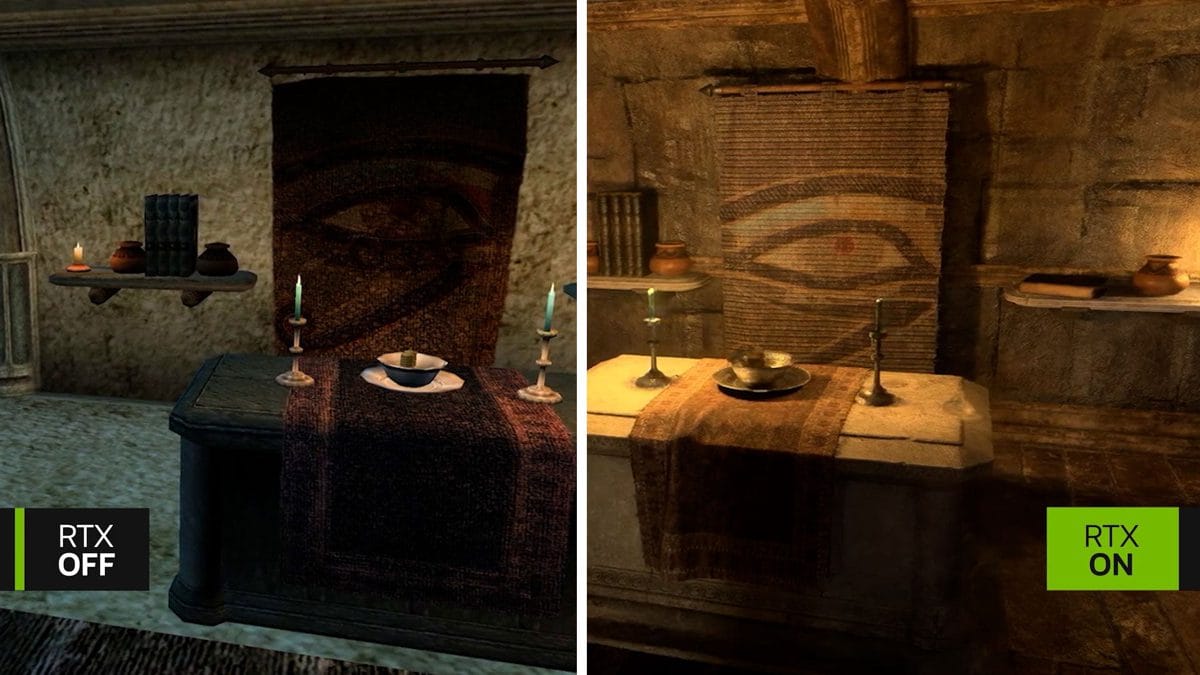
Before (2002 Vanilla Pipeline): In the original game, dungeons like the Addamasartus smuggler cave relied on hard-coded point lights with abrupt falloffs. Torches cast flat circles of light that failed to illuminate surrounding crevices. Stone walls looked like flat wallpaper stretched over angular geometry, water was a simple repeating animated normal plane, and light clipped straight through solid objects.
After (RTX Remix Neural Pipeline): Ignite a torch in that same cave under RTX Remix, and the chamber comes alive. The dynamic flame emits realistic light that bounces off the damp limestone walls, creating soft penumbra shadows behind wooden crates. Volumetric dust motes and thick coastal fog roll through Seyda Neen, catching the morning sun. Cast a Fireball spell down a narrow corridor in Vivec, and the fiery projectile illuminates every architectural archway dynamically as it travels.
Crucially, because RTX Remix operates solely on the presentation layer, the gameplay remains pure. The dice-roll combat, weapon degradation, dialog trees, and quirky NPC pathfinding remain entirely untouched. You still miss mudcrabs at level one with an iron dagger, but now you miss them in stunning, path-traced fidelity.

What Modders and Studios Are Building With RTX Remix
The community response to RTX Remix has rapidly evolved from tech demos to full-scale collaborative revamps. While NVIDIA proved the concept internally with Portal with RTX and supported Orbifold Studios on the upcoming Half-Life 2 RTX, the Morrowind community is building one of the largest decentralized remaster projects in gaming history. Modders are pooling resources via Discord and GitHub, systematically replacing AI-upscaled baseline assets with handcrafted, high-poly geometry built inside the Omniverse ecosystem.
For independent creators and mid-sized studios, this tech levels the playing field against mega-budget remaster teams. Modern development suites are aggressively integrating these generative and neural toolsets into their everyday workflows:
- NVIDIA Omniverse: The collaborative USD framework powering RTX Remix asset swapping and path-traced viewport workflows.
- Inworld AI & Convai: Middleware suites enabling dynamic, unscripted NPC dialog and voice synthesis integrated alongside modern graphics overhauls.
- Unity Sentis & Unreal MetaHuman Animator: Neural execution runtimes bringing AI facial capture and real-time model inference directly into game engines.
The Catch: Performance Overhead, Art Direction, and AI Artifacts
As revolutionary as neural rendering is, it is not without severe technical compromises. First and foremost is hardware demand. Full path tracing is notoriously punishing. Running Morrowind RTX at native 4K with multiple light bounces will bring even modern high-end GPUs to their knees without AI reconstruction tools like DLSS 3.5 (Ray Reconstruction) and Frame Generation. If you are on an older GPU without dedicated RT cores, this tech is effectively out of reach.
Then there is the aesthetic risk. Unvetted AI texture upscaling frequently strips away original art direction. We saw this disaster play out in the shipped release of Grand Theft Auto: The Trilogy – The Definitive Edition, where automated AI upscaling smudged iconic storefront signs, turned hexagonal nuts into warped circles, and ruined character facial geometry. In early Morrowind RTX tests, AI models occasionally hallucinated wood grain onto ancient Dwemer metal or made weathered ash beds look like shiny polished marble. Human artistry and curated oversight remain mandatory to prevent the uncanny valley from destroying a game’s nostalgic soul.
What Comes Next: The Future of Neural Game Remastering
The next frontier for neural remastering is moving beyond surface-level textures and lighting into automated volumetric asset generation. Researchers and engine architects are actively integrating Neural Radiance Fields (NeRFs) and 3D Gaussian Splatting into modding pipelines. In the near future, RTX Remix tools could automatically convert low-poly 2002 NPC meshes into high-fidelity, anatomically correct 3D character models complete with physically simulated clothing.
We are standing at the beginning of an era where classic cult favorites—from Deus Ex and Vampire: The Masquerade – Bloodlines to original direct-3D RPG classics—can be resurrected for modern high-refresh-rate displays in months rather than decades.
Neural rendering is not a magic replacement for human game designers, but RTX Remix has permanently killed the traditional, painfully slow video game remaster.
Frequently Asked Questions
How does NVIDIA RTX Remix use generative AI on Morrowind textures?
RTX Remix captures classic low-resolution textures during gameplay and passes them through specialized neural networks running on Tensor Cores. The AI upscales the resolution and predicts the physical surface properties, automatically generating modern normal, roughness, and height maps required for realistic path-traced lighting.
Do I need an RTX 40-series GPU to play the Morrowind RTX AI remaster?
While any modern GPU with hardware ray tracing support (including RTX 20/30-series and modern Radeon cards) can technically run RTX Remix mods, RTX 40-series GPUs are strongly recommended due to the heavy performance cost of full path tracing and the need for DLSS 3 Frame Generation to maintain high framerates.
Will RTX Remix neural rendering replace manual remastering by game studios?
RTX Remix will not eliminate manual art teams, as human artists are still essential for curating art direction, fixing AI hallucinations, and authoring hero assets. However, it dramatically accelerates the production pipeline by automating the tedious foundational work of lighting overhauls and base texture upscaling.