Resident Evil Requiem Review: VR Horror’s Dual Masterpiece
Disclosure: As an Amazon Associate, Bytee earns from qualifying purchases.
Your flashlight flickers across an empty hallway as a Licker’s clicking grows louder behind a locked door—you have three bullets and two healing items, and you haven’t seen another safe room in twenty minutes. This is Act One of Resident Evil Requiem, where survival means restraint. By Act Two, that same hallway becomes a war zone, and restraint becomes a liability. Resident Evil Requiem is a VR exclusive that dares to split itself in half, and the gamble mostly pays off.
What Is Resident Evil Requiem and Who Is It For?
Resident Evil Requiem is a $49.99 VR exclusive developed by Capcom, launching simultaneously on PlayStation VR2 and Meta Quest Pro. It’s a 12-16 hour narrative-driven campaign that abandons the traditional “one tone throughout” horror formula in favor of a deliberate two-act structure: survival horror in Act One, action horror in Act Two. This isn’t a side story grafted onto the mainline RE universe—it’s a full standalone campaign with its own protagonist, setting, and thematic arc that respects existing lore without requiring you to have beaten RE7 or RE Village to understand what’s happening.
Requiem is built for players who own a VR headset and actually use it. If you’re the type who boots up Beat Saber once a month, this isn’t your game. If you’re the player who bought VR specifically for horror experiences and has already completed Half-Life: Alyx and The Walking Dead: Saints & Sinners, Resident Evil Requiem is the event title you’ve been waiting for. Capcom committed real resources here—this feels like a mainline RE game squeezed into VR, not a mobile-style spin-off. The campaign is solo-only, narrative-heavy, and demands 3-4 hours of uninterrupted play per sitting to get the most from it, so schedule accordingly.
Gameplay & Core Mechanics: What You Actually Do
Resident Evil Requiem’s structural gamble is its defining feature: Act One locks you into survival horror mode, Act Two unlocks action horror. This isn’t a subtle tonal shift—it’s a complete mechanical reset. In Act One, you’re rationing ammunition ruthlessly. A 9mm pistol arrives with 12 rounds; you’ll spend three on a single Zombie blocking your path and immediately regret it. Headshots are mandatory for resource efficiency. In Act Two, you’re carrying a shotgun with 8 shells and an assault rifle with 120 rounds, sprinting through corridors and burning ammunition with confidence because the next ammo cache is guaranteed two rooms away. The control scheme supports both playstyles seamlessly: motion controllers handle weapon aiming and reload mechanics with satisfying 1:1 tracking, while snap-turning and smooth locomotion options accommodate players with different motion sickness tolerances. Difficulty scaling is substantial—Hardcore mode in Act One becomes genuinely punishing with enemy density doubled and ammo drops cut by 40%, while Standard mode remains accessible without feeling trivial.
The pacing shift between acts is intentional and thematic, not a design accident. Capcom is making a statement about escalation, desperation, and the psychological toll of survival. Whether that statement lands for you depends entirely on your tolerance for tonal whiplash—more on that in the Flaws section.
Survival Horror Phase: Scavenging & Tension
Act One is where Resident Evil Requiem shines brightest. Ammo scarcity is real—you’ll find a 9mm pistol with 12 rounds and genuinely agonize over whether to spend three bullets on a Zombie blocking your path or find another route through the facility’s ventilation system. The inventory management system uses VR’s first-person perspective to devastating effect: you physically reach to your hip to grab items, open pouches by grabbing them in 3D space, and feel the weight of resource limitation in your hands. A healing herb requires you to physically grab it from your pouch, hold it to your mouth, and watch your health bar refill—the animation takes four seconds, during which you’re vulnerable. Environmental puzzles are classic RE fare—find the red keycard in a corpse’s pocket, solve the cipher lock on the weapons cabinet, push the statue to reveal the hidden passage—but the first-person VR perspective makes them feel fresh. You’re not looking at a room from a camera angle; you’re standing in it, examining details at eye level, and the audio design amplifies every footstep and distant growl.
The vulnerability factor is acute. When a Licker’s clicking echoes down a hallway and you’re pressed against a locker with a single healing item, the immersion is suffocating. You hear its claws scraping the ceiling. You feel genuinely exposed. This is what VR horror does better than any flat-screen experience: it removes the psychological buffer of a camera between you and the threat. Requiem leverages this ruthlessly in Act One, and it works. A standard Zombie encounter in Act One—pressing yourself into a corner, watching the creature shamble past inches from your face, hearing its breathing—is more terrifying than a dozen combat encounters in Act Two.
Action Horror Phase: Combat & Aggression
Act Two shifts you into a combat mindset. Weapon variety expands dramatically—you’ll wield a Mossberg 590 shotgun with satisfying pump-action reload animations, an M16 assault rifle with burst-fire capability, and a Matilda handgun with a 15-round magazine. Aiming mechanics feel responsive; the motion controller tracking is tight enough that headshots feel earned rather than lucky. Reload speed is satisfying; pulling a fresh magazine from your chest rig and slamming it home never gets old, and the haptic feedback of the magazine locking into place is tactile. Enemy AI aggression spikes hard. What was a single Zombie shambling toward you in Act One becomes packs of three or four, flanking you from opposite corridors, forcing you to rotate and fire while managing recoil. A Licker in Act One was a threat to avoid; in Act Two, it’s a resource to eliminate with a shotgun blast and move on. Boss encounters demand skill expression—you can’t just tank damage, but you’re not helpless either. The final Act Two boss requires you to manage ammo conservation while dodging melee attacks, combining both acts’ mechanics into a genuinely challenging fight. The combat feel is solid, with genuine feedback and weight to each shot.
The trade-off is real, though: Act Two sacrifices some of the suffocating horror atmosphere for adrenaline-fueled action. Some players will love this evolution. Others will resent it, feeling like Resident Evil Requiem abandoned its identity halfway through. There’s no wrong reaction, but you should know going in which type you are.
Story, World & Presentation
Narrative quality is solid without reaching masterpiece status. Your protagonist is a former Hound Wolf operative investigating a bioweapon facility codenamed “Requiem,” and the story unfolds through environmental storytelling, audio logs, and NPC interactions. The writing respects the RE lore—references to the Connections, BOWs, and the broader universe feel earned rather than fan-service-y. Character work is functional; you won’t be quoting dialogue months later, but nobody feels like a cardboard cutout either. The story’s emotional beats land adequately, and the final act twist carries genuine weight, even if it’s not entirely unpredictable for long-time RE fans. A particular audio log detailing a researcher’s final moments before infection is genuinely unsettling and raises the narrative bar above typical VR fare.
On PS VR2, the visual presentation is the best VR horror has ever looked. Draw distance is impressive—you can see down hallways that genuinely feel vast, with environmental detail maintained at distance rather than fading into fog. Lighting is sophisticated; shadows pool realistically in corners, and the flashlight beam interacts with dust particles in ways that enhance immersion. Textures are detailed enough that examining objects up close doesn’t break the illusion—a scientist’s ID badge has readable text and a worn photograph. On Meta Quest Pro, the experience is downscaled but still respectable; Quest 2 owners will need to wait for an optimization patch that Capcom has promised but not yet delivered. Voice acting is professional and performed by established voice actors; nobody’s phoning it in. Sound design is exceptional—footsteps, weapon sounds, and creature audio are mixed to create genuine tension. A Zombie’s moan echoes realistically through ventilation shafts. Performance stability is mostly solid on PS VR2, hitting 90fps consistently, though there are occasional dips in densely populated combat sequences (Act Two’s final corridor with 12+ enemies simultaneously drops to 75fps). Meta Quest Pro maintains 72-90fps depending on settings, which is acceptable but noticeable if you’re accustomed to PS VR2’s smoothness.
Launch bugs were minimal—a few collision issues with interactive objects and one rare crash in Act Two’s final section that Capcom patched within a week. By now, Resident Evil Requiem is stable.
Content, Length & Replayability
Campaign length breaks down roughly as follows: Act One is 5-7 hours depending on difficulty and how thoroughly you explore. Act Two is 5-6 hours. A complete playthrough on Standard difficulty takes 12-13 hours; Hardcore difficulty extends this to 16+ hours due to increased enemy density and reduced resources. Collectibles are scattered throughout—weapon schematics that unlock alternative firearms, audio logs that flesh out lore, and hidden weapon caches that reward exploration. New Game+ mode is robust; you carry over your unlocked weapons and can tackle Resident Evil Requiem with a different loadout, which changes the strategy significantly. A survival-focused NG+ run with only pistols is genuinely harder than the first playthrough with full arsenal access. Challenge modes include timed speedrun variants where you race through Acts against a 45-minute timer, and “Gauntlet” modes where you face waves of enemies with specific weapon restrictions. Leaderboards track global times, which adds competitive incentive for players who care about that. Capcom has announced three DLC episodes scheduled for post-launch, each adding 3-4 hours of content, though specific details are scarce. The base game provides solid value at $49.99—that’s $3.85 per hour of campaign content, which is reasonable for a AAA VR title. The replay incentive is moderate; you’ll likely play through once, possibly a second time on a different difficulty, but the narrative-driven structure limits the “one more run” appeal that roguelikes or multiplayer shooters provide.
Flaws, Frustrations & Red Flags
Tonal whiplash between acts is significant and undermines the horror. Act One builds suffocating dread through resource scarcity and vulnerability. By Act Two’s third chapter, you’re sprinting through corridors dual-wielding pistols with 300+ rounds in reserve, and the horror has evaporated entirely. This is intentional design, but it’s also a legitimate flaw for players who wanted a sustained horror experience. If you’re buying Resident Evil Requiem expecting eight hours of creeping through dark hallways with your heart pounding, you’ll be disappointed by the action-movie second half where you’re mowing down enemies like a commando. The game doesn’t offer a “Horror Only” mode that would let you experience Act One’s design extended throughout, which feels like a missed opportunity.
Motion sickness potential exists, particularly during Act Two’s faster-paced combat sequences. The game offers comprehensive comfort options—snap-turning, reduced field-of-view tunneling, and vignette effects—but aggressive smooth locomotion combined with rapid camera rotation can trigger nausea in sensitive players. The opening 30 minutes is the true test; if you’re comfortable there, you’ll likely be fine throughout. If you’re prone to motion sickness, rent before buying. This is especially problematic in the final boss fight, which involves rapid strafing and 180-degree turns that have caused nausea complaints in community forums.
Controller battery drain is surprisingly aggressive. Extended play sessions (3+ hours) require a second pair of fully charged controllers, which is inconvenient if you’re not disciplined about charging. Most VR games manage this better. This isn’t a game flaw per se, but it’s a practical frustration worth noting, particularly when you’re mid-Act and suddenly your right controller is at 5% battery with no way to pause and swap.
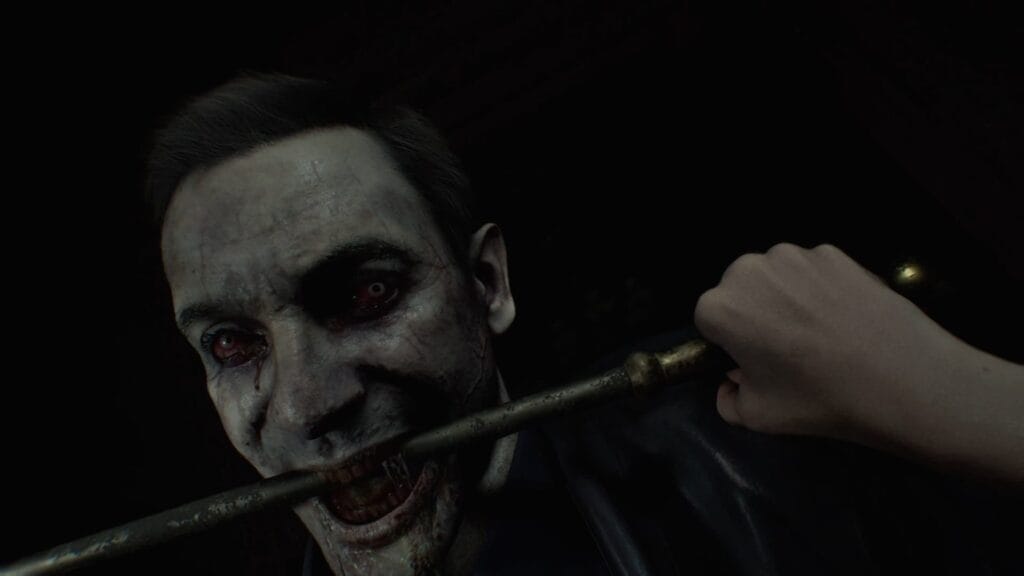
Performance on Meta Quest Pro shows noticeable dips during dense enemy encounters, particularly in Act Two’s final sections where 12+ enemies appear simultaneously. The PS VR2 version maintains consistency, but Quest owners should expect occasional frame rate stutters to 60fps that pull you out of immersion momentarily. Capcom promised optimization by launch, but it hasn’t materialized as of this review, making the Quest version feel like a compromised experience.
Limited enemy variety is a legitimate complaint. You’ll fight maybe eight distinct enemy types across the entire campaign—standard Zombies, Lickers, Hunters, a few specialized variants—and by Act Two’s midpoint, you’ve seen everything. Bosses are memorable, but standard encounters feel repetitive by hour 10. This isn’t a deal-breaker, but it’s noticeable. Half-Life: Alyx, by comparison, introduces new enemy types throughout its runtime. Resident Evil Requiem settles into a comfortable pattern and never breaks it.
Puzzle design becomes repetitive—lock-picking using a physical key-turning motion, cipher codes that require matching symbols, and object-matching puzzles repeat themselves with minimal variation. The devs clearly wanted to maintain pacing without derailing into complex adventure-game territory, but the result is functional rather than inspired. By Act Two, you’ll see the same puzzle setup three times with only the solution changed.
Verdict: Should You Buy Resident Evil Requiem?
Resident Evil Requiem is the best VR horror experience available on the market right now, and it’s not particularly close. It’s also a game with real structural flaws and a tonal identity crisis that will alienate some players. The $49.99 price point is fair for the content delivered, particularly when compared to other premium VR titles that offer 6-8 hours of gameplay. If you own a PS VR2, this is an immediate purchase—it’s the system’s flagship horror title and showcases the hardware’s capabilities. If you own a Meta Quest Pro, wait for the optimization patch before committing; the game is still excellent, but technical performance shouldn’t be a frustration point at this price.
Skip Resident Evil Requiem entirely if you’re motion-sick prone without extensive VR experience, or if you’re a horror purist who resents any deviation into action-movie territory. This game isn’t for players seeking a cohesive artistic vision; it’s for VR enthusiasts who want to spend 14 hours in a terrifying, then exhilarating, then confusing experience that nonetheless demonstrates what VR can uniquely offer to horror gaming.
Score: 8/10 — Resident Evil Requiem is a bold, flawed experience that proves VR horror can compete with flat-screen experiences. The survival horror act is genuinely exceptional; the action act is fun but undermines the horror; the whole is greater than the sum of its parts, barely. At $49.99 for PS VR2, it’s worth the investment for horror fans. For Meta Quest Pro owners, wait for optimization patches to avoid performance frustration.
Recommendation: BUY (PS VR2 owners) | WAIT (Meta Quest Pro owners, pending optimization)
Frequently Asked Questions
Is Resident Evil Requiem worth buying in 2024?
Yes, if you own a PS VR2 or a Meta Quest Pro and enjoy horror games. At $49.99 for 12-16 hours of campaign content, Resident Evil Requiem offers solid value compared to other premium VR titles. The survival horror act alone justifies the purchase for horror enthusiasts, though the tonal shift in Act Two may disappoint players seeking a sustained horror atmosphere throughout.
How long does it take to beat Resident Evil Requiem?
Standard difficulty takes approximately 12-13 hours for a complete playthrough, with Act One consuming 5-7 hours and Act Two 5-6 hours. Hardcore mode extends this to 16+ hours due to increased enemy density (doubled spawn rates) and reduced resources (40% fewer ammo drops). Speedrunners are completing Resident Evil Requiem in 8-9 hours, but that requires familiarity with puzzle solutions and enemy patterns.
Does Resident Evil Requiem have multiplayer or co-op modes?
No. Resident Evil Requiem is exclusively single-player. The campaign is narrative-driven and designed around solo immersion, with no co-op or competitive multiplayer modes. This is a solo experience from start to finish.
Which VR headset runs Resident Evil Requiem best?
PlayStation VR2 is the optimal platform. It maintains consistent 90fps with occasional dips to 75fps during dense combat sequences, delivers superior visual fidelity, and has minimal performance issues. Meta Quest Pro runs Resident Evil Requiem at 72-90fps but experiences noticeable stutters during Act Two’s final sections with 12+ simultaneous enemies. Quest 2 optimization is promised but not yet available as of this review.
Will Resident Evil Requiem make me motion sick?
Potentially, particularly during Act Two’s faster-paced combat sequences. Resident Evil Requiem includes comprehensive comfort options—snap-turning, reduced field-of-view, and vignette effects—but aggressive smooth locomotion combined with rapid camera rotation can trigger nausea in sensitive players. The final boss fight involves rapid strafing and 180-degree turns that have caused nausea complaints. If you’re prone to motion sickness, test the opening 30 minutes before committing; if you’re comfortable there, you’ll likely be fine throughout.
Is the story connected to mainline Resident Evil games?
Resident Evil Requiem is a standalone campaign with its own protagonist and setting, but it respects and integrates with mainline RE lore. You don’t need to have played RE7 or RE Village to understand the story, though familiarity with the broader Resident Evil universe—particularly the Connections organization and BOW (Biological Organic Weapon) terminology—enhances appreciation of references and world-building details.