Outbound Review: Cozy Van-Life Adventure With a Shallow Engine
Disclosure: As an Amazon Associate, Bytee earns from qualifying purchases.
You’ve just parked your van on a cliff edge at golden hour, the acoustic guitar on the soundtrack swells, the campfire crackles to life — and then you realize, with a quiet sinking feeling, that you’ve already seen everything this world has to show you, and it’s only been four hours.
That moment captures Outbound perfectly. It’s a beautiful, intentionally slow cozy van-life sandbox from indie developer Pixel Reef that nails atmosphere and aesthetic in ways that genuinely move you — and then immediately reveals the paper-thin mechanics underneath. For a player who values a 10-hour meditative experience above all else and owns a copy of Spiritfarer or A Short Hike, that’s exactly enough. For everyone else — players seeking progression depth, co-op adventures, or mechanical variety — it’s a missed opportunity dressed up in stunning art direction and a soundtrack that deserves its own Spotify release.
What Is Outbound and Who Is It For?
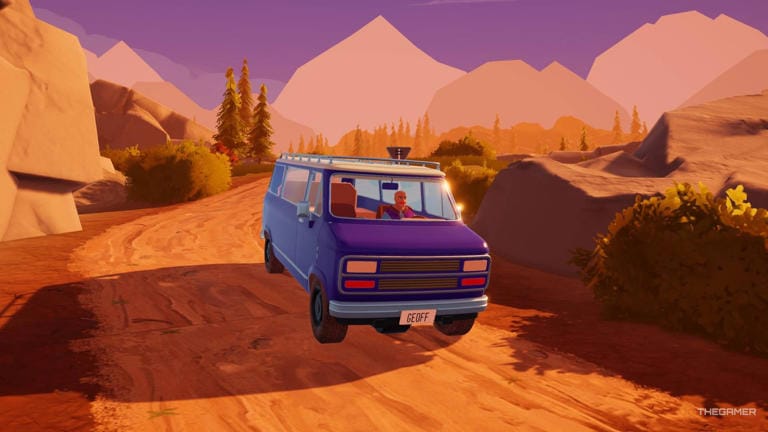
Outbound is a solo-only open-world sandbox built around the fantasy of van-life exploration. You drive a customizable camper van between painterly biome zones (coastal cliffs, pine forests, desert valleys, snowy highlands), gather four resource types (wood, metal, fabric, plants), unlock van upgrades and furniture recipes, set up camp with tents and cooking stations, prepare simple meals (salmon with herbs, mushroom stew, coffee), and repeat. There’s no story to chase, no enemies to fight, no timer ticking down. The entire design philosophy is “vibe and explore at your own pace,” and for the cozy-game enthusiast who loved titles like Alba: A Wildlife Adventure or the niche Camper Van Adventures, that premise is catnip.
Developer Pixel Reef released Outbound into Early Access on Steam in 2025 with a full launch expected through 2026. It’s a $19.99 title positioned squarely at players who want zero stakes, zero pressure, and the meditative experience of sitting by a virtual campfire while rain patters on the tent roof. If you’re here for action, narrative depth, progression systems with meaningful milestones, or multiplayer road-trip shenanigans, you’re in the wrong van.
Gameplay & Core Mechanics: What You Actually Do in Outbound
The core loop of Outbound is simple enough to explain in one sentence: drive to a location, gather resources, unlock van upgrades, decorate your camp, repeat. The moment-to-moment feel is deliberately slow and meditative. You’ll spend 20-30 seconds driving your van across a biome, watching the landscape scroll past, listening to the orchestral folk soundtrack swell. Driving physics are intentionally floaty and imprecise — your van drifts like it’s on ice, which undermines the fantasy of piloting a real vehicle but also reinforces the “this is a dream, not a simulator” vibe the game is going for. After your first hour, you’ll have mastered every control and discovered every mechanic the game offers.
The resource-gathering system is where mechanical depth collapses immediately. You’ll spot nodes of wood, metal, fabric, and plants scattered across the map. Walk up, hold a button, watch a short 3-second animation, collect the resource. That’s the entire depth of gathering — no puzzle-solving, no timing windows, no strategic choices about when or where to harvest. The first time you gather materials feels meditative and purposeful. By hour three, you’re watching the same animation for the 50th time. By hour six, gathering feels like padding. The crafting system is equally shallow: you unlock recipes for tent upgrades (canvas color variants, structural size changes), cookware (basic cookstove, upgraded cookstove), and van furniture (15 unique items at launch: picnic table, fire pit, lantern, sleeping bag, water tank, storage boxes, and cosmetic variations). Most recipes require the same three resources in slightly different quantities — 5 wood plus 3 metal, or 4 fabric plus 2 metal. There’s no strategic resource management or scarcity; you’ll have gathering surplus by hour 4.
Camping mechanics are legitimately the highlight of the moment-to-moment experience. Placing a tent (snap-to-grid, rotation controls), arranging a fire pit, positioning a picnic table, setting up lanterns, and cooking a simple meal (salmon with herbs takes 45 seconds, mushroom stew takes 60 seconds, coffee takes 30 seconds) feels tactile and satisfying in ways the rest of the game doesn’t achieve. There’s a real sense of creating a cozy space, and the animation and sound design make these moments feel earned — the sizzle of fish on a pan, the crackle of a freshly lit fire. But even this high point is content-starved — there are roughly 15 furniture and decoration items at launch (picnic table, fire pit, lantern, sleeping bag, water tank, storage boxes, tent color variants, awnings), which is criminally thin for a game that positions itself as a decorating sandbox. You’re rearranging the same 12 pieces across different campsites.
Van Customization and Progression Systems
Van upgrades are the closest thing Outbound has to a progression system, and it’s shallow. You unlock cosmetic skins (color swaps, decal patterns, awning styles), functional upgrades (storage capacity increases from 50 to 75 to 100 items, cooking stove speed improvements reducing meal prep time from 60 to 45 to 30 seconds, water tank capacity increases), and new vehicle types (compact van, full-size camper, retro Airstream-style trailer) as you gather resources and complete light objectives like “gather 20 pine cones” or “cook five meals.” The progression tree is visual and rewarding — watching your van transform from a bare shell into a personalized home is genuinely motivating for the first 4-5 hours. After that, the upgrade well runs dry. You’ll have unlocked all functional upgrades, customized your van to your taste, and have nothing left to chase except pure cosmetic decoration. There are no skill trees, no level-ups, no long-term goals that pull you forward. By hour 8, you’ve seen the entire progression ladder.
Camp building is where the game shines brightest. Placing furniture feels intuitive, the snap-to-grid system prevents frustration, and the ability to rotate and fine-tune placement (rotate in 15-degree increments, position within 1-meter accuracy) satisfies the interior-design itch. The visual payoff is real — a well-arranged campsite with a glowing fire, a tent, a cooking station, and ambient lantern lighting genuinely looks cozy and photographable. But again, the item variety is painfully limited. You’re rearranging the same 12 pieces of furniture across different campsites. For a game that sells itself on customization and decoration, the content gap here is inexcusable at $19.99. Compare this to Animal Crossing: New Horizons, which launched with 2,400+ furniture items, or even Spiritfarer, which offered 50+ decorative options per room.
Exploration and World Design
The open world is divided into four distinct biome zones: coastal cliffs (turquoise water, golden-hour lighting, rocky outcrops), pine forests (deep greens, misty mornings, dense trees), desert valleys (burnt oranges, rock formations, sparse vegetation), and snowy highlands (cool blues, white drifts, sparse NPCs). Each zone has its own color palette and visual identity, and the art direction genuinely deserves praise — the low-poly aesthetic combined with warm, saturated colors creates a storybook quality that photographs beautifully. Driving between zones is the primary mode of traversal, and the driving itself becomes the meditation. No fast travel exists early on (you unlock fast-travel between campsites after 4 hours of play), which creates padding but also forces you to sit with the landscape and the soundtrack.
Discovery moments are the emotional peaks of Outbound. Finding a hidden cliff overlook with a perfect sunset view, stumbling upon a pristine lake reflecting the sky, or parking your van at the perfect vantage point for sunrise genuinely lands — for the first time. Event triggers include occasional deer passing through a clearing, sudden rainstorms that darken the sky and trigger ambient sound (rain on canvas tent), and rare aurora borealis displays in the snowy highlands. But the world lacks density and mechanical variety. NPCs are sparse (roughly 8 static characters scattered across biomes) and don’t interact meaningfully — they offer no dialogue, quests, or dynamic reactions. Event triggers are rare enough that you’ll exhaust the surprise factor by hour 5. The terrain, while visually varied, plays identically across all biomes — drive, park, gather the same four resource types, cook the same meals, decorate with the same 15 items. Mechanical variety in exploration is nearly nonexistent. There’s no fishing system (despite lakes being prominent), no climbing mechanics (despite cliffs everywhere), no foraging puzzle-solving (despite plants being a core resource). Everything funnels into the same gather-cook-decorate loop.

Story, World & Presentation: Does Outbound Look and Sound the Part?
There is no traditional narrative in Outbound. The premise is a loose framing device: you’ve left civilization to find yourself on the open road. That’s the entire story. No characters to meet, no dialogue trees, no plot beats to chase, no personal growth arc. For a pure sandbox experience, this is intentional and appropriate — the game trusts you to create your own meaning. But it also means there’s no narrative hook to pull you forward when the mechanics plateau around hour 6.
The visual presentation is Outbound’s strongest asset. The art direction is painterly and genuinely beautiful. Low-poly geometry (biomes average 50,000-100,000 polygons each) paired with a warm color palette (burnt oranges at sunset, soft greens in forests, cool blues in snowy zones) creates an aesthetic that feels like a children’s book illustration rendered in 3D. Every biome is distinct and photographable. The UI is clean and minimal — menus use a simple sans-serif font and flat design — though the menus lack polish compared to the world itself. They’re functional but don’t feel as thoughtfully designed as the camping mechanics. Performance on mid-spec PC hardware (RTX 3060, Ryzen 5 5600X) is mostly stable at 60 FPS in open areas, though occasional stutters occur during zone transitions (1-2 second freezes when moving between biomes). No game-breaking bugs were encountered during review, but minor clipping is present (trees intersecting terrain at edges, water physics oddities where rivers meet cliffs).
The soundtrack is the game’s second-strongest pillar. The composer has created an acoustic folk-ambient score featuring fingerpicked guitars, ambient strings, and subtle synth pads that genuinely elevate every moment. Parking your van at a scenic overlook while the OST swells with a fingerpicked guitar melody creates an emotional resonance that few games achieve. The sound design for environmental ambience — crackling campfires (layered with wood pops and ember crackles), wind through pine trees (with directional rustling), rain on canvas tent roofs (with varying intensity based on storm severity) — is excellent and carries significant emotional weight. There’s no voice acting, which fits the meditative tone perfectly. If you’re someone who plays games for the OST, Outbound’s score alone justifies the purchase price.
Content, Length & Replayability: How Long Will Outbound Keep You Busy?
Expect 8 to 12 hours before Outbound’s content walls become impossible to ignore. The core loop is completable in that timeframe — you’ll have unlocked all van upgrades (approximately 20 total: 5 functional upgrades, 12 cosmetic skins, 3 vehicle variants), decorated multiple campsites (4 across different biomes), gathered every resource type, unlocked every recipe (approximately 40 items: 5 tent variants, 3 cookware types, 15 furniture pieces, 17 cosmetic van skins), and discovered every static NPC and event trigger. After that, the game becomes a pure decoration sandbox with no new mechanical challenges or discovery moments. There’s no ending to reach, no final boss, no narrative payoff. That’s intentional design, but it also means the game has no momentum pushing you toward a conclusion or sense of accomplishment.
Side objectives are thin fetch-and-collect tasks: “gather 20 pine cones,” “cook five meals,” “photograph three sunrises,” “visit all four biomes.” These are padding, not content. They exist to give you a reason to drive around, but they lack the structure or reward loop that would make them feel meaningful. Completing a side objective nets you a small amount of currency or a cosmetic reward (a tent color variant), but there’s no sense of progression or achievement attached. The absence of multiplayer or co-op is a glaring omission for a game that screams “road trip with a friend.” Imagine if Outbound supported local co-op (two players sharing one van, jointly decorating campsites) or asynchronous online co-op (visiting friends’ campsites, sharing discoveries, collaborative decorating). That alone would double the appeal and justify the price point. Instead, you’re alone in a world that feels designed for companionship.
The post-launch roadmap exists but is vague on specifics and timelines. Pixel Reef has promised new biomes (5-7 additional zones planned), more furniture options (expanding from 15 to 50+ items), and expanded crafting systems (fishing, foraging puzzles), but there’s no clarity on when these arrive or how substantial they’ll be. Early Access is a reasonable position for a game this content-starved, but at full retail price ($19.99), the current state feels unfinished and incomplete. Replayability is low unless you’re a pure chill-and-decorate player who will happily replay the same loop with different van skins and furniture arrangements. For everyone else, Outbound is a one-playthrough experience with minimal reason to return after the 10-hour mark.
Flaws, Frustrations & Red Flags: What Outbound Does Badly
The world feels empty and inert after the first three hours. NPC interaction is minimal — you’ll encounter a handful of static characters (a park ranger, a fellow camper, a shopkeeper) who offer no dialogue, quests, or meaningful interaction. They simply exist as scenery. Event density is extremely low; the world doesn’t feel alive or dynamic. You won’t stumble upon emergent moments, unexpected encounters, or dynamic weather that changes your plans beyond visual ambience. The landscape is beautiful but completely inert — nothing reacts to your presence or changes based on your actions. A world this sparse demands either a compelling narrative thread (which Outbound lacks) or robust multiplayer/co-op (which it also lacks) to justify the exploration. Solo exploration of a static, event-free world loses its appeal by hour 5.
Van driving physics undermine the core fantasy of piloting a real camper. Your vehicle handles like it’s floating on ice, which might be intentional, but it strips away the tactile satisfaction of piloting a real camper van. The steering is imprecise (no weight or momentum), acceleration feels sluggish (0-60 takes 8 seconds in-game, which is not realistic), and there’s no sense of the van’s mass or handling characteristics. For a game built around driving as the primary mode of traversal — you’ll spend roughly 30-40% of your playtime driving — the physics should feel solid, responsive, and satisfying. Instead, every drive feels like you’re guiding a ghost through the landscape. Contrast this with Euro Truck Simulator 2, where driving physics are the core appeal, or even A Short Hike, where movement feels snappy and responsive. Outbound’s driving is purposefully dreamlike, but it sacrifices gameplay satisfaction in the process.
Resource gathering becomes tedious with zero mechanical variety. Gathering wood, metal, fabric, and plants follows the exact same interaction pattern every single time: walk to node, hold button, watch 3-second animation, receive resource. There are no gathering puzzles, no strategic choices about where to harvest, no tools that evolve or change the experience. The first 20 times you gather materials feel meditative; the next 200 times feel like a chore. By hour 5, you’ll have gathered approximately 500+ individual resources, and each one uses the identical animation. The game needed at least three distinct gathering mechanics (fishing with a minigame for lakes, foraging with a search-and-find puzzle for plants, mining with a timing-based rhythm game for metal) to keep this loop fresh. Instead, everything is one-button gathering.
The progression system lacks meaningful milestones or long-term goals. After your first van upgrade (unlocking storage capacity increase) and your first decorated campsite (arranging 5-6 furniture items), motivation to continue drops sharply. There are no level-ups, no skill trees, no long-term goals that pull you forward. You’re gathering the same resources for the same recipes with no sense of building toward something. By hour 5, you’ve seen the entire progression ladder — all 20 unlockable upgrades are visible from the start, and you’ll unlock them all within 8 hours. The game needed milestone-based goals: “unlock 10 recipes,” “decorate 5 campsites,” “explore all four biomes,” with meaningful rewards (new vehicle type, exclusive furniture, story cutscene) to create a sense of progression and accomplishment. Instead, progression is flat and predictable.
The absence of co-op is a critical missed opportunity for a game about road-trip companionship. For a game centered on van-life and road-trip aesthetics, the inability to share the experience with a friend is a massive gap. Local co-op (two players on one van journey, jointly making decisions about where to camp) or online co-op (asynchronous camp visits, shared discoveries, collaborative decorating) would transform Outbound from a solo meditation into a social experience. The game feels designed for companionship — the van is a home for two, the campfire is inherently a social gathering space, the journey is a classic “road trip with a friend” fantasy — but offers none of it. This is a design failure that significantly limits appeal.
Early Access content gaps are real and inexcusable at full retail price. Furniture variety is thin (15 items at launch vs. 50+ in comparable cozy games), the NPC roster is sparse (8 static characters with zero interaction), event triggers are rare (you’ll see all of them by hour 6), biome count is low (4 zones vs. 7-10 in comparable open-world games), and biome variety is visual-only (they play mechanically identically). The game feels unfinished in several core systems. For a full retail price ($19.99), this is a hard ask. Comparable titles like Spiritfarer ($25) offer 30+ hours of content with meaningful narrative, Animal Crossing: New Horizons ($60) offers 200+ hours with 2,400+ items, and A Short Hike ($15) offers 15 hours with dense world interaction. Outbound at 10 hours and 15 items doesn’t compete on value.
Minor friction points compound into frustration. No controller remapping on PC at launch is frustrating for players with non-standard input setups (lefties, accessibility needs). Menu navigation lacks the polish of the world itself — menus feel clunky and slow to navigate. Load times between zones are noticeable (5-8 seconds), which breaks immersion during exploration. There’s no settings menu for brightness/contrast adjustment, forcing you to adjust monitor settings. No colorblind mode exists despite the game’s reliance on resource color differentiation (wood is brown, metal is gray, fabric is tan, plants are green).
Outbound Review Verdict: Should You Buy It?
Outbound is a beautiful, atmospheric experience that excels at creating cozy moments and fails at sustaining them beyond the 10-hour mark. The presentation — art direction, soundtrack, sound design — is genuinely excellent and worth experiencing. The mechanics, however, are paper-thin and exhaust their depth within a few hours. The game offers approximately 8-10 hours of core content (gathering, upgrading, decorating) before hitting a wall with no progression, no new challenges, and no reason to continue. At $19.99 in Early Access, the price-to-content ratio is borderline at best.
The game’s value proposition is simple and narrow: if you loved Spiritfarer (narrative-driven cozy game), A Short Hike (exploration-based cozy game), or Animal Crossing: New Horizons (decoration-focused cozy game), and you specifically love van-life and camping aesthetics above all else, and you’re comfortable with 8-10 hours of meditative, low-stakes gameplay with zero challenges and zero story, Outbound delivers exactly what you’re looking for. If you need progression depth, meaningful challenges, multiplayer co-op, more than 10 hours of content, or any mechanical variety beyond “gather-cook-decorate,” you’ll feel shortchanged.
BUY if you are a pure cozy-game enthusiast who values atmosphere and aesthetic above all else, owns a copy of Spiritfarer, loves van and camping aesthetics specifically, and are comfortable with 8-10 hours of meditative gameplay with zero progression pressure. At $19.99, you’re paying for a gorgeous art direction and excellent soundtrack experience.
WAIT if you’re on the fence about cozy games or want more mechanical depth. The game will improve with Early Access updates — new biomes, expanded furniture options, and additional crafting systems are planned — and waiting 6 months for content patches and polish refinements is the smarter play at this price point. Check back when the furniture count reaches 50+ and biome count reaches 7+.
SKIP if you need systems depth, progression with meaningful milestones, co-op adventures, mechanical variety, or long-term replayability. If you bounced off games like Animal Crossing because you needed challenge or narrative, Outbound will frustrate you. If you want a cozy game with story (play Spiritfarer), exploration (play A Short Hike), or co-op (play Moving Out), look elsewhere.
Score: 6/10 — Outbound is a gorgeous, atmospheric experience held back by thin mechanics and Early Access content gaps. The presentation (art direction, soundtrack, sound design) earns a 9/10; the design depth (mechanics, progression, content variety) earns a 3/10. For cozy-game purists who value atmosphere above all else, add one point (7/10). For players expecting mechanical substance or long-term engagement, subtract one point (5/10).
Price Assessment: At $19.99 for 8-10 hours of content with zero progression after hour 8, Outbound costs approximately $2 per hour of meaningful gameplay. Comparable titles offer better value: A Short Hike ($15 for 15 hours = $1/hour), Spiritfarer ($25 for 30 hours = $0.83/hour). Outbound is worth $19.99 only if you’re a specific type of cozy-game devotee willing to pay for presentation over content. Otherwise, wait for a $9.99 sale or skip entirely.
Frequently Asked Questions
Is Outbound worth buying at $19.99 in 2026?
Only if you’re specifically a cozy-game enthusiast who values atmosphere and aesthetic over mechanical depth. Outbound offers approximately 8-10 hours of meaningful gameplay (gathering resources, unlocking upgrades, decorating campsites) before hitting a content wall with zero progression, no new challenges, and no reason to continue. At $2 per hour of content, it’s a borderline purchase. If you love van-life aesthetics and meditation-paced gameplay with zero pressure, yes. If you need progression systems, mechanical variety, or multiplayer, wait for Early Access updates or skip entirely.
How long does it take to complete Outbound?
Outbound doesn’t have a traditional “ending” to beat. The core loop (gathering resources, unlocking van upgrades, decorating campsites) takes 8-12 hours to exhaust completely. After that, you’re purely decorating and exploring with no new mechanical challenges, recipe unlocks, or discovery moments. Replayability is extremely low unless you enjoy repeating the same activities with different van skins and furniture arrangements.
Does Outbound have multiplayer or co-op?
No. Outbound is solo-only at launch, with no confirmed plans for multiplayer or co-op. This is a significant missed opportunity for a game centered on van-life and road-trip aesthetics. If you’re hoping to share the van-life journey with a friend — either local co-op on one van or asynchronous online co-op visiting friends’ campsites — you’ll be disappointed.
What platforms is Outbound available on?
Outbound is currently available exclusively on PC via Steam Early Access. No console releases (PlayStation 5, Xbox Series X/S, Nintendo Switch) have been announced as of early 2026. If you’re a console-only gamer, you’ll need to wait for a potential future port, though nothing is officially confirmed.
How many biomes and furniture items does Outbound have?
Outbound launches with 4 biomes (coastal cliffs, pine forests, desert valleys, snowy highlands) and approximately 15 furniture items (picnic table, fire pit, lantern, sleeping bag, water tank, storage boxes, tent color variants, awnings). The developer has promised to expand both in Early Access updates, but current content is thin compared to comparable cozy games. For context, Animal Crossing: New Horizons launched with 2,400+ items.
Is Outbound good for players new to cozy games?
Yes, absolutely. Outbound has zero complexity, zero combat, zero time pressure, and zero failure states — it’s an ideal entry point for cozy-game newcomers. The learning curve is non-existent (you’ll master all controls in 30 minutes), and the vibe is immediately welcoming. If you’ve never played a cozy game and love the idea of a relaxing van-life sandbox with no stakes, Outbound is a perfect starting point. However, experienced cozy-game players may find it too thin mechanically.
Can you get stuck or fail in Outbound?
No. Outbound has zero failure states, no permadeath, no resource scarcity, and no way to “lose.” You can’t run out of resources, can’t get stuck on terrain (though minor clipping exists), and can’t make wrong decisions. This is intentional design for a meditation-focused game, but it also means there’s zero challenge or consequence to any action you take.
Will my Outbound save carry over when the game leaves Early Access?
The developer has not publicly confirmed whether Early Access saves will carry over to the full 1.0 launch. Given that Outbound is a sandbox with no story or progression milestones, save compatibility is likely, but you should not assume it. Check the Steam community forums or contact Pixel Reef directly before investing significant playtime if save persistence is important to you.
Can you customize the van’s interior layout in Outbound?
No. The van’s interior is not customizable in Outbound — only the exterior (color, decals, awnings) and functional upgrades (storage capacity, cooking speed) are available. Interior customization is limited to campsite decoration (placing tents, fire pits, furniture outside the van). This is a limitation compared to games like Spiritfarer, where you decorate entire rooms, or Animal Crossing, where you customize interior home spaces.