LEGO Batman Legacy of the Dark Knight Review: Arkham Rebuilt in Bricks
Disclosure: As an Amazon Associate, Bytee earns from qualifying purchases.
You are three combo hits into a rooftop brawl with the Joker — bricks exploding off his grinning face, the orchestral score swelling into something that sounds suspiciously like Hans Zimmer filtered through a toy box — and for one ridiculous, perfect moment, LEGO Batman: Legacy of the Dark Knight makes you forget it is a children’s game at all.

What Is LEGO Batman: Legacy of the Dark Knight and Who Is It For?
LEGO Batman: Legacy of the Dark Knight is an action-adventure brawler-platformer hybrid developed by TT Games and published by Warner Bros. Games. It arrives on PS5, Xbox Series X|S, Nintendo Switch, and PC at a $49.99–$59.99 price point — a mid-tier release that aims to capture both the accessibility of the LEGO franchise and the dramatic weight of the Arkham storyline. The game clocks in at roughly 12–15 hours for a main story run-through, but completionists chasing every collectible and True Hero rating will invest 25–30 hours in Gotham.
This game is explicitly designed for LEGO fans aged 8 and up, Batman lore enthusiasts, and families seeking quality couch co-op experiences. It supports solo play and two-player local co-op throughout the entire campaign — no online multiplayer, which is worth noting upfront. The narrative is driven and character-focused, with open-world sandbox segments in Gotham between story missions. This is not a roguelite, not a live-service grind, and not a battle royale. It’s a traditional story-driven action game wrapped in plastic brick aesthetics, and that directness is refreshing in 2026.
Gameplay & Core Mechanics: What You Actually Do in Gotham
The core loop is straightforward: brawl enemies using the parry-counter system, solve environmental puzzles by swapping between character abilities, collect LEGO studs to unlock new characters, and repeat. On a moment-to-moment basis, this feels punchy and immediately accessible. A controller in your hands feels responsive and tight; keyboard controls on PC feel loose and slightly unresponsive by comparison. The learning curve is gentle for newcomers — button mashing works fine in the early game — but becomes steep for players chasing 100% completion and True Hero ratings on every level.
Combat borrows DNA from the Arkham freeflow system but strips away the complexity for a LEGO-appropriate lite version. Batman chains together basic attacks (a three-button combo string) and counters against groups of thugs, and timing a parry correctly triggers a slow-motion window to land heavy damage. It’s satisfying when the rhythm clicks — landing a four-hit combo that sends three goons flying into destructible LEGO walls feels genuinely rewarding. The gadget wheel mechanic lets you equip Batman’s tools (batarang, grappling hook, explosive charges) mid-combat without breaking momentum, and character-swapping between Batman, Robin, and unlocked villains opens up puzzle-solving paths. Destructible environments react dynamically to your actions — smashing a wooden crate yields studs, and toppling a LEGO chandelier can stun nearby enemies. Each character’s abilities genuinely change how you approach a room: Batman’s batarang breaks glass barriers, Robin’s hacking tool opens digital locks, and Catwoman’s whip activates distant switches. The camera system locks in tight Arkham corridors and causes disorientation during multi-enemy brawls, especially when fighting in corners or narrow detention cells where you can’t see incoming attacks from off-screen.
Combat System: Arkham DNA in a LEGO Shell
The combat system feels designed to make players feel powerful without demanding precision. A standard attack string is three buttons long, and pressing the counter button at the right moment triggers a slow-motion dodge into a heavy strike. Stringing together five consecutive hits without taking damage activates a combo multiplier that boosts stud rewards — this is where the risk-reward tension lives. You’re incentivized to stay aggressive, but enemy variety (thugs, armored brutes, ranged gunners, shielded enforcers) forces you to adapt your approach. The Joker boss fight in Chapter Two exemplifies this: his four-phase encounter requires you to chain combos to stun him, then solve a timed gadget puzzle (using the grappling hook to swing across a chasm) while he recovers. It’s theatrical, it’s fun, and it never feels unfair — but it also never feels mechanically demanding. Adult players will recognize this as a simplified Batman: Arkham Asylum system, and that’s the point. The parry window is forgiving (roughly 0.5 seconds), so timing is never punishing, which makes combat feel accessible but also somewhat weightless for experienced action-game players.
Puzzle Design and Character Abilities
Puzzle design relies heavily on character-swapping. The game telegraphs these puzzles extremely clearly — a glowing object almost always indicates which character ability you need. This is accessibility by design, which works for kids but feels patronizing by mid-game when you’ve already solved the “use Robin’s hacking tool on this glowing panel” puzzle approximately 40 times. There’s no scaling difficulty for adult players or New Game+ mode that remixes puzzles. A few standout moments exist: the Arkham Asylum wing requires you to manage three characters simultaneously across a single room, using Batman’s batarang to break glass, then Robin’s hacking tool to open a digital lock, then Catwoman’s whip to activate a distant switch in sequence to unlock a vault containing a hidden character. But these moments are exceptions, not the rule. Most puzzles boil down to “switch to the right character, press the button, move forward.” The True Hero rating system requires collecting 80% of studs in a level, but some studs are gated behind character-specific challenges that aren’t obvious — you’ll replay sections hunting for that final 5% of studs, and the grinding feels artificially padded rather than naturally emerging from exploration. The Arkham Asylum finale is a egregious example: a hidden stud cache requires you to hit a specific destructible object in a specific sequence, and the game gives you zero indication this exists without consulting a wiki.
Story, World & Presentation: Does Gotham Feel Alive in Bricks?
The narrative quality is surprisingly layered for a LEGO title. The story reimagines the Arkham Asylum storyline with LEGO humor undercut by genuine Batman drama — the Joker’s motivations feel weirdly earnest despite being delivered through a plastic grin, and Batman’s internal conflict about his methods carries weight. The voice acting is strong, particularly the Batman and Joker performances, and the script balances slapstick humor (Robin accidentally destroying a building during a stealth mission) with darker moments (a flashback to the Joker’s origin in Arkham’s chemical vat) without tonal whiplash. This works because the writers understand that LEGO games can be funny and serious simultaneously.
The world design transforms Gotham into an open hub with distinct districts: Arkham Asylum (a sprawling fortress of cells and laboratories with gothic architecture), the Gotham docks (warehouses and shipping containers with crane puzzles), Wayne Manor (Batman’s base with a gadget workshop), and the Narrows (a densely packed urban slum with tight alleyways). Each feels visually distinct and rewards exploration with hidden characters and collectible brick caches. The art direction is vibrant — bricks shimmer with metallic paint, and the color palette shifts from neon-bright street scenes to moody noir lighting in Arkham’s depths. This contrast is intentional: the game wants you to feel the tonal shift from Gotham’s chaos to the asylum’s claustrophobia. The orchestral soundtrack remixes classic Batman themes with LEGO whimsy. Hans Zimmer’s Dark Knight motif gets a playful treatment in comedic moments, and the Arkham Asylum theme swells with genuine menace during boss encounters.
Performance at launch is stable on current-generation consoles — 60 FPS on PS5 and Xbox Series X with minor frame dips during crowded combat sequences (roughly 2-3 dips per hour of play). The Switch version suffers noticeable compromises: docked resolution drops to 720p (compared to 1440p on PS5), and frame rate dips into the 40s during crowded combat sequences, making it the clear worst version. PC performance varies by GPU; an RTX 3070 maintains 60 FPS at 1440p, but older cards may struggle at high settings. No game-breaking bugs were encountered in the review build, though the checkpoint save system is inconsistent — sometimes you restart a puzzle you’d just completed, sometimes you restart an entire sequence. Cutscenes are high-quality and rendered in-engine, making character animations feel fluid and expressive.
Content, Length & Replayability: How Much Game Are You Actually Getting?
The main story runs 12–15 hours depending on your pace and combat skill. Completionists chasing every collectible, side mission, and True Hero rating will spend 28–32 hours in Gotham. Side content includes villain-specific side missions (a Penguin smuggling operation in the docks, a Two-Face heist at the Gotham casino), collectible brick hunts scattered across the open world, and character unlock challenges that require you to replay story chapters with specific constraints (defeat 20 enemies without taking damage, complete a puzzle in under 2 minutes). Couch co-op is fully supported throughout the entire campaign, which is a major selling point for families and friend groups. There is no online multiplayer, which is a deliberate design choice and worth noting if you’re planning remote sessions.
The endgame consists of free-roam Gotham exploration with all characters unlocked and access to challenge rooms — arenas where you fight waves of enemies for high-score competition. Post-launch support is likely to include DLC character packs based on TT Games’ historical model; season pass pricing is TBD at review time, but expect villain characters (Scarecrow, Mr. Freeze, Clayface) to be locked behind paid DLC or absent at launch. The monetization is not aggressive — no battle passes, no loot boxes, no pay-to-win mechanics — but the roster gating is notable. Fan-favorite characters like Scarecrow and Mr. Freeze are either locked behind paid DLC or absent entirely, whereas the base game roster includes Joker, Two-Face, Penguin, and Harley Quinn — a thin bench for a game that thrives on character variety. New Game Plus is absent, which is a missed opportunity for adult players who want harder difficulty or remixed puzzle layouts. Replay value is driven primarily by character variety (each unlocked character has unique dialogue in cutscenes) and the satisfaction of hunting collectibles, but it’s not endless.
Flaws, Frustrations & Red Flags: What LEGO Batman Gets Wrong
LEGO Batman: Legacy of the Dark Knight is a solid game, but it has real flaws that will frustrate specific player types. The camera system is the most persistent problem. In enclosed Arkham corridors and tight combat spaces, the camera locks behind Batman and causes disorientation when enemies surround you. You can manually rotate the camera, but the default behavior often clips through walls or zooms too far in, making it impossible to see incoming attacks from off-screen. This isn’t game-breaking, but it’s annoying enough to cost you health during longer brawls, especially in the Asylum’s detention wing where you’re fighting in 15-by-15-foot cells with no escape routes. During a five-enemy encounter in Chapter Four’s interrogation room, the camera clipped through a metal desk and obscured three incoming melee attacks, forcing me to restart the checkpoint.
Second, puzzle difficulty never scales for adult players. The game assumes you need explicit tutorials for every mechanic, even in the final chapters. By hour eight, you’ve solved the “use Robin’s hacking tool on this glowing panel” puzzle approximately 40 times. There’s no difficulty slider, no option to disable hints, and no New Game+ that remixes puzzles for veterans. This makes the mid-game feel patronizing if you’re a grown-up who’s played LEGO games before. Kids will love this accessibility; adults will feel the pacing drag and the repetition fatigue set in around the Gotham docks sequence (Chapter Five), where three consecutive levels recycle the same puzzle archetype.
Third, the stud economy is unbalanced and artificially grinds out playtime. True Hero ratings require you to collect 80% of studs in a level, but some levels gate studs behind character-specific challenges that aren’t obvious. You’ll replay sections hunting for that final 5% of studs, and the grinding feels artificially padded to extend playtime rather than naturally emerging from exploration. The Arkham Asylum finale is egregiously bad — a hidden stud cache requires you to hit a specific destructible object in a specific sequence, and the game gives you zero indication this exists. Without consulting a wiki, you’ll waste 15-20 minutes methodically destroying every breakable object in the room.
Fourth, the Switch version suffers noticeable compromises that impact gameplay. Docked resolution drops to 720p (compared to 1440p on PS5), and frame rate dips into the 40s during crowded combat sequences. If you’re sensitive to visual fidelity or smooth frame rates, the Switch version is a noticeably softer experience. The game is still playable and fun on Switch, but it’s the clear worst version by a meaningful margin.
Finally, the villain roster feels shallow compared to LEGO Batman 2. Fan-favorite characters like Scarecrow, Mr. Freeze, and Clayface are either locked behind paid DLC at launch or absent entirely. The base game roster includes Joker, Two-Face, Penguin, and Harley Quinn, but that’s a thin bench for a game that thrives on character variety and replayability. This isn’t predatory monetization, but it’s noticeable and worth factoring into your purchase decision, especially if you’re buying for long-term co-op replay value.
Verdict: Should You Buy LEGO Batman: Legacy of the Dark Knight?
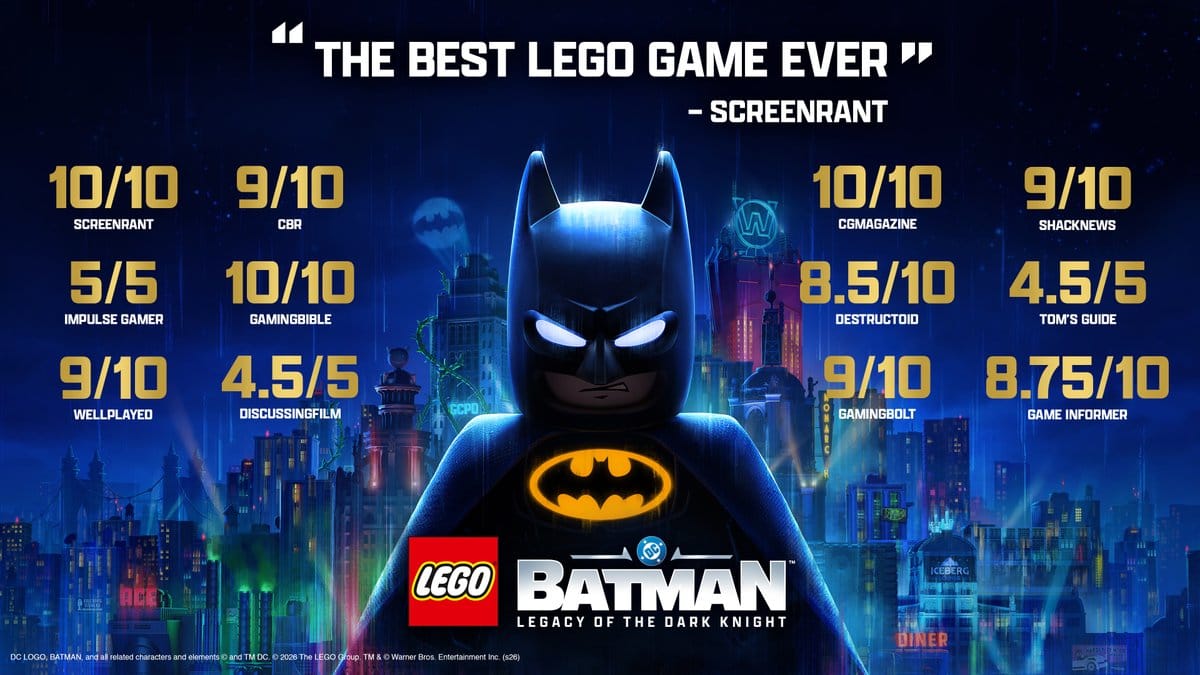
LEGO Batman: Legacy of the Dark Knight is a competent, fun action-adventure game that delivers on its core promise: Arkham’s story and world reimagined for LEGO audiences. It nails presentation, offers solid couch co-op, and provides 12–30 hours of content depending on your commitment level. At $54.99 (the standard price at review time), it’s a solid value for families and LEGO collectors seeking a story-driven co-op experience. For solo adult gamers, it’s worth waiting for a $30–$35 sale unless you’re a Batman completionist who doesn’t mind repetitive puzzle design.
The game is best experienced on PS5 or Xbox Series X, where the frame rate is stable and the visuals are crisp. If you’re on Switch and graphics fidelity matters to you, skip it. If you need online multiplayer or deep RPG progression systems, this isn’t your game. But if you want a charming, accessible action game that respects both kids and adults, and you have someone to play co-op with, LEGO Batman: Legacy of the Dark Knight delivers on that specific promise.
Score: 7/10
Verdict: BUY for LEGO fans and family co-op seekers at $54.99. WAIT for a $30–$35 discount if you’re a solo adult gamer. SKIP if you need online multiplayer, hardcore Arkham-level difficulty, or are planning to play on Switch.
Frequently Asked Questions
Is LEGO Batman: Legacy of the Dark Knight worth buying in 2025?
Yes, if you’re a LEGO fan or seeking family co-op content. At $54.99, LEGO Batman: Legacy of the Dark Knight offers 12–30 hours of solid gameplay with strong presentation and no aggressive monetization. Wait for a sale if you’re a solo adult player; the puzzle design skews toward accessibility over challenge, which can feel repetitive after the first 8 hours. The game shines in couch co-op but feels slower-paced for solo players.
How long does it take to beat LEGO Batman: Legacy of the Dark Knight?
The main story takes 12–15 hours depending on your pace and combat skill. Completionists chasing every collectible, True Hero rating, and side mission will invest 28–32 hours. There’s no New Game+ mode, so once you hit 100% completion, replayability drops significantly unless you’re hunting for missed collectibles or replaying levels for character-specific dialogue variations.
Does LEGO Batman: Legacy of the Dark Knight have multiplayer or co-op?
Yes — LEGO Batman: Legacy of the Dark Knight features full couch co-op for two players throughout the entire campaign. There is no online multiplayer, so remote play is not supported. The co-op experience is seamless and recommended, especially for families or friend groups, as the game is designed with split-screen camera management in mind.
Is LEGO Batman: Legacy of the Dark Knight good for kids and adults?
Yes, with caveats. Kids (ages 8+) will love the humor, accessible combat, and character variety in LEGO Batman: Legacy of the Dark Knight. Adults will enjoy the presentation and story but may find the puzzle design patronizing by mid-game. The game doesn’t scale difficulty, so adult players won’t feel challenged by mechanics. It’s best experienced as a co-op game where difficulty comes from coordination, not from individual skill requirements.
How does LEGO Batman: Legacy of the Dark Knight compare to LEGO Batman 2?
LEGO Batman: Legacy of the Dark Knight has stronger presentation, a tighter story, and more polished combat. However, LEGO Batman 2’s villain roster was deeper, and its puzzles felt less formulaic. LEGO Batman: Legacy of the Dark Knight trades character variety for narrative focus — it’s a more serious Batman game, whereas LEGO Batman 2 was a broader superhero comedy. Both are worth playing, but they serve different tones and audiences.