EA In-Game Advertising AI Platform: What It Means for Players
Disclosure: As an Amazon Associate, Bytee earns from qualifying purchases.
Picture this: you’re lining up a penalty kick in EA Sports FC, the crowd noise swells, and the digital billboard behind the goal smoothly swaps to a real Pepsi ad timed exactly to the three seconds your eyes are locked on that corner of the screen — that’s not a hypothetical anymore, that’s EA’s new AI advertising engine doing exactly what it was built to do. Not a static texture that’s been baked into the stadium model since launch. Not a banner ad in the main menu. A real-time, context-aware, machine-learning-powered advertisement that fires because an algorithm just calculated that you were about to look in that direction for long enough to register the brand. Welcome to the next frontier of in-game monetization, and it’s way more invasive—and technically impressive—than anything EA has shipped before.
What Is EA’s In-Game Advertising AI Platform and Why Are Gamers Talking About It?
EA’s in-game advertising AI platform isn’t just a rebranding of the billboard ads you’ve been seeing in sports games since 2005. The company announced a full machine-learning infrastructure designed to inject dynamically-served, contextually-aware advertisements directly into active gameplay sessions in real time. This is fundamentally different from static in-world billboards because those old stadium ads were painted onto the 3D geometry months before launch—they couldn’t change, couldn’t adapt, and most importantly, they were just part of the stadium’s visual design. You could ignore them or stare at them, and they’d remain exactly the same whether you were winning 5-0 or down to the final seconds of injury time.
EA’s new system watches what you’re doing, measures where your attention is likely focused based on camera position and game state, and serves branded content that’s supposed to feel native to the moment. The difference matters because it signals a shift from “we printed ads on the digital stadium wall” to “we’re actively targeting you with advertisements while you play.” That’s a psychological and technical leap. The company has positioned this as a revenue tool for publishers and a better experience for brands (who get real engagement metrics instead of guesses), but for players, it means your gameplay session is now a data stream being analyzed for advertising opportunities. This announcement hit hard in gaming discourse because it arrives against a backdrop of EA’s monetization history—loot boxes, battle passes, cosmetic pricing that makes $20 skins look reasonable by comparison. The company has spent a decade eroding player trust on the monetization front. An AI advertising platform lands differently when it comes from the studio that invented the aggressive loot box economy.
Why now? Because AI makes this economically viable at scale. Static billboards require manual placement and seasonal updates. Dynamic AI-driven ads can be managed by algorithms, served to millions of concurrent players, and optimized in real time based on engagement metrics. EA isn’t inventing in-game advertising—that’s existed since product placement in racing games in the 1990s. But EA is industrializing it with machine learning, turning ad delivery into a programmable, scalable, measurable system. This is exactly what middleware providers like Admix have been doing for years with studios like Ubisoft, but EA is building proprietary infrastructure that gives the publisher direct control over the entire ad ecosystem. That’s the shift that matters, and it’s why this announcement rippled through player communities and industry watchers faster than a typical monetization tweak.
How It Works: The AI Engine Serving Ads Inside Your Game
Think of EA’s advertising AI like a loot-drop algorithm, except instead of rolling for rare cosmetics, it’s rolling for the optimal moment and location to show you a brand advertisement. The system ingests real-time game state data—your current camera angle, your position on the pitch, how long you’re likely to hold that angle, what game mode you’re in, how long you’ve been in session, your player profile data, and contextual signals like whether you’re in a high-stress moment (penalty kick, final seconds of a match) or a low-attention moment (menu navigation, halftime). The ML model then calculates which ad placement, from which advertiser, in which visual location, has the highest likelihood of being seen and registered by your brain without breaking immersion or causing frustration.
The data inputs are the key to understanding why this feels invasive. The system isn’t just saying “show an ad somewhere on screen.” It’s analyzing your gaze patterns, session duration, behavioral signals within the game (are you aggressive or defensive? do you pause a lot? how do you react to previous ads?), and external profile data (age, region, inferred interests from your EA account history). That feeds into a neural network trained on millions of previous ad exposures to predict which brand, which message, at which moment, will maximize what the ad industry calls “brand lift”—the measurable change in your perception of a brand after exposure. In EA Sports FC, this might mean showing you a Nike ad during a moment you’re customizing your player’s kit, because the system predicts your attention is already on apparel. In Madden NFL 25, it could mean timing a sports drink ad to appear during a timeout, when you’re not actively controlling the play and your attention is more receptive to messaging.
The technical stack involves several layers. First, there’s the game engine integration—the publisher SDK that hooks into the game’s rendering pipeline and state machine, allowing the ad system to query game data without slowing down frame rates. Second, there’s the real-time decision engine, running on EA’s servers, that processes incoming game state and makes placement decisions in milliseconds. Third, there’s the advertiser marketplace—the backend that manages which brands have bought inventory, what their targeting parameters are, and how to allocate impressions fairly across competing advertisers. Finally, there’s the analytics layer, which measures engagement, tracks whether the ad was actually visible, and feeds that back into the model to improve future placements.
This is where it differs radically from the static billboards in older sports games. FIFA 22’s stadium ads were just textures. If you never looked at them, they were invisible to the system. EA’s AI ads are designed to make sure you look at them—or at least, the algorithm tries to predict that you will. The system is optimizing for a behavioral outcome, not just rendering a static asset. Compare this to how Admix operates in Ubisoft titles: Admix places ads in post-processing, essentially overlaying them on top of the rendered game. EA’s approach is more deeply integrated, allowing for seamless 3D billboard swaps and more sophisticated context awareness because the system has access to deeper game state information.
Dynamic Placement vs. Static Billboards: A Real Difference
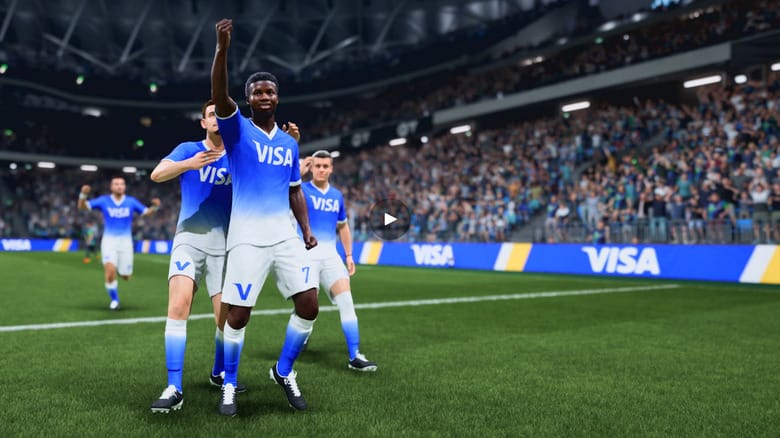
To ground this concretely: in FIFA 23, the Adidas billboard in the corner of the pitch is always there, always the same size, always the same location. It’s part of the stadium model. You see it 50 times during a match, and after the first glance, your brain filters it out as environmental noise. That’s actually good for players—visual consistency reduces cognitive load. The ad is there, but it’s not demanding your attention.
With EA’s AI system, that billboard doesn’t have a fixed sponsor. Instead, during your match, the algorithm is constantly evaluating: Is the player looking at the left side of the pitch? Are they about to take a corner? Did they just score, and are they likely to look toward that corner during the celebration camera angle? If the answers align with what a particular advertiser is willing to pay for, the billboard texture swaps in real time to show that brand. The visual placement is identical, but the content is now adaptive and targeted. The psychological difference is subtle but real—your brain is no longer passively accepting a static environment. Instead, you’re being actively targeted with content that’s been algorithmically optimized to catch your attention at a moment when you’re most vulnerable to brand messaging.
In a game like Need for Speed or Forza, this becomes even more obvious. A static billboard on a racetrack is just scenery. But an AI-driven billboard that swaps sponsors based on which cars you’re using, which race you’re running, or what brands you’ve engaged with in previous sessions? That starts to feel like the game is watching you, adapting to you, personalizing the advertising experience around your behavior. Some players might find that immersive—”oh, they know I love Nike, so they’re showing me Nike gear.” Others will find it creepy—”the game is tracking my attention and serving me ads based on my gaze patterns.” Both reactions are valid, and EA hasn’t fully addressed the psychological impact of that shift.
What Changes for Players: Real Gameplay Impact
Let’s be specific about what this looks like in practice. In the old system—say, FIFA 22—you load into a match, the stadium is rendered with pre-baked sponsor logos, and those logos remain static for the entire session. Your experience is identical whether you’re playing your first match of the day or your hundredth. Loading screens might have banner ads, menus might have sponsored content, but once you’re in-game, the advertising is passive and unchanging.
In the new AI system, here’s the before-and-after: Before (EA Sports FC 24): You pause the match at halftime. The pause menu shows a static Coca-Cola banner at the top (placed there by the UI designers months ago). You unpause, play the second half, and the same Coca-Cola banner is still there. The ad’s placement, size, and timing are fixed across all players and all sessions. The in-world stadium billboards never change—if Adidas paid for the left-corner billboard, it stays Adidas for the entire season. After (EA Sports FC 25 with AI ads): You pause the match at halftime. The system notes that you’ve been in-session for 20 minutes, you’re winning by two goals (low stress, receptive mental state), and your player profile suggests you engage with sports drink brands. The pause menu shows a different ad—maybe an energy drink or hydration brand—chosen and served in real time by the AI system based on your predicted attention and demographic targeting. You unpause, play into the second half, and the in-world billboards have also dynamically updated based on your camera position and the algorithm’s prediction of where your eyes will be during the next corner kick. A teammate takes a corner on the left side, and the corner billboard now displays a brand that the system calculated you’d be most receptive to seeing at that exact moment.
The gameplay impact is multifaceted. First, there’s the immersion question. When an ad feels native to the moment—like a sports drink brand appearing during a timeout in Madden NFL 25—it can actually enhance realism. Real sports broadcasts show sponsor content during breaks. But when the AI misfires—when you’re down 4-0 in the final minutes of a match and the system serves you an upbeat energy drink ad because it misread your emotional state—the dissonance breaks immersion hard. The ad feels tone-deaf, which is worse than a static ad because it suggests the game is actively misunderstanding you. This is a documented complaint from beta testers of similar systems: the algorithm optimizes for engagement metrics, not emotional appropriateness, so it can serve contextually inappropriate ads at scale.
Second, there’s frequency and fatigue. EA’s system likely includes frequency capping—algorithms designed to avoid showing the same brand too many times in a session, or showing too many ads in a short window. But the specifics aren’t public yet. If you’re playing 10 matches in an evening, are you seeing 10 different ads or the same 3 on rotation? If the algorithm decides to show you an ad every 15 minutes of active play, that’s dramatically different from the current system where ads appear only in menus or at specific environmental locations. Players have complained about ad fatigue in other platforms (Twitch, YouTube) where algorithmic optimization leads to the same ads appearing repeatedly in short windows, creating annoyance rather than engagement.
Third, there’s the opt-out question. EA hasn’t confirmed whether players can disable personalized ad targeting, request ad-free gameplay, or pay a subscription fee to remove ads entirely. This is a critical gap. In free-to-play games, ads are expected—players trade privacy for free access. But in premium-priced games like EA Sports FC (which costs $60 to $70 at launch), or in subscription services like EA Play, players are already paying. Adding a second monetization layer on top of the base purchase price is a different animal. If there’s no opt-out, this could trigger the kind of backlash that greeted aggressive loot box implementation in 2017-2018, when players discovered that $60 games contained $20 cosmetics and randomized loot boxes. The lack of transparency here is a red flag.
The most likely rollout targets are EA Sports titles first—EA Sports FC, Madden NFL, NHL 25, NBA Live (when it returns). These games already have in-world advertising as a core part of their visual design. The player base is accustomed to sponsor logos. And the sports advertising market is mature; brands are already spending on traditional sports broadcast slots, so the transition to dynamic in-game ads is a natural extension. The risk is lower for The Sims, but the opportunity is actually higher—imagine a Sims game where the furniture catalog, clothing stores, and food brands you see are dynamically served based on your player profile and building preferences. That’s a revenue goldmine, but it also feels invasive in a way that sports games might not.
What EA and Partner Studios Are Building With This
EA’s internal advertising division has been quietly expanding for years, but this platform represents a significant organizational shift. The company is positioning itself not just as a publisher that runs ads in its own games, but as an ad platform provider for the broader industry. That means EA is building tools, SDKs, and a marketplace that other studios can plug into. This is the monetization equivalent of Unity selling game engines—EA is creating infrastructure that makes ad implementation standardized and scalable across multiple publishers.
The third-party brand partners are the obvious tier: Nike, Coca-Cola, energy drink brands, automotive manufacturers, tech companies. These are the same brands that already buy billboard space in real sports broadcasts. They’re accustomed to sports advertising, they have massive budgets, and they understand the value of reaching engaged audiences. But EA is also building tools for indie publishers and smaller studios to access the platform, likely taking a revenue share (EA gets a cut, the developer gets a cut, the brand pays the rest). This is how the company scales the system beyond its own titles, competing directly with established middleware providers like Admix and Anzu.io that already serve hundreds of titles.
On the developer side, the tooling is crucial. Studios need to be able to define ad zones—specific 3D locations in the world where ads can appear. They need frequency controls—”don’t show more than 3 ads per session,” “don’t show the same brand twice in 30 minutes.” They need targeting controls—”this ad zone is appropriate for all regions except China” or “this brand should only appear in mature-rated game modes.” The middleware here is important: engines like Unreal Engine 5 and Unity are adding native ad support through partnerships. Middleware providers like Admix (which already works with Ubisoft on titles like Splinter Cell Remake) and Anzu.io provide the abstraction layer between the game engine and the ad system, handling rendering, tracking, and compliance. EA is essentially building its own version of this, which gives it competitive advantages in speed and data access but also locks developers into EA’s ecosystem if they want to use the most sophisticated features.
How This Compares to Existing In-Game Ad Tech
EA is not the first to do this. Admix has been serving dynamic in-game ads for years, working with studios like Ubisoft on titles like Splinter Cell Remake and other AAA projects. Anzu.io has been placing ads in games since 2018 and claims to work with over 1,000 game titles. Bidstack specializes in contextual ad placement in open-world games. These platforms already do real-time, contextual ad serving with machine learning components. So what’s EA’s angle?
Scale and first-party data. EA has 500+ million registered players across its portfolio. It owns the game engine, the game servers, the player data, and the advertising infrastructure. Competitors like Admix have to negotiate with individual studios, prove ROI on a game-by-game basis, and work through multiple layers of middleware. EA is building a closed system where it controls every layer—the game, the ad decision engine, the brand marketplace, and the analytics. That’s a massive advantage. Additionally, EA’s reputation and existing relationships with major brands give it leverage. When EA says “we have 100 million concurrent players in EA Sports FC alone,” that’s a pitch that Admix or Anzu.io can’t match with their aggregated network. EA is competing partly on technology, but mostly on distribution and scale.
The other difference is sophistication and integration depth. Competitors’ ad systems are often bolted onto games after the fact, using post-processing or overlay techniques that don’t require deep game engine access. Admix, for example, uses post-processing rendering to place ads without modifying the game’s core systems. EA’s system is integrated into the game engine itself, allowing for more seamless rendering and deeper game state access. That means better prediction models, more natural-feeling placements, and fewer technical artifacts (like ads that clip through geometry or render on top of UI elements). The tradeoff is that EA’s approach requires tighter coordination with developers and more engine-level access, which is easier for EA’s own titles but harder to license to third parties.
The Catch: Limitations, Risks, and Player Concerns
Let’s talk about what can go wrong, because the history of AI in gaming gives us plenty of cautionary tales. Remember when Activision announced that it was using AI to detect and ban cheaters in Call of Duty? The system was supposed to be smarter and faster than human moderation. Instead, it generated massive false-positive bans, locked legitimate players out of their games, and created a trust crater with the community that took months to recover from. The lesson: when you deploy AI at scale in games, especially systems that affect player experience, there’s enormous risk that the algorithm will misfire in ways you didn’t anticipate.
With EA’s advertising AI, the failure modes are concrete and documented in similar systems. First, immersion-breaking misreads: The algorithm serves an upbeat, energetic ad when you’re losing badly, or a “premium luxury” ad when you’re playing a budget squad. The AI doesn’t understand emotional context the way humans do, so it can easily serve tone-deaf content. In a match where you’ve just conceded three goals in five minutes, an ad for a luxury sports watch feels insulting, not aspirational. The system might technically be “working” (showing an ad to a player), but it’s failing at the psychological level. This is a real complaint from players who’ve tested similar systems in mobile games and streaming platforms—the algorithmic optimization for engagement creates contextually inappropriate moments.
Second, data privacy concerns. The system is tracking your gaze patterns, your session length, your in-game behavior, your player preferences, and your external profile data. That data is being used to build predictive models about your attention and behavior. Where is that data stored? How long is it retained? Is it being sold to third parties? Can advertisers request specific targeting parameters that are essentially behavioral surveillance? EA has a history of being vague about data practices—the company collects massive amounts of telemetry but doesn’t always clearly disclose what happens with it. An AI advertising system makes that opacity feel more sinister because it’s not just collecting data, it’s using it to target you in real time. The regulatory landscape is tightening (GDPR, CCPA, UK Online Safety Bill), so this is a genuine legal risk, not just a trust issue.
Third, performance overhead. Real-time ad rendering, decision-making, and analytics all add computational cost. If the system isn’t well-optimized, it could impact frame rates, increase load times, or cause stuttering. This is especially risky in competitive multiplayer games where frame consistency is critical. A 10ms delay caused by ad-serving infrastructure could be the difference between a clean win and a laggy death. EA has the engineering resources to minimize this, but it’s a risk factor that exists and has manifested in other platforms—YouTube’s ad injection has been documented to cause stuttering in browser-based games, and similar overhead could appear here.
Fourth, the job displacement angle. AI-driven ad systems reduce the need for in-house marketing teams and UI artists who currently design and manage sponsorship placements. If ad decisions are automated, there’s less work for humans to do in that space. This doesn’t mean wholesale layoffs, but it does mean fewer positions and less creative autonomy for the people who currently manage in-game branding. It’s a structural shift in how the industry allocates creative labor.
Finally, the trust precedent. EA has spent the last decade building a reputation for aggressive monetization. Loot boxes in FIFA, cosmetics in Apex Legends, battle passes in The Old Republic—the company has consistently pushed the boundaries of what players will tolerate in terms of paid content. An AI advertising platform arrives in that context as yet another revenue stream, another layer of monetization, another way for EA to extract value from its player base. Even if the system is implemented fairly, the company’s history makes players skeptical. The company needs to prove that this isn’t going to become another aggressive, predatory system. The lack of transparency about opt-out mechanisms, frequency caps, and data usage suggests it might. Players have legitimate concerns based on documented precedent: EA has introduced aggressive monetization in games before and only backed off after public backlash, not because of internal ethical review.
What Comes Next: Where EA’s Ad AI Is Heading
Based on EA’s announcement language and typical rollout timelines, expect to see this system live in at least one EA Sports title within the next 12-18 months. Most likely candidate: EA Sports FC or Madden NFL. These franchises already have sophisticated sponsor integration, so the technical barriers are lower. The company will probably start with a limited rollout—specific regions, specific game modes, specific ad zones—to test the system and gather performance data. If it works and doesn’t trigger massive backlash, the rollout will expand to other sports titles, then to other genres.
The question of subscription tiers is critical here. If EA Play subscribers can opt into an ad-free experience, that creates a two-tier system where paying more gets you cleaner gameplay. That’s actually consumer-friendly and precedent for the model exists in mobile gaming and streaming. But if ads appear everywhere regardless of subscription status, that’s a different story. Right now, EA hasn’t confirmed whether this will be the case. The silence on this point is telling—it suggests EA is still deciding, which means there’s room for player feedback to influence the decision. This is the moment for organized player advocacy to matter most.
Genre expansion is inevitable. Sports games are the natural starting point, but the system will eventually move to open-world games (The Sims, Star Wars: The Old Republic), competitive multiplayer (Apex Legends, The Old Republic PvP zones), and possibly even single-player story games if EA decides the revenue justifies the immersion risk. The milestone to watch is the first non-sports AAA title that ships with AI-driven advertising. That’s the moment the system becomes normalized across the industry, not just a sports game thing.
Industry follow-through is the bigger picture. If EA’s system generates significant revenue without destroying player trust, competitors will follow. Activision Blizzard is already aggressively monetizing, so an AI ad system in Call of Duty or Overwatch is plausible. Ubisoft is already using Admix, so they might develop their own proprietary system. Microsoft could integrate ads into Game Pass. Sony might add advertising to PlayStation Plus. Once one major publisher succeeds with this, the pressure on others to implement similar systems becomes enormous. We’re potentially looking at a future where in-game advertising becomes as normalized as ads on YouTube or Twitch—unavoidable, personalized, and optimized to catch your attention whether you want it to or not.
The real test isn’t whether EA’s AI advertising system is technically impressive—it clearly is—but whether players will tolerate being targeted with personalized ads in games they’ve paid $60-70 to play, without clear opt-out options or transparency about data usage. Based on EA’s track record of opacity and aggressive monetization, skepticism is warranted.
Frequently Asked Questions
Does EA’s in-game advertising AI platform make ads feel like part of the game or do they break immersion?
It depends entirely on execution. When the AI correctly predicts context—like showing a sports drink ad during a timeout in Madden NFL 25—the ad can feel native and enhance realism. But when the algorithm misfires and serves tone-deaf content (like a luxury ad when you’re losing 4-0), immersion breaks immediately. The system is only as good as its training data and real-time decision-making, so misreads are inevitable, especially early in the rollout. This is a documented complaint from players who’ve tested similar algorithmic ad systems in mobile games and streaming platforms.
Which EA games will use the in-game advertising AI platform first?
EA Sports FC and Madden NFL are the most likely candidates for initial rollout, since they already have sophisticated sponsor integration and player bases accustomed to in-world advertising. These titles have natural ad zones (stadium billboards, sideline boards) that the AI system can dynamically populate. Expect to see the system live within 12-18 months, probably starting with limited regional or game-mode rollouts to test performance and gather player feedback. NHL 25 and NBA Live are secondary candidates if those franchises launch with AI ad infrastructure in place.
Will EA’s ad AI platform push other studios like Activision and Ubisoft to follow suit?
Almost certainly, if EA’s system generates meaningful revenue without triggering major player backlash. Ubisoft is already using Admix for in-game ads in titles like Splinter Cell Remake, so they have infrastructure in place and could develop proprietary alternatives. Activision is aggressively monetizing across Call of Duty and Overwatch. Once one major publisher succeeds with AI-driven advertising, the competitive pressure on others becomes enormous. We’re likely looking at industry-wide adoption within 3-5 years if EA’s rollout is successful.
Can players opt out of EA’s in-game ads or pay to remove them?
EA hasn’t publicly confirmed opt-out mechanisms or ad-free subscription tiers yet, which is a significant gap. In theory, EA Play subscribers could get an ad-free experience, but that’s not confirmed. The lack of transparency on this point is concerning—it suggests EA is still deciding how aggressive to be with the system. This is the critical issue to watch, because opt-out availability will determine whether this system feels like reasonable monetization or predatory targeting. Players should advocate for clear opt-out options before the system launches.
How is EA’s AI-driven ad system different from the stadium billboards already in FIFA and Madden?
The old billboards in FIFA 23 and Madden 24 are static textures baked into the stadium model—they never change and require no real-time processing. EA’s AI system dynamically serves different ads based on your game state, camera position, behavioral data, and attention patterns in real time. The billboard location is the same, but the content is adaptive and targeted. This is fundamentally more invasive because the game is now actively tracking you and personalizing advertising around your predicted attention, not just rendering a static asset. In concrete terms: FIFA 23’s Adidas billboard stays Adidas all season; EA Sports FC 25’s billboard could show Nike one moment and Puma the next, depending on what algorithm predicts you’ll respond to.