David Rez Graham Game AI: How Modern Game AI Works
Disclosure: As an Amazon Associate, Bytee earns from qualifying purchases.
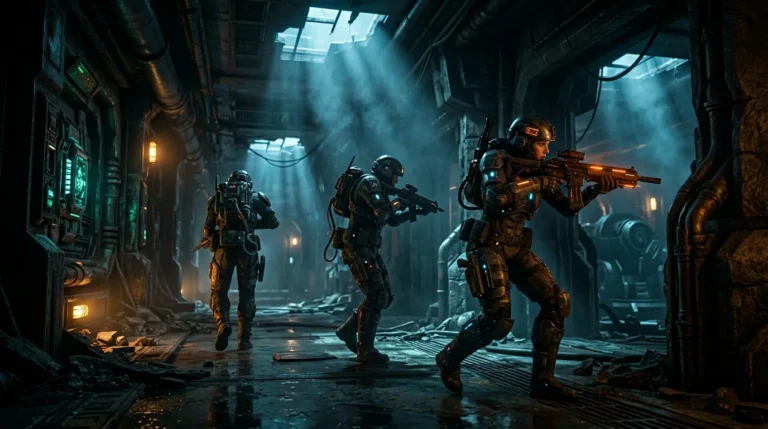
You peek around a crumbling stone pillar, expecting the enemy guard to follow his predictable four-second patrol route, only to find him flanking through the side corridor because he heard your reload. That sudden spike of adrenaline isn’t coming from an unhinged large language model hallucinating dialogue in the cloud; it is the calculated result of modern game AI architecture firing on a rigid 2-millisecond frame budget. While venture capital floods social feeds with generative tech demos, seasoned engineers know that making an NPC feel alive inside a real-time game engine requires an entirely different discipline.

What Is Modern Game AI Architecture and Why Is the Industry Debating It?
The conversation around artificial intelligence in interactive media has fractured into two camps: the speculative hype of generative models and the hard-nosed reality of real-time execution. Industry veterans like David Rez Graham—best known for architecting the intricate behavioral frameworks behind The Sims 4—and Luke Dicken have spent decades solving the actual bottleneck in games: systemic responsiveness. When engineers talk about David Rez Graham Game AI paradigms, they are not talking about chatbots. They are talking about robust, deterministic, and modular systems capable of evaluating thousands of simultaneous environmental variables without dropping a single frame.
The gaming public’s expectations have shifted dramatically. In the early 2000s, an enemy taking cover behind a wooden crate in F.E.A.R. blew players’ minds. Today, players demand persistent worlds where NPCs remember previous interactions, coordinate tactical squad movements, and react dynamically to player-driven chaos. If an NPC stands idle while a grenade bounces off their helmet because an API call timed out, the illusion shatters immediately.
This reality has triggered a fierce debate across major development studios. Pure machine learning and generative tools promise infinite variation, but they lack authorial control and predictability. Structured NPC AI systems built on classical decision architectures offer total designer control and lightning-fast execution. As veterans like Luke Dicken have consistently pointed out, real game AI development is fundamentally an exercise in illusion management: giving non-player characters just enough perceived autonomy to challenge the player while preserving the narrative and mechanical vision of the game designers.
How It Works: Under the Hood of Modern Video Game AI Development
At the engine level, video game AI development is a pipeline of rapid decision-making loops executing every few ticks. Modern engines juggle three primary decision paradigms, each suited for distinct gameplay genres and performance footprints:
1. Finite State Machines (FSMs) & Behavior Trees: Popularized across AAA action titles from Halo 2 to Tom Clancy’s The Division, Behavior Trees evaluate hierarchical nodes (Selectors, Sequences, Conditions) from top to bottom. They allow designers to visually construct reactive patterns, such as “Find Cover → Suppress Player → Call for Backup.”
2. Goal-Oriented Action Planning (GOAP): Instead of hardcoding branching paths, GOAP provides an agent with an end state (e.g., “Kill Target”) and a list of atomic actions with dynamic costs. The AI calculates the most efficient chain of actions on the fly, enabling emergent problem-solving seen in titles like Deus Ex: Human Revolution.
3. Utility AI: Championed extensively by David Rez Graham in life-simulation architecture, Utility AI scores every potential action using mathematical response curves based on an agent’s internal needs and external stimuli. In The Sims 4, an agent does not follow a linear script; it continually weighs hunger, fatigue, bladder, and social proximity, picking whichever interaction yields the highest utility score at that precise microsecond.
The decision layer is only half the battle. Data must flow cleanly from Perception Systems (which use raycasts and stimulus listeners to query the game world) through the Spatial Navigation layer (NavMesh queries and clearance calculations) down to the Animation Graph (motion matching and root-motion blending). If an agent decides to sprint to an alternate vantage point, the navigation system must generate a collision-free path while the animation system smoothly blends the character’s locomotion from a crouch-walk to a full sprint without foot sliding. Modern development environments rely heavily on specialized visualizers, dynamic heatmaps, and rewindable state debuggers so engineers can track precisely why an NPC selected a specific branch at frame 4,218.
What Changes for Players: Real Gameplay Impact and Emergent Behavior
When these modular architectures are configured correctly, the gameplay experience transforms from a shooting gallery into a high-stakes chess match. The difference between legacy scripted routines and modern systemic AI is night and day:
Before: In classic action games, enemies were chained to strict trigger volumes. Step across an invisible threshold on the floor, and three guards run down a predetermined hallway straight into your crosshairs. If you throw a smoke grenade off-path, they ignore it because their script does not have an evaluation node for indirect environmental disruption.
After: In modern tactical titles like The Last of Us Part II or Alien: Isolation, agents utilize dynamic blackboards and shared squad awareness. Spotting a fallen comrade triggers a dynamic alert state across the entire sector; the squad splits into suppressive fire teams and flankers while communicating their intentions through contextual voice lines. In Alien: Isolation, the Xenomorph operates under a dual-brain architecture: a Macro Director AI that constantly feeds subtle hints about player proximity, and an internal Micro AI that explores, listens for floorboard creaks, and learns which diversion tactics the player reuses.
The ultimate design challenge lies in balancing this tactical autonomy with player agency. An AI that acts with flawless mathematical efficiency is not fun—it is an aimbot. High-level architecture focuses on crafting “perceptible intelligence,” designing intentional vulnerabilities, telegraphing flank routes, and giving enemies deliberate hesitation windows so players feel outsmarted rather than cheated.

What Game Studios Are Building With Advanced AI Systems
Across both AAA giants and agile indie studios, the engineering focus has pivoted toward hybrid architectures that merge deterministic logic with deep systemic simulation. Large-scale open worlds cannot afford to run full decision loops on thousands of distant background characters, prompting the adoption of hierarchical LOD (Level of Detail) AI pipelines.
In massive simulations like Hitman World of Assassination, crowd characters run stripped-down, low-cost state machines, while key targets operate under fully fleshed-out Utility AI graphs capable of dynamic schedule disruption, panic routing, and disguise detection. Studios are also increasingly integrating modern runtime toolsets directly into engine middleware to accelerate this pipeline:
- Unreal Engine MassEntity & StateTree: Epic Games’ data-oriented framework (showcased in The Matrix Awakens tech demo) allowing tens of thousands of simultaneous agents to execute lightweight AI logic via high-performance ECS (Entity Component System) architecture.
- Unity Sentis: A runtime inference engine that enables developers to embed lightweight neural networks directly into local game loops for physics-based animation and procedural movement without server latency.
- Inworld AI & Convai: Specialized middleware toolkits targeting contextual dynamic dialogue and character perception layers, anchoring dynamic NPC interactions within structured narrative guardrails.
Rather than letting machine learning control high-level game logic, developers are using ML where it shines: training deep reinforcement learning models for complex locomotion, driving models (such as the Drivatars in Forza Motorsport), and physics-driven ragdoll balancing, while keeping combat decisions and quest logic anchored to strict, debuggable behavior trees.
The Catch: Performance Budgets, Player Frustration, and Design Control
Building high-end game AI is a constant battle against physical hardware limitations. On a standard 60 FPS target, a game has 16.6 milliseconds to process graphics, physics, sound, networking, and gameplay logic. The AI subsystem often gets a strict slice of just 1 to 2 milliseconds per frame. Complex pathfinding queries across intricate geometry or high-frequency GOAP planners can easily choke the CPU, causing severe framerate stutters if spatial caching and time-sliced ticking are not meticulously implemented.
Beyond hardware bottlenecks lies the critical issue of designer control. When artificial intelligence becomes too autonomous, narrative structures fall apart. A classic historical example occurred during the development of The Elder Scrolls IV: Oblivion. Bethesda’s initial implementation of “Radiant AI” gave town NPCs open-ended goals with high autonomy; guards would abandon their posts to hunt deer for food, or starve and murder merchants for a loaf of bread, completely breaking essential questlines before the player ever arrived. The developers were forced to heavily constrain the system to maintain basic game stability.
More recently, the disastrous launch state of Cyberpunk 2077 highlighted the danger of shipping an undercooked AI pipeline. Night City’s initial pedestrian and driving systems lacked robust spatial awareness and dynamic recovery routines, leading to traffic freezing perpetually behind parked bicycles and police officers instantaneously teleporting behind the player. It served as a stark reminder to the industry: when AI fails to handle systemic edge cases gracefully, the entire world feels like a cheap plastic set.
What Comes Next: The Evolution of Game AI Architecture
The future of interactive character design will not be defined by fully generative worlds that build themselves, but by cohesive hybrid architectures. As demonstrated by the engineering philosophies of David Rez Graham and modern systems researchers, the breakthrough will come from coupling classical deterministic scaffolds with context-aware parametric models.
We are moving toward sandbox worlds where NPCs possess deep episodic memory, dynamic tactical coordination, and situational dialogue that responds organically to the player’s historical actions—all while executing safely within local hardware constraints. When enemies coordinate a dynamic breach-and-clear maneuver based on the exact structural damage you just dealt to a wall, you won’t care about cloud-hosted models or buzzwords.
The real future of game AI belongs not to unconstrained generative algorithms, but to robust, engineered architectures that turn complex decision mathematics into unforgettable gameplay moments.
Frequently Asked Questions
What is the difference between generative AI and game AI architecture?
Generative AI focuses on producing new content such as text, images, or audio through probabilistic models like LLMs, often running with significant latency. Game AI architecture consists of deterministic, real-time systems like Behavior Trees, Utility AI, and GOAP designed to execute spatial navigation, tactical combat, and decision-making within a strict 1-2 millisecond frame budget in titles like The Last of Us Part II and The Sims 4.
Why do industry veterans like David Rez Graham and Luke Dicken favor structured AI systems over pure machine learning?
Structured systems provide game designers with total authorial control, immediate visual debugging, and predictable performance profiles necessary for shipping balanced games. Games like The Sims 4 and Alien: Isolation rely on structured mathematical utility curves and hierarchical trees to ensure characters behave consistently without breaking quest progression or game balance.
How does modern video game AI development prevent NPCs from feeling scripted or repetitive?
Modern development pairs dynamic environmental perception queries with Utility AI and shared blackboard systems, allowing NPCs to evaluate multiple viable actions based on real-time combat conditions rather than fixed rail scripts. By continually scoring options like flanking, seeking cover, or calling for reinforcements against shifting player tactics, characters produce emergent, unpredictable gameplay responses.