Crepe Master VR Kids Game Review: Worth It on Quest?
Disclosure: As an Amazon Associate, Bytee earns from qualifying purchases.
You’re standing at a tiny virtual kitchen counter, a ladle of batter hovering in your right hand, your six-year-old beside you absolutely losing their mind because the crepe you just flipped actually landed — and for about thirty seconds, neither of you cares that this is a video game at all. The batter sizzles. Your kid reaches over and grabs the chocolate sauce bottle. The presence is real. This is what Crepe Master VR does best: it collapses the distance between imagination and tactile play in a way that flat-screen cooking games simply cannot touch. For young VR newcomers, it’s a revelation. For parents tired of screen fatigue, it’s a lifeline. But before you strap on a headset, let’s talk about what you’re actually getting into.
Platform(s): Meta Quest 2 / Meta Quest 3
Genre: Family-Friendly Cooking Simulation
Developer: Klang Games
Price: $9.99 USD (Meta Quest Store)
Play Area: Seated or Standing (no roomscale required; ~2m × 2m recommended for comfort)
Game Length: ~2–4 hours of main gameplay; unlimited creative cooking sessions
Motion Sickness Risk: None — stationary kitchen environment, no artificial locomotion, no vestibular triggers
What Is It? VR-Native Design and Headset Compatibility
Crepe Master VR is a purpose-built VR cooking game from Austrian developer Klang Games, arriving on Meta Quest 2 and Quest 3 as a native VR experience — no flat-screen port, no lazy adaptation. At $9.99, it positions itself as an accessible entry point into family VR, sitting comfortably alongside other child-friendly titles like Le Dino Labo (which has since expanded via DLC, setting a precedent for post-launch content). The game’s focus is laser-sharp: you run a crepe stand, you take orders, you cook, you serve. Repeat. The core loop is simple enough for a five-year-old to grasp but tactile enough to hold a parent’s attention for a few sessions.
Currently, Crepe Master VR is exclusive to the Meta Quest ecosystem (Quest 2 and Quest 3). There is no PSVR2 version, no Steam VR port, and no PlayStation 5 release on the horizon. This is worth noting upfront: if you’re committed to PlayStation’s VR2 ecosystem, you’ll need to look elsewhere. For Quest owners, however, the game is immediately accessible via the Meta Quest Store, downloadable directly to your headset with no PC tethering required. Developer Klang Games has built a solid reputation for child-friendly VR (their earlier work includes VR puzzle games), so there’s institutional competence behind this release. Estimated playtime sits between 2–4 hours for the structured campaign, though the sandbox-style crepe creation can stretch that indefinitely if your child finds the loop rewarding.
The VR Experience: Hand Presence, Spatial Audio, and Embodied Cooking
Here’s what a flat-screen iPad cooking game cannot replicate: the moment your kid’s hand closes around a virtual spatula and they *feel* the weight of intention behind the gesture. When you pour batter from a bottle into a pan, the physics engine responds in real time — the liquid pools, spreads, and sizzles with spatial audio that places the sound exactly where your hand is moving relative to your head. When you spread jam across a crepe, the resistance of the virtual knife feels grounded in your grip. The kitchen environment is intimately scaled to child proportions, which makes presence hit different. These aren’t revolutionary mechanics, but in VR, the embodied sensation of *doing* these tasks rather than *watching* them transforms the experience into something closer to actual cooking play — your muscle memory builds genuinely as you repeat the flip motion across sessions.
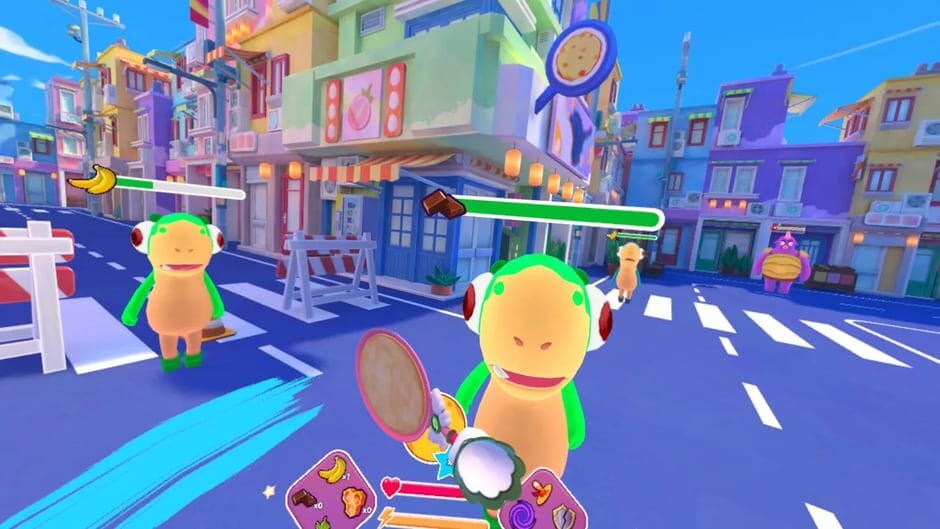
The standout moments are genuinely charming: pouring batter and watching it pool in the pan with convincing fluid dynamics, the satisfying *snap* of a successful flip, the moment a kid realizes they can grab three toppings at once and layer them with their free hand. Visually, Crepe Master opts for a soft, toy-like aesthetic — think Pixar meets a children’s book — rather than pursuing realism. This choice pays dividends. The colors pop without overwhelming at Quest 3’s 1728×1824 per-eye resolution (or Quest 2’s 1832×1920), the UI is intuitive without being patronizing, and the overall tone is playful rather than stressful. Adults playing alongside kids will find the experience engaging, though not in the way a complex narrative game might be. The appeal for adults is primarily vicarious: watching your child’s face light up when they nail a flip. The game doesn’t pretend to be something it isn’t, and that honesty is refreshing in a market often chasing false depth in family titles.
Gameplay Deep Dive: Controls, Comfort, and Session Structure
The control scheme is deliberately intuitive. Each hand holds a tool (ladle, spatula, bottle, knife — context-sensitive), and the primary interaction is grab-and-move. The trigger fires actions like pouring or spreading; the grip steadies your hand. For kids aged 6–12, this is manageable within the first minute. Younger kids (4–5) may need a parent’s hands-over guidance initially, but the muscle memory builds fast. Orders appear on a virtual notepad, and you fulfill them by cooking the right crepe with the right toppings. There’s no timer pressure in the early levels, which is crucial for young players — the game respects their pace. As difficulty ramps, time constraints introduce light challenge without becoming frustrating.
The comfort profile is nearly ideal for family VR. Because the kitchen is stationary and you never teleport, move quickly, or look at extreme angles, motion sickness risk is effectively zero. The absence of artificial locomotion and head-tracking-dependent movement eliminates the primary vestibular triggers that cause nausea in VR. Sessions naturally cap at 15–30 minutes for young children before attention drifts, which aligns perfectly with recommended VR break intervals. A parent can supervise from outside the headset without missing the action — a significant advantage for families where only one headset exists. The repetition loop (order → cook → serve → repeat) holds attention across multiple short sessions because each crepe is a mini-puzzle: What toppings does this order need? How do I combine them fastest? Kids find genuine satisfaction in optimization, even at this simple level. Repetitive wrist-flipping may cause mild fatigue in sessions exceeding 45 minutes; we recommend 20-minute breaks for children under 8.
Headset Comparison: Quest 3 vs Quest 2 — Which Version Should You Buy
Crepe Master VR runs on both Meta Quest 2 and Quest 3, and the difference is noticeable but not transformative. The Quest 3’s superior Snapdragon Gen 2 processor and higher refresh rate (90 Hz vs. Quest 2’s 72 Hz) deliver crisper text on the order notepad, sharper edges on the crepe pan and utensils, and richer colors in the toppings — strawberries are more vivid, chocolate sauce more appetizing. Load times on Quest 3 are marginally faster (~2 seconds vs. ~4 seconds on Quest 2), which matters less for a game with no mid-session loading, but the overall responsiveness and frame stability feel snappier. The Quest 3’s mixed reality passthrough, while not utilized by Crepe Master itself, is a nice bonus if you want to glance at your physical kitchen without removing the headset. Frame rate stability is rock-solid on both devices, so gameplay never stutters — the difference is purely visual polish and responsiveness.
The honest recommendation: Quest 3 is the superior experience and the one we’d pick if budget allows. The visual polish makes the kitchen feel more inviting at sustained 90 Hz, and the faster load times reduce friction for young players with short attention spans. However, Quest 2 is absolutely adequate and the smarter financial choice if you’re testing whether family VR is worth the investment. A six-year-old will have just as much fun on Quest 2; they won’t notice the softer visuals or the occasional frame timing variance. Both devices support Meta Quest parental controls and kid accounts, which is essential for family buyers — you can set playtime limits, restrict certain games, and monitor activity directly from a parent app. This ecosystem-level feature is a major advantage over any PC VR alternative and a key reason to choose Quest for family VR in the first place.
| Headset | Visual Quality | Frame Rate | Price (Headset + Game) | Parental Controls | Verdict |
|---|---|---|---|---|---|
| Meta Quest 2 | Good — soft visuals, readable UI | 72 Hz | $199 (used) + $9.99 | Yes — full parental ecosystem | BUY — Best budget pick for families testing VR |
| Meta Quest 3 | Excellent — sharp text, vivid colors, faster loading | 90 Hz | $299 + $9.99 | Yes — full parental ecosystem | BUY — Best overall experience, future-proofed |
Verdict: Is Crepe Master VR Worth Your Money?
Crepe Master VR earns a solid 7.5 / 10 as a family VR experience. It does exactly what it sets out to do: deliver tactile, joyful cooking play in VR with zero friction for young players and zero motion sickness risk. The controls are intuitive, the aesthetic is charming, and the core loop is satisfying enough to sustain 2–4 hours of engagement before the novelty settles. For a $9.99 investment, the price-to-hours ratio is fair — you’re not paying AAA prices for a niche experience. Kids aged 6–10 will replay it across multiple sessions. Older kids and adults will burn through it faster and likely move on.
The primary weakness is content brevity. Once you’ve completed the order-based campaign and experimented with the sandbox crepe creation mode, there’s limited reason to return unless your child is genuinely obsessed with cooking games. There’s no progression system beyond completing orders, no unlockables, no multiplayer. Compare this to titles like Tiny Castles (which offers longer exploration and building depth) or Gadgeteer (which delivers mechanical puzzle complexity), and Crepe Master feels lighter by design — which is fine if you know what you’re buying. The game is honest about its scope.
VERDICT BY HEADSET:
Meta Quest 3: BUY (9/10) — Best for families with the budget for current-gen hardware. The 90 Hz refresh rate and sharper visuals create noticeably smoother hand-tracking and clearer UI text. If you’re building a family VR library from scratch, Quest 3 is the future-proofed choice.
Meta Quest 2: BUY (7.5/10) — Excellent value if you already own a Quest 2 or can find a used unit. Crepe Master runs identically in terms of gameplay; only visual polish and frame rate differ. Best for: Parents testing family VR without major investment, or households where a second headset is needed for multiplayer sessions.
PSVR2 / Steam VR: SKIP — No version exists for these platforms. Crepe Master is Meta Quest exclusive.
Best For: Young VR newcomers (ages 6–10) and parents seeking a motion-sickness-free, co-play experience that genuinely respects their child’s comfort and attention span. Ideal for families new to VR who want confidence-building, zero-nausea gameplay without overstimulation.
Does Crepe Master VR work on Meta Quest 2 or only Quest 3?
Crepe Master VR runs on both Meta Quest 2 and Quest 3. There is no exclusive version for either headset. The game is fully compatible with Quest 2, though Quest 3 delivers superior visual fidelity (sharper UI text, crisper crepe details, 90 Hz refresh rate vs. Quest 2’s 72 Hz, faster load times). If you own a Quest 2, you can play Crepe Master without any performance issues or missing features. The experience is identical in gameplay; only visual polish and frame rate differ between the two platforms.
Is Crepe Master VR safe and comfortable for young kids and toddlers?
Crepe Master VR is extremely safe and comfortable for young players. Motion sickness risk is effectively zero because the kitchen environment is stationary — there is no teleportation, fast movement, or height-based vertigo. The game respects VR comfort best practices: it uses a gentle color palette to avoid eye strain, keeps sessions naturally short (15–30 minutes), and avoids sudden camera movements or spinning. Children as young as four can play with parental guidance, though ages 6+ is the recommended sweet spot for independent play. Meta’s parental controls on Quest 2 and Quest 3 allow you to set playtime limits and monitor activity, making this a genuinely child-safe VR experience. Caution: Repetitive wrist-flipping may cause mild fatigue in extended sessions; recommend 20-minute breaks for children under 8.
How long does Crepe Master VR take to complete and is there replay value?
Crepe Master VR’s structured campaign takes approximately 2–4 hours to complete, depending on your child’s age and play speed. The game includes an order-based progression system (early levels are gentle, later levels introduce time pressure) and a sandbox crepe creation mode for open-ended play. Replay value is moderate: younger kids (6–8) will revisit it across multiple sessions and enjoy the repetition loop of taking orders and cooking. Older kids and adults will likely complete it once and move on unless they’re genuinely passionate about cooking games. There are no unlockables, achievements, or multiplayer modes, so long-term engagement depends entirely on whether your child finds the core loop inherently rewarding. For the $9.99 price tag, it delivers solid value for its intended audience, though it’s not a 20+ hour experience.