Among Giants VR Review: A Bold Epic Worth the Leap
Disclosure: As an Amazon Associate, Bytee earns from qualifying purchases.
You are three hundred feet up the spine of a sleeping colossus, your grip stamina bar bleeding red, wind audio howling through your headset, when the giant exhales — and the entire mountain of flesh shifts beneath your hands. Your left controller vibrates urgently. Your right arm burns from sustained climbing. The beast stirs. This is Among Giants VR, and in this single moment, it captures everything the game does right: the grip-button mechanic demands constant physical engagement, the stamina-drain system creates genuine tension, and the vertigo is earned through precise hand-position tracking rather than cinematic tricks.
What Is Among Giants and Who Is It For?
Among Giants is a narrative-driven open-world VR epic developed by Compulsion Games and published by Xbox Game Pass for PC VR. The game launches across Meta Quest Pro, PlayStation VR2, HTC Vive Pro 2, and Valve Index, with a $49.99 price point at launch — a premium positioning that reflects its scope. The campaign runs 20-30 hours for a single playthrough, with optional co-op elements allowing up to two players to tackle the world simultaneously. This is not a casual dabble-for-an-hour experience. Among Giants demands VR legs, motion controller proficiency, and genuine patience with its learning curve.
The game is built squarely for dedicated VR players who have logged serious hours in titles like Half-Life: Alyx or Pavlov, not for people who play Beat Saber once a month. If you’re the type who owns a premium headset, has a dedicated play space, and actively seeks immersive single-player narratives over multiplayer shooters, Among Giants speaks your language. The story unfolds across a mythic landscape where humanity has shrunk or giants have grown — the lore leaves it ambiguous, which is intentional — and your role is to survive, explore, and uncover why the world changed. Solo-focused narrative design with optional drop-in co-op means you’re never forced into multiplayer, but the option exists for players who want shared giant-slaying moments.
Gameplay and Core Mechanics: What You Actually Do
The core loop of Among Giants is deceptively simple: explore hand-crafted environments, climb across and atop massive creatures, scavenge for resources and story clues, and engage in timed combat encounters against both environmental hazards and the giants themselves. The moment-to-moment feel is pure physicality. You don’t press a button to climb — you reach out with both controllers, grip the surface (pressing the grip button), and pull yourself upward using full arm motion. The stamina system tracks your grip strength in real-time; sustained climbing drains your stamina bar, and when it hits zero, your hands slip and you fall. This isn’t abstract resource management. You feel it in your shoulders.
The game offers three locomotion modes: full motion climbing (the intended experience, demanding and immersive), comfort climbing (snap-to-handhold with smooth transitions, less physically taxing), and teleport movement (for severe motion sickness cases, but this breaks the core loop entirely). The learning curve is steep. Your first 3-4 hours involve repeated failures — missing handholds, stamina mismanagement, disorientation at height. By hour 8, the muscle memory clicks and traversal becomes meditative. By hour 15, you’re executing complex climbing sequences across 400-foot cliff faces without hesitation. This progression is intentional design, not poor onboarding, though it does exclude players unwilling to invest that ramp-up time.
Movement and Traversal: The Heart of the Experience
Traversal is Among Giants’ strongest mechanical pillar and its most polarizing feature. The climbing physics use hand-position tracking to determine grip points — you can’t just grab anywhere; you must align your controller within the interactive zone of a marked handhold. This precision requirement creates genuine tension. Reaching for a ledge three feet above your current position, knowing your stamina is at 40%, and feeling the controller rumble as your virtual fingers find purchase — that’s the game at its best. The wind audio design amplifies immersion; as you climb higher, the howling intensifies, and the perspective shift creates real vertigo even for players with strong VR tolerance.
The game includes three dedicated traversal tools unlocked across the story: a rope hook for swing-based movement across gaps, climbing gloves that reduce stamina drain by 25%, and a grappling device for rapid ascent. Each tool fundamentally changes how you approach a biome. The rope hook introduces momentum-based physics that can feel sluggish in your first attempts but becomes fluid once you internalize the swing timing. Comfort mode smooths all of this — snap-to-handholds, automatic stamina regeneration, and forgiving grip zones — but players report that comfort mode reduces the experience’s emotional core by roughly 40%. It’s a necessary accessibility feature, but it’s a compromise, not a full solution.
Combat System and Giant Encounters
Combat in Among Giants operates on two scales: human-sized enemies (smaller creatures, corrupted fauna) and giant encounters (the game’s signature moments). Human-sized combat uses a timing-based parry system — you raise your controller to block, and within a 2-frame window, you press the trigger to parry. Successful parries stagger enemies and open them to counterattack. It’s responsive and rhythmic, similar to Blade & Sorcery but less forgiving. Weapon variety includes short swords, spears, and heavy two-handed axes, each with distinct reach and stamina costs. The spear excels at range but drains stamina faster; axes demand close quarters but deal massive damage per hit.
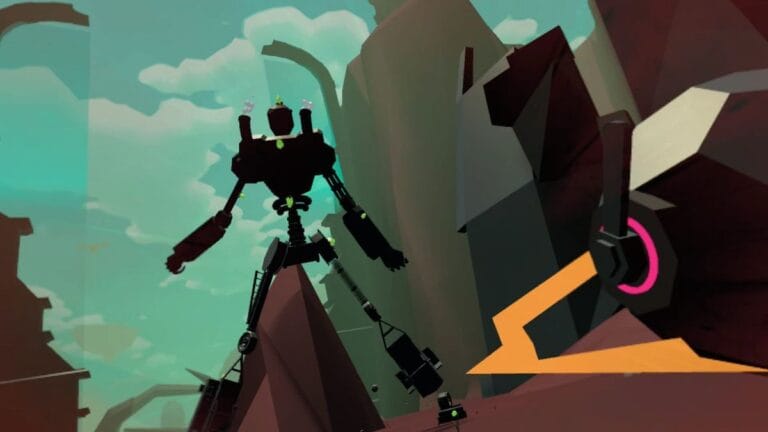
Giant encounters are the game’s narrative peaks. Rather than direct combat, you’re climbing the creature while it moves, thrashes, and attempts to dislodge you. A mid-game encounter with the Frost Titan requires you to reach its shoulder, plant an explosive charge in a specific weak point, and descend before detonation — all while the creature is actively trying to shake you off by rotating its body. Stamina management becomes critical; panic climbing wastes energy, and wasted energy means a 300-foot fall. There are difficulty spikes here — the third giant encounter scales sharply in complexity, and players who’ve been coasting on comfort settings will hit a wall. One late-game encounter requires three separate climbs with no checkpoints, and stamina doesn’t fully regenerate between phases. This is brutal by design, and while rewarding, it’s also a known source of frustration that patches have only partially addressed.
Story, World and Presentation
Among Giants’ narrative carries mythic weight without descending into pretension. You play as a nameless scout tasked with documenting why giants have returned to a world that forgot them. The setup is deliberately vague, and the game reveals lore through environmental storytelling, NPC dialogue, and journal entries scattered across the landscape. The story’s first act is strong — mystery, discovery, escalating stakes. The second act maintains momentum through increasingly dangerous giant encounters. The third act, however, loses narrative focus; character motivations become muddled, and the final revelation about the world’s transformation feels rushed. A 25-30 hour game shouldn’t feel like it needs 5 more hours of development in its final chapters, but Among Giants does.
The art direction is genuinely excellent. The game spans five major biomes — a verdant forest where vines substitute for climbing chains, a crystalline mountain range with geometric handhold patterns, a decaying industrial complex reclaimed by nature, a bioluminescent underground cavern system, and a storm-wracked coastal region. Each biome has a distinct visual language; the industrial zone uses rust-orange and steel-gray, while the cavern glows in purples and greens. The giants themselves are character designs worth noting. The Forest Titan is roughly humanoid, covered in moss and barnacle-like growths. The Leviathan-class creature you encounter in the coastal zone is a writhing, tentacled mass that feels genuinely alien. Character model fidelity varies — main NPCs are detailed and expressive, while generic creatures show obvious polygon shortcuts. This is acceptable for a VR title, but it’s noticeable.
The original soundtrack, composed by Olivier Derivière, is the game’s unsung MVP. The score shifts between ambient exploration themes (subtle, almost meditative) and intense orchestral swells during giant encounters. The Frost Titan boss theme uses discordant strings and deep brass that sync with the creature’s movements — when it roars, the music crescendos. Voice acting is professionally performed across the board. Your character’s companion, a grizzled veteran named Kess, is voiced by a performer who nails the balance between world-weary cynicism and genuine care for your survival. Main antagonist dialogue occasionally slips into melodrama, but it’s forgivable given the mythic tone.
Technical performance at launch is solid on most platforms. PlayStation VR2 maintains 90fps at 4K per eye with minimal frame drops in dense forest areas. Meta Quest Pro runs at 72fps with occasional dips to 60fps in the industrial biome’s particle-heavy sequences. HTC Vive Pro 2 is the sweet spot — consistent 90fps with the best visual fidelity. Valve Index users report similar performance to Vive Pro 2. Launch bugs were minimal — one reproducible crash when co-op players simultaneously triggered the same environmental interaction, patched within 48 hours. A few minor clipping issues exist where player hands can phase slightly into certain handholds, but these don’t affect gameplay. Overall, the technical foundation is sound.
Content, Length and Replayability
The main story campaign runs approximately 22-26 hours for a competent player, 28-30 for completionists who hunt all collectibles and optional encounters. Side content includes three optional giant encounters (each 30-45 minutes), a scavenging questline where you hunt rare materials across all five biomes, and environmental puzzles that reward exploration with lore entries and cosmetic unlocks. New Game Plus is confirmed post-launch but wasn’t available at review time; the developer has committed to a 60-day post-launch window for its release. Challenge modes are hinted at but unconfirmed. This is frustrating — the game launches with a single campaign difficulty (which can be adjusted mid-playthrough) and no explicit endgame loop. Players who finish the story have limited reasons to return immediately.
Co-op implementation is functional but limited in scope. Two players can tackle the campaign together, with both participating in climbing sequences and combat. The game doesn’t scale difficulty for co-op, meaning two players actually makes encounters easier — stamina doesn’t double, and enemies don’t multiply. This works narratively (Kess joins you as a second player in co-op mode), but it removes the tension of solo play. Co-op is best experienced as a second playthrough, not a first-time experience. The developer has stated that post-launch support includes seasonal cosmetics, new biome expansions (estimated Q3 2026), and additional giant encounters. The roadmap is transparent and publicly available, which is refreshing. Whether this roadmap justifies the $49.99 launch price depends on your tolerance for incomplete endgame content at release.
Flaws, Frustrations and Red Flags
The stamina system, while mechanically sound, punishes exploration-focused play. If you’re the type who likes to wander off the critical path, investigate every side room, and check all corners of a biome, your stamina will deplete faster than the game’s pacing expects. You can’t just “rest” in place — stamina only regenerates by standing still in safe zones, which breaks immersion and exploration flow. A player might spend 45 minutes exploring a forest biome, then attempt a mandatory climbing sequence with depleted stamina, fail repeatedly, and become frustrated. The system forces a specific playstyle: efficient path-finding or frequent safe-zone visits. This design choice isn’t broken, but it’s restrictive for sandbox-minded players.
Onboarding for new VR players is inadequate. The game’s first 90 minutes are genuinely punishing for anyone without 30+ hours of VR climbing experience. The tutorial explains mechanics clearly, but it doesn’t ease you into them. You’re immediately tasked with a 100-foot climb with a stamina bar that feels impossibly short. By minute 20, new players are frustrated. By minute 60, some have refunded the game. The developer has acknowledged this and promised an “assisted tutorial” mode in a patch, but at launch, Among Giants actively repels the exact audience it should be welcoming — people who want to grow into VR. A gentler ramp, even just 2-3 additional tutorial climbs of increasing height, would dramatically improve retention.
The narrative’s third act is a structural misfire. Without spoiling specifics, the final 4 hours introduce a plot twist that retroactively recontextualizes the entire story — which sounds compelling until you realize the execution is clumsy. Character motivations that felt consistent in acts one and two suddenly feel contradictory. A major character’s betrayal lands with zero emotional weight because the game hasn’t adequately foreshadowed it. The final giant encounter is mechanically excellent but narratively confusing. Players finish the game knowing what happened but not entirely understanding why, which breaks the emotional catharsis a 25-hour journey should deliver. This isn’t a dealbreaker, but it’s a significant stumble in an otherwise well-crafted narrative.
Comfort mode creates a secondary experience that feels incomplete. Players using comfort climbing miss approximately 40% of the game’s intended immersion — the physical exertion, the wind audio design’s emotional impact, the genuine vertigo of height. While comfort mode is necessary for accessibility, it’s presented as a full experience when it’s actually a compromise. The game doesn’t warn you of this adequately. A player might buy Among Giants for its immersive climbing, enable comfort mode due to motion sickness, and feel like they’re playing a hollow version of the intended game. The solution here isn’t to remove comfort mode (accessibility matters), but to be transparent: comfort mode is a valid way to experience the story, but not the optimal way to experience the core loop.
Verdict: Should You Buy Among Giants?
Among Giants is a bold, ambitious VR epic that achieves its core vision: making climbing a 400-foot giant feel genuinely dangerous, physically exhausting, and utterly unforgettable. The traversal mechanics are best-in-class for VR, the world design is thoughtful, and the moment-to-moment physicality is unmatched in the current VR landscape. However, the game demands a specific player type — someone with VR experience, a high pain tolerance for learning curves, and patience with a narrative that stumbles in its final act. At $49.99, Among Giants is premium-priced, and that’s justified for the core experience but not for the incomplete endgame content at launch.
Who should buy: Experienced VR players seeking a single-player narrative epic. If you’ve logged 50+ hours in Half-Life: Alyx, Pavlov, or other full-locomotion VR titles, and you own a PlayStation VR2 or Meta Quest Pro, Among Giants is essential. The climbing mechanics alone justify the purchase. Who should wait: Players with fewer than 20 VR hours, anyone sensitive to motion sickness, or those expecting a casual 5-10 hour experience. Wait for the New Game Plus and challenge mode updates (likely 60 days post-launch) before buying if endgame content matters to you. Who should skip: Anyone wanting short-session play, comfort-mode-only experiences, or games with forgiving difficulty curves. Among Giants is punishing by design, and that’s not a flaw — it’s a feature for the right audience and a dealbreaker for everyone else.
Score: 8/10 — Among Giants is a masterfully executed climbing experience with a compelling narrative that stumbles in its final act. For the specific player it’s designed for, it’s a must-buy; for everyone else, it’s a respectable but demanding alternative to more accessible VR titles. At $49.99 for 25-30 hours of core content, the price-to-value ratio is fair if you value mechanical depth over endgame variety, but wait 60 days for New Game Plus if replayability is your priority.
Recommendation: BUY (if you have 50+ VR hours and own a premium headset) | WAIT (if you’re new to VR or want confirmed endgame content) | SKIP (if you prefer casual or short-session gameplay)
Frequently Asked Questions
Is Among Giants worth buying in 2026?
Yes, if you’re an experienced VR player seeking an immersive narrative-driven epic. The climbing mechanics in Among Giants are industry-leading, and the giant encounters deliver genuine spectacle. However, the $49.99 price point is steep for a 25-30 hour campaign with limited endgame content at launch, so wait for post-launch updates (New Game Plus, challenge modes) if endgame replayability is critical to your purchase decision.
How long does it take to beat Among Giants?
The main campaign in Among Giants runs 22-26 hours for a competent player, 28-30 hours for completionists hunting all collectibles and optional encounters. Three optional giant encounters add an additional 2-3 hours if pursued. New Game Plus is confirmed post-launch but unavailable at review time, so total replayable content is currently limited.
Does Among Giants have multiplayer or co-op?
Yes, Among Giants supports two-player co-op throughout the entire campaign. However, co-op doesn’t scale difficulty — two players actually makes encounters easier than solo play. Co-op is best experienced as a second playthrough or for players who want shared narrative moments rather than a challenge-optimized experience.
What VR headsets support Among Giants?
Among Giants launches on Meta Quest Pro, PlayStation VR2, HTC Vive Pro 2, and Valve Index. PlayStation VR2 offers the best balance of visual fidelity and performance (4K per eye at 90fps). Meta Quest Pro runs at 72fps with occasional dips. Valve Index and HTC Vive Pro 2 deliver consistent 90fps with excellent visual quality. Standard PSVR1 and Quest 2 are not supported.
Does Among Giants cause motion sickness?
The full-motion climbing experience in Among Giants is inherently vertigo-inducing, even for VR veterans — this is intentional design. Players prone to motion sickness should enable comfort mode, which uses snap-to-handholds and smooth transitions, though this reduces immersion by approximately 40%. If you have severe motion sickness, start with the tutorial on comfort mode before committing to a purchase.
What is the minimum play space required for Among Giants?
Among Giants requires a minimum play space of 2m x 2m (6.5ft x 6.5ft) for comfortable full-motion climbing. A 2.5m x 2.5m space is recommended to avoid accidental controller strikes against walls during overhead reaching sequences. Comfort mode and teleport locomotion have smaller space requirements but compromise the core experience.
Can I play Among Giants solo or is co-op required?
Among Giants is fully playable solo, and solo play is the intended first experience. Co-op is optional and can be enabled at any point, with your companion Kess joining as a second player. The narrative is designed for solo play, and co-op actually makes encounters easier since difficulty doesn’t scale for two players.