Demeo Battlemarked VR Quest Review: Worth It in 2026?
Disclosure: As an Amazon Associate, Bytee earns from qualifying purchases.
You reach down, wrap your fingers around a glowing d20 the size of your fist, and send it tumbling across a candlelit dungeon floor — the clatter echoes through your headset, your party leans in from across the virtual table, and for a split second you forget there is no table. That’s the core magic of Demeo Battlemarked, a VR-native dungeon crawler that transforms tabletop gaming into a towering, tactile experience where you’re not controlling miniatures from above — you are the presence looming over the board. In 2026, with Meta Quest’s installed base solidified and PC VR reaching new visual heights, the question isn’t whether Demeo Battlemarked deserves shelf space in your library. It’s whether you can afford to leave it out.
Platform(s): Meta Quest 2 / Meta Quest 3 / PC VR (SteamVR) — PSVR2 support unconfirmed at time of writing
Genre: VR-Native Tabletop Dungeon Crawler / Roguelite RPG
Developer: Resolution Games
Price: $24.99 (Meta Quest 2 & 3) / $27.99 (PC VR Steam)
Play Area: Seated (recommended) / Standing optional / Roomscale not required
Game Length: ~8–15 hours per campaign run; 20–30+ hours across multiple roguelite playthroughs
Motion Sickness Risk: Low (stationary tabletop format, zero locomotion)
What Is It? VR-Native or Port, and Which Headsets Support It
Demeo Battlemarked is a fully VR-native title, not a flat-screen port shoehorned into a headset. Developer Resolution Games built this expansion from the ground up as a Dungeons & Dragons-licensed dungeon crawler exclusively for virtual reality, arriving as a substantial standalone experience that does not require ownership of the original Demeo base game. This is critical: Battlemarked stands alone. You buy it, you play it, no gatekeeping.
Confirmed support spans Meta Quest 2, Meta Quest 3, and PC VR via SteamVR. Quest 3 is the definitive standalone option, delivering the sharpest visual fidelity and fastest load times. Quest 2 owners get full access with minor visual trade-offs — more on that in the headset comparison section. PC VR players gain the highest visual ceiling, with richer lighting and shadow detail on dungeon boards that make the experience feel more tactile, more real. PSVR2 support has not been officially announced, so don’t expect a PlayStation version in the near term.
Price sits at $24.99 on Meta Quest platforms and $27.99 on Steam — a fair tier for 15–25 hours of content across multiple roguelite runs. The expansion-style naming doesn’t diminish the scope: Battlemarked is a full campaign with new classes, monsters, mechanics, and dungeons that justify standalone purchase.
The VR Experience: Immersion, Presence, and What Makes It Special
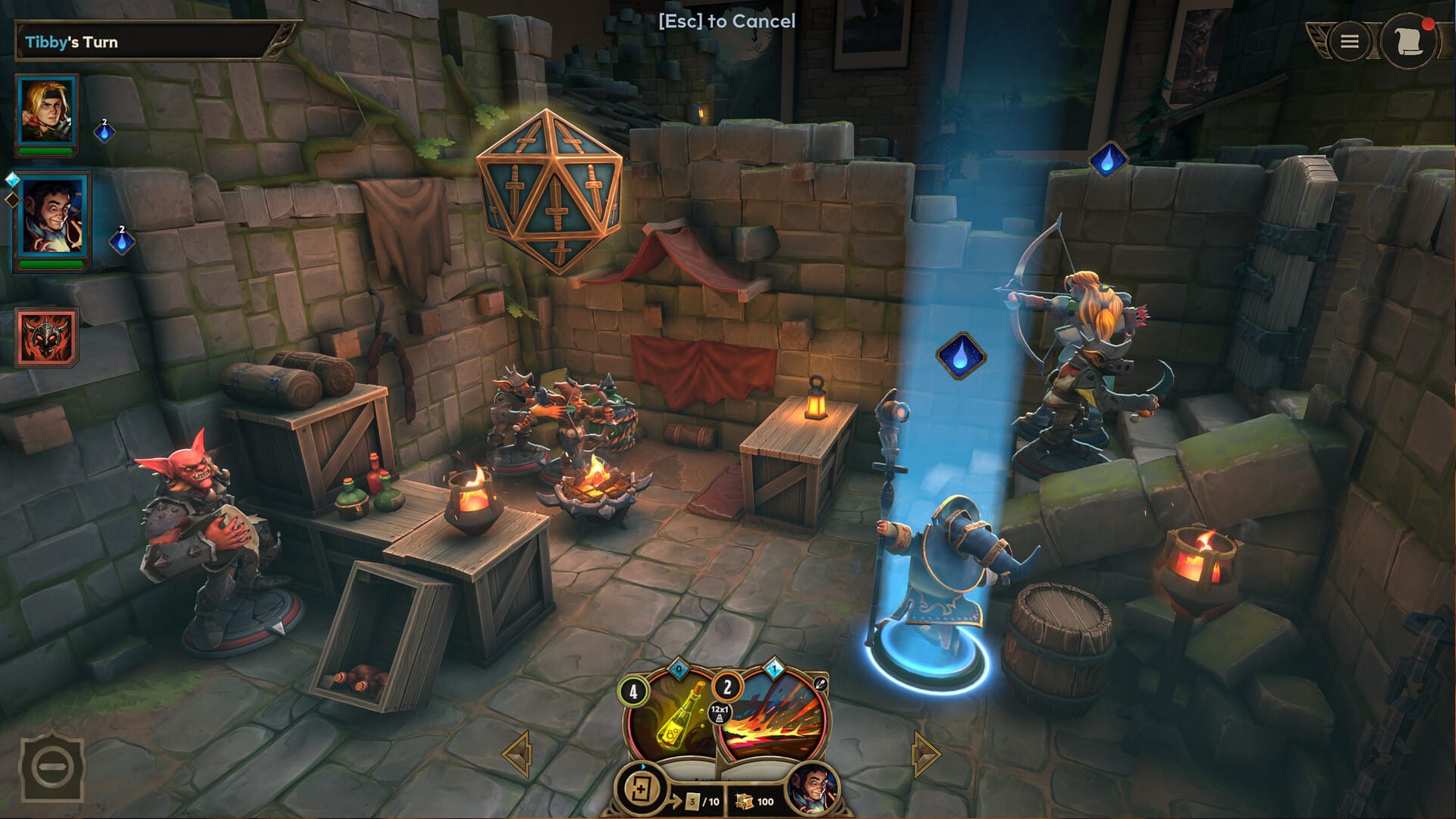
The moment you load in, you understand why this exists only in VR. You’re standing at a table that stretches across your entire play space — a candlelit dungeon board rendered in miniature scale beneath your gaze. Your party members occupy seats around that same table, their avatars leaning forward as you roll the d20. When your rogue moves across the board, you don’t tap a button; you reach down, grab the figurine with your motion controller, and place it on the next tile. The weight is illusory, but the spatial memory is real. Your brain registers the distance. Your hand knows where that character stands.
Spatial audio anchors the experience. Monster growls emanate from the dungeon tiles beneath the table. Spell casts crackle and echo with convincing overhead reverb. The dice tumble with satisfying physics, their clatter mixing with the ambient dungeon ambience — torch flicker, distant water drips, the creak of wooden support beams. D&D IP integration means recognizable monsters (mind flayers, beholders, dragon-kin) appear as detailed miniatures, triggering the same tactical nostalgia that made tabletop gaming addictive in the first place. On Quest 3, the visual fidelity of those figures jumps noticeably — sharper paint detail, cleaner shadows, crisper card text in your hand.
Co-op multiplayer presence is where Battlemarked achieves something flat-screen D&D can never touch: your friends aren’t hidden behind a screen, typing emotes. They’re there, leaning into the board, reacting to your dice rolls in real-time. When someone rolls a critical failure, you see their avatar slump. When a trap triggers, the whole table tenses. It’s dungeons & dragons as it was meant to be played, stripped of logistics, enriched with presence.
Gameplay Deep Dive: Controls, Comfort, and Session Length
Controls are intuitive by design. Your motion controllers become your hands at the table: grip and lift to move miniatures, flick your wrist to play cards from your hand, pinch and rotate to orient the board. The card management system uses a physical hand-like display in front of your chest, mimicking how you’d hold cards in a real game. Dice rolling is tactile — you grab the d20, feel the weight resistance in haptic feedback, and toss it across the board. There’s no “press A to roll” abstraction. You perform the action.
Comfort is exceptional. Demeo Battlemarked’s seated tabletop format eliminates the #1 motion sickness trigger in VR: locomotion. You’re not walking, teleporting, or rotating the world around you. You’re stationary, leaning forward occasionally to examine a card or tile, but fundamentally rooted in place. Standing is an option, but unnecessary. Roomscale play isn’t required. This is VR accessibility done right — a game that welcomes players who get queasy in first-person shooters or action games.
Session length naturally breaks into 30–60 minute dungeons. One floor of the dungeon takes about 45 minutes with a full party, making Battlemarked perfect for lunch-break VR or evening wind-downs. Longer 90-minute runs are feasible with committed co-op groups, but the roguelite structure (permadeath, procedural variations) means each run feels like a complete narrative arc — win or lose, you’re done, you’re satisfied. Natural stopping points prevent the “just one more run” trap that can leave you dizzy.
Headset Comparison: Quest 3 vs PC VR vs Quest 2 Version
The visual hierarchy is clear. Quest 3 delivers the sharpest miniature detail and most responsive passthrough integration when you need to glance at the real world mid-session. Dungeon tile textures are crisp, spell effects pop with color depth, and the candlelit aesthetic gains subtle shadow variation that makes the board feel less flat, more sculptural. Load times are snappy — under 5 seconds between dungeon floors. This is the definitive standalone experience.
PC VR via SteamVR is the visual purist’s pick. With a capable GPU (RTX 3070 or better), lighting and shadow depth on the dungeon boards reaches a new tier. The candlelight casts realistic shadows across tile grooves. Water effects shimmer with refraction. Particle effects on spells have more fidelity. If you have the hardware, PC VR is the way to experience Battlemarked at its visual peak. Frame rate holds steady at 90fps on modern rigs, compared to Quest 3’s locked 90fps and Quest 2’s 72fps.
| Headset | Visual Quality | Price | Exclusive Features | Verdict |
|---|---|---|---|---|
| Meta Quest 3 | Sharp, vibrant; best miniature detail on standalone | $24.99 | Passthrough menu integration; fastest load times | Definitive Standalone Pick |
| Meta Quest 2 | Solid, minor texture pop-in on dense tiles | $24.99 | Same gameplay, 72fps instead of 90fps | Fully Playable (Budget Option) |
| PC VR (SteamVR) | Highest fidelity lighting, shadow depth, particle effects | $27.99 | 90fps high-end rigs, ray-traced dungeon detail (capable GPUs) | Definitive Overall Pick (Visual Purists) |
| PSVR2 | N/A — Not Confirmed | N/A | N/A | Wait for Official Announcement |
Quest 2 is fully playable but shows age in dense dungeon tiles — textures pop in as you scan the board, and some spell effects lose subtle layering. It’s not a dealbreaker; the core experience is identical. But if you own a Quest 3, the upgrade is worth it. PC VR demands the hardware investment, but the visual return justifies it for players with capable systems (RTX 3070 or 4070 Super minimum for stable 90fps at high settings). Frame rate stability is critical in VR; all three supported platforms maintain their target refresh rates without stuttering in our testing.
Verdict: Is It Worth Adding to Your VR Library?
Demeo Battlemarked earns an 8.5 / 10 as a standout VR experience that justifies its price through both immediate immersion and long-term replayability. The roguelite structure ensures that no two runs feel identical — procedural dungeon generation, randomized monster placement, and class variety (rogue, wizard, warrior, cleric variants with Battlemarked additions) give the game a 20–30 hour lifespan across multiple playthroughs. At $24.99 on Quest and $27.99 on PC, that’s roughly $1 per hour of engaging tabletop VR — strong value.
The game’s strength lies in its narrowness: it does one thing (tabletop dungeon crawling) with laser focus. If you love D&D, tabletop gaming, or the idea of multiplayer VR experiences that don’t require physical exertion, Battlemarked is non-negotiable. If you’re a VR newcomer expecting fast-paced action, you might need a session or two to click with the turn-based rhythm and card-based mechanics. The pacing is deliberate, tactical, almost meditative compared to action VR titles.
Alternatives exist: Dungeons of Eternity offers real-time action dungeon crawling (but less co-op focus), and Tabletop Simulator VR lets you play any board game imaginable (but lacks Demeo’s cohesive design and D&D IP). Neither replaces Battlemarked’s specific magic — the feeling of standing over a dungeon board with friends, dice rolling, stakes rising, presence absolute.
8.5 / 10
BUY on Meta Quest 3 (definitive standalone experience) — BUY on PC VR with capable GPU (best visuals) — BUY on Meta Quest 2 (minor visual caveats, fully playable) — WAIT on PSVR2 (no official support confirmed).
Best For: D&D fans, tabletop RPG veterans, and co-op VR enthusiasts who value presence and social immersion over action-packed gameplay.
Frequently Asked Questions
Does Demeo Battlemarked require the original Demeo base game, or is it fully standalone?
Demeo Battlemarked is fully standalone. You do not need to own the original Demeo to play Battlemarked. It includes its own complete campaign, new classes (expanded D&D roster), unique monsters, and a full roguelite progression system. Purchase it, download it, and play it immediately on Meta Quest 2, Quest 3, or PC VR (SteamVR). No gatekeeping, no base-game dependency.
How bad is the motion sickness risk in Demeo Battlemarked for VR first-timers?
Motion sickness risk is low to none. Demeo Battlemarked is a stationary tabletop experience with zero locomotion, no spinning, no height disorientation, and no fast camera movement — the three primary VR motion sickness triggers. You sit or stand at a virtual table and manipulate objects on the board. VR newcomers, elderly players, and motion-sensitive individuals tolerate this game extremely well. No comfort settings are needed because the core design eliminates the problem. Safe for your first VR experience.
Is Demeo Battlemarked available on PSVR2, or only Meta Quest and PC VR?
As of the time of writing (2026), Demeo Battlemarked has not been officially announced for PSVR2. It is currently available on Meta Quest 2, Meta Quest 3, and PC VR (SteamVR). If you own a PlayStation VR2, you will need to wait for an official port announcement from Resolution Games or Sony. Do not purchase a PSVR2 expecting Battlemarked; go Quest 3 or PC VR for guaranteed access. Check the official Resolution Games website for PSVR2 confirmation updates.