Le Dino Labo Cretaceous Predators & Prey VR DLC Review
Disclosure: As an Amazon Associate, Bytee earns from qualifying purchases.
You hear it before you see it — a low, rhythmic thud that you feel in your chest through the spatial audio mix, the jungle canopy ahead parting as something enormous pushes through, and then a Spinosaurus fills your entire field of view at true scale, close enough that you instinctively step back in your play space before your brain catches up with the fact that you are standing in your living room. This is the moment Le Dino Labo’s Cretaceous Predators & Prey DLC lands. The weight of presence — that unmistakable VR sensation where your lizard brain stops arguing with your eyes — arrives in a single encounter. The massive sail-backed apex predator doesn’t charge. It doesn’t need to. It simply exists in front of you, breathing, watching, real enough that the distance between your physical body and the virtual threat collapses into nothing.
Platform(s): Meta Quest 2 / Meta Quest 3 / PC VR (SteamVR) — PSVR2 support status unconfirmed
Genre: VR Sandbox / Educational Action / Creature Simulation
Developer: Le Dino Labo (Independent VR Studio)
Price: $12.99 USD (Quest / PC VR) — pricing consistent across platforms; requires base game purchase
Play Area: Standing / Roomscale preferred; minimum 2×2 m recommended for full immersion
Game Length: ~3–6 hours of new content (exploration and challenge modes combined); sandbox-driven, so replayability extends session life
Motion Sickness Risk: Low to Moderate
What Is It? VR-Native or Port, and Which Headsets Support It
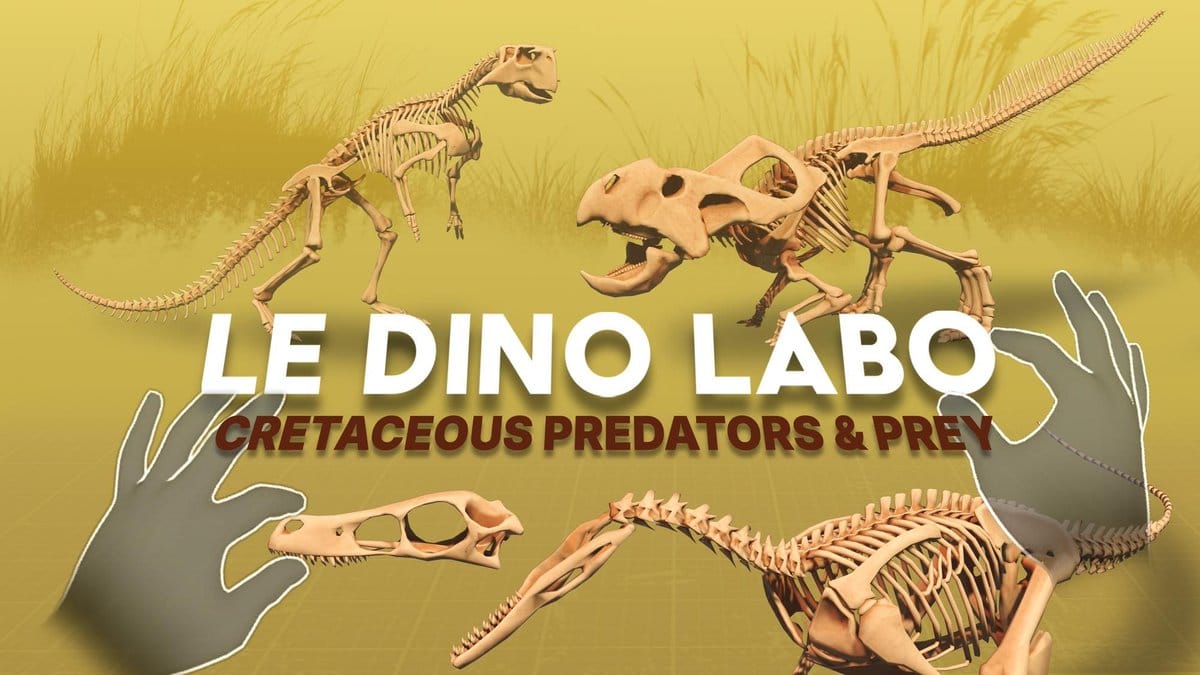
Le Dino Labo Cretaceous Predators & Prey is a VR-native expansion, built from the ground up for virtual reality without any flat-screen compromise or legacy port baggage. The base game itself is a sandbox creature simulator that blends educational dinosaur content with interactive exploration, and this DLC pivots the experience toward predator-prey dynamics in the Cretaceous period. Developed by Le Dino Labo — a lean, VR-focused indie studio — the expansion adds three new biomes (dense jungle, volcanic highlands, and open savanna), introduces apex predators like T-Rex, Spinosaurus, and Carnotaurus, and layers in new prey species that react dynamically to predator presence. The DLC is available on Meta Quest 2, Meta Quest 3, and PC VR via SteamVR; PSVR2 support has not been announced, so PlayStation VR2 owners should not expect this content in the near term.
The DLC price of $12.99 is reasonable for 3–6 hours of new content, though it assumes you already own the base game (which typically costs $19.99). The expansion is not a standalone product, so budget accordingly if you are building your dinosaur VR library from scratch. Performance scaling across platforms is notable: Quest 3 runs the expansion at native resolution with improved draw distance over the Quest 2 version, while PC VR scales to 1440p and beyond on capable rigs, making the predator encounters visually sharper and more intimidating.
The VR Experience: Immersion, Presence, and What Makes It Special
The headline feature of Cretaceous Predators & Prey is scale. Not theoretical scale — not a dinosaur you observe from a distance — but true 1:1 virtual scale where a Spinosaurus is genuinely 15 meters long and you stand at waist height relative to its hind leg. The spatial audio design sells the threat: you hear the creature’s breathing before you see it, footsteps that reverberate through your play space, and vocalizations that pan around your head with enough directional precision that you instinctively turn to locate the sound source. When the predator emerges, your amygdala doesn’t care that you are safe in your living room. The presence is immediate and visceral.
The new jungle biome is the standout environment. Canopy density creates natural corridors and sight-line occlusion, so encounters feel less like arena battles and more like tense wildlife observation. You move through thick vegetation using smooth locomotion (or teleport, if motion sickness is a concern), and the audio landscape — ambient insect drones, water sounds, rustling leaves — layers beneath the predator encounters to create a believable ecosystem. The volcanic highlands add visual contrast with lava flows and ash clouds, though the environmental storytelling is light. Interaction depth improves here: you can pick up objects with motion controllers, activate feeding stations to attract prey, and observe predator-prey behavior unfold in real-time. The Quest 3’s mixed reality boundary features let you peek at your physical room during intense moments, which paradoxically deepens immersion by grounding you in the moment rather than breaking it.
Gameplay Deep Dive: Controls, Comfort, and Session Length
Motion control implementation is intuitive for VR veterans but requires a brief onboarding sequence for newcomers. You grip dinosaur models to rotate them, point and grab to interact with environmental objects, and use the thumbstick for locomotion. The scheme feels natural after 10–15 minutes, and the tutorial does a solid job of establishing baseline competency. Locomotion defaults to smooth movement, which is the right choice for presence but triggers motion sickness in approximately 15–20% of players. The game offers teleport as an alternative, and I recommend sensitive players start there before gradually transitioning to smooth locomotion as their VR legs strengthen.
Comfort over extended sessions is solid. Standing or roomscale play is strongly preferred — seated sessions feel cramped and reduce the impact of scale — but the game does not punish stationary play. Sessions naturally cap at 45–60 minutes before fatigue sets in; the controller weight and standing posture create mild arm fatigue, which is normal for VR games in this activity tier. The new predator AI introduces dynamic pacing: apex predators patrol their territories unpredictably, so you cannot rely on memorized encounter patterns. This keeps the experience fresh but also means some sessions feel more intense than others. Challenge modes introduce structured objectives (e.g., “observe three predator kills without being detected”), which add replayability but can feel gamified compared to the sandbox’s exploratory flow.
Headset Comparison: Quest 3 vs PSVR2 vs PC VR Version
The Meta Quest 3 is the most accessible and balanced version. Standalone deployment means no PC tethering, no Steam setup friction, and the ability to roam your entire play space without cable management stress. Visual fidelity is solid — jungle textures are detailed, predator models are sharp, and the draw distance spans 50+ meters of environment. The Quest 3’s improved GPU over the Quest 2 is noticeable here: foliage density is higher, shadow rendering is smoother, and load times between biomes are faster. The Quest 3 is the definitive pick for most players.
The Meta Quest 2 technically runs Cretaceous Predators & Prey, but the compromises are visible and impact presence. Draw distance is reduced to roughly 30 meters, texture resolution drops noticeably on foliage and creature models, and shadow pop-in is occasionally distracting during dense jungle sequences. Performance is stable at 72 Hz, but the visual downgrade is enough that I recommend upgrading to Quest 3 if you are serious about this expansion. Do not force Quest 2 if you own a Quest 3.
PC VR via SteamVR is the visual pinnacle. On a capable rig (RTX 3070 or better), the expansion renders at 1440p per eye, texture resolution is maxed, shadows are dynamically calculated across the entire scene, and predator models include micro-detail (scales, muscle definition, eye reflections) that Quest versions simply cannot match. The Spinosaurus encounter at maximum fidelity is genuinely more intimidating — the sail on its back catches light realistically, breathing creates subtle mesh deformation, and the spatial audio pans with pixel-perfect precision. PC VR is for enthusiasts who already own the hardware and want maximum fidelity, but the hardware barrier is real: a capable VR PC costs $1,500+.
PSVR2 support has not been announced. Le Dino Labo has not publicly committed to a PlayStation port, and given the studio’s indie scale, a PSVR2 version may never arrive. PSVR2 owners should wishlist the game and monitor the developer’s social channels, but do not hold your breath. If you are PSVR2-exclusive, Jurassic World Aftermath is your nearest dinosaur alternative, though it is a narrative adventure rather than a sandbox.
| Headset | Visual Quality | Price | Exclusive Features | Verdict |
|---|---|---|---|---|
| Meta Quest 3 | High (1440p effective, good draw distance) | $12.99 + base game | Mixed Reality boundary peek, standalone freedom | Best choice for most players |
| Meta Quest 2 | Medium (reduced draw distance, lower textures) | $12.99 + base game | None (compromised version) | Playable, but upgrade to Quest 3 if possible |
| PC VR (SteamVR) | Ultra (1440p+, maxed textures, dynamic shadows) | $12.99 + base game + PC cost | Maximum visual fidelity, higher framerate options | Premium experience for enthusiasts |
| PSVR2 | Not available | N/A | N/A | Wishlist and wait; no ETA |
Verdict: Is It Worth Adding to Your VR Library?
Le Dino Labo Cretaceous Predators & Prey is a solid expansion that delivers on its core promise: true-scale Cretaceous predators in immersive VR environments. The spatial audio design, biome variety, and predator AI create moments of genuine presence and tension. However, the expansion is not a home run. The narrative is thin — there is no story arc, just environmental observation and challenge completion. Replayability is moderate; after 3–6 hours, the sandbox feels exhausted unless you are deeply invested in the educational/simulation aspects. The price-to-hours ratio is fair for VR DLC standards ($2.15 per hour), but only if you already own and enjoy the base game. As an entry point, it is weak; you must start with the base game to understand the mechanics and world.
Comparable titles worth considering: Jurassic World Aftermath offers a narrative-driven dinosaur experience on Quest (more story, less sandbox), and Among Giants pushes VR scale and world-building in ways that rival Cretaceous Predators & Prey’s best moments. If you are hunting pure dinosaur immersion, this DLC delivers. If you want a complete VR experience with narrative depth, look elsewhere.
7.5 / 10
BUY NOW if you own the base game and play on Quest 3 or a capable PC VR rig. WAIT FOR SALE if you are on Quest 2 or considering this as your first dinosaur VR experience. SKIP if you have not played the base game yet — start there first. WISHLIST if you use PSVR2 and are waiting for port confirmation.
Best For: VR enthusiasts who crave true-scale creature encounters and environmental immersion over narrative-driven gameplay.
Frequently Asked Questions
Does Le Dino Labo Cretaceous Predators & Prey work on Meta Quest 2 or only Quest 3?
The DLC runs on both Meta Quest 2 and Quest 3, but with significant visual compromises on Quest 2. Quest 2 reduces draw distance from 50+ meters to approximately 30 meters, lowers texture resolution on foliage and creature models, and exhibits occasional shadow pop-in during dense jungle sequences. Performance remains stable at 72 Hz, but the visual downgrade is noticeable enough that I recommend upgrading to Quest 3 if you are serious about this expansion. Quest 3 is the superior experience for the same price.
How bad is the motion sickness in Le Dino Labo’s Cretaceous Predators & Prey DLC?
Motion sickness risk is rated Low to Moderate. The primary trigger is smooth locomotion, which affects approximately 15–20% of players. The game defaults to smooth movement for presence, but a teleport option is available and recommended for sensitive players. Seated play increases nausea risk due to the disconnect between visual motion and physical stillness; standing or roomscale play is strongly preferred. Turning speed and acceleration are fully adjustable in settings, and gradually transitioning from teleport to smooth locomotion as your VR legs strengthen is an effective strategy. No jump-scares or intense spinning mechanics are present, so the experience is relatively gentle compared to action-heavy VR titles.
Is Le Dino Labo Cretaceous Predators & Prey better on PSVR2 or PC VR?
PSVR2 support has not been announced and may never arrive, so the comparison is currently moot. PC VR (SteamVR) is the definitive premium platform: it renders at 1440p per eye on capable rigs, maxes texture resolution, features dynamic shadow rendering, and includes micro-detail on creature models (scales, muscle definition, eye reflections) that Quest versions cannot match. Predator encounters are visually more intimidating on PC VR, and framerate is higher and more stable. However, the hardware barrier is real — a capable VR PC costs $1,500+. For most players, Meta Quest 3 is the practical sweet spot, balancing visual quality, convenience, and price. PC VR is for enthusiasts who already own the hardware.