Survive The Night VR Co-op Roguelite Review: Worth Buying?
Disclosure: As an Amazon Associate, Bytee earns from qualifying purchases.
Your hands are shaking — not you, exactly, but the virtual ones gripping a flashlight in the pitch-black corridor — and somewhere behind you, your co-op partner just stopped talking mid-sentence, and that silence in your headset is somehow the scariest thing you’ve experienced in VR all year. You can hear their breathing, labored and tense, through spatial audio that places them just over your left shoulder. Then: a sound. Not from the game world. From them. A sharp intake of breath. Your stomach drops. In Survive The Night VR, the horror isn’t just what’s hunting you in the dark — it’s the raw, unfiltered presence of another human being trapped in that darkness with you, their fear bleeding through the headset as tangibly as your own.
Genre: Co-op Horror Roguelite
Developer: Into Black VR (Resist, Into Black)
Price: $24.99 (Quest) / $29.99 (PC VR) — Cross-platform play supported
Play Area: Standing / Seated / Roomscale (min 2×2 m for optimal co-op)
Game Length: ~45–90 min per run / 15–30 hours for full roguelite progression
Motion Sickness Risk: Moderate (smooth locomotion in dark corridors; specific triggers noted below)

What Is Survive The Night? VR-Native Horror Roguelite From the Into Black & Resist Developers
Survive The Night is a ground-up VR experience from Into Black VR, the studio behind the atmospheric sci-fi horror Resist and the cult-classic Into Black. This isn’t a flat-screen port hastily strapped into a headset — it’s a roguelite built from the ground up for the unique affordances of VR, and that distinction matters profoundly. The game supports 2–4 players in cross-platform co-op (Quest 3, Quest 2, and PC VR via SteamVR; PSVR2 support is listed as “coming soon” but has not yet materialized). Solo play is available, though the game’s architecture and design clearly prioritize the co-op experience.
A typical run lasts 45–90 minutes depending on difficulty and player skill, with permadeath mechanics that reset your loadout but carry over permanent upgrades earned through a meta-progression system. The full roguelite experience — unlocking all survivors, weapons, and map variations — is estimated at 15–30 hours of play. On Meta Quest 3, Survive The Night retails for $24.99; the PC VR version via Steam runs $29.99. Cross-platform play is supported, meaning a Quest 3 player can team up with a PC VR player without friction, a rarity that elevates the game’s accessibility and longevity in the co-op space.
The VR Experience: Why Surviving the Night Feels Different in a Headset
What Survive The Night understands — and what separates it from flat-screen horror or even mediocre VR ports — is that true horror in VR is not about jump scares or grotesque visuals. It’s about vulnerability. The moment you’re standing in a pitch-black room with nothing but a flashlight beam, and your co-op partner’s breathing becomes audible through spatial audio, your nervous system stops recognizing the experience as a game. Your hands genuinely shake as you grip a virtual shotgun. Your eyes genuinely dart to check corners. When your partner goes silent, your heart rate genuinely spikes because you know they’re experiencing the same primal dread. This is presence in its rawest form — the headset dissolves away, and you’re simply two people in the dark.
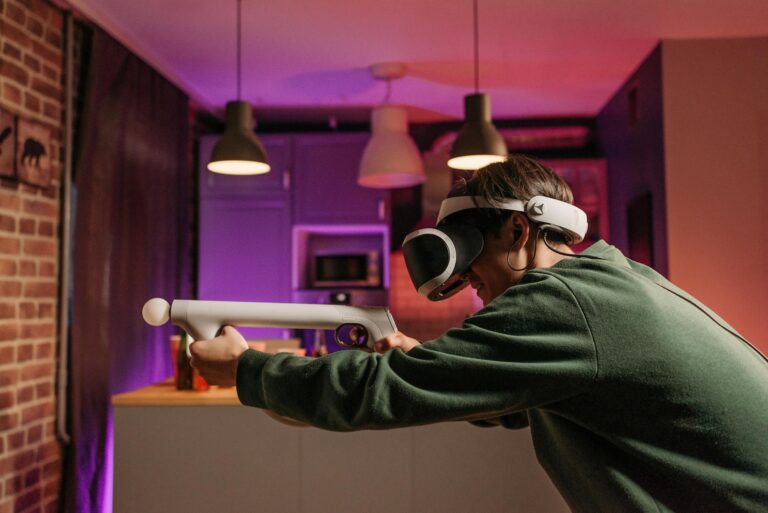
The standout VR mechanics amplify this presence in ways flat-screen horror cannot replicate. Grabbing weapons feels weighty and tactile — shotguns require two-handed stabilization with real arm positioning, pistols snap to your hip holster at waist height, and melee weapons demand genuine arm momentum and spatial awareness. Barricading doors is a collaborative, physical act: one player holds planks at shoulder height while the other secures them with nails, creating genuine interdependence and shared vulnerability. Most memorable is the communicative design: there’s no minimap, no UI callouts, no objective markers floating in your field of view. You must verbally coordinate with teammates, and in the dark, that human voice becomes your lifeline — callouts like “contact left” or “reload, covering you” carry real stakes because your survival depends on trust and communication. The visual fidelity on Quest 3 is respectable — sharp textures at native resolution, convincing shadow detail that creates genuine ambiguity in dark corners, and an art direction that privileges atmosphere and dread over raw polygon count. PC VR versions push lighting complexity and shadow cascades further, with volumetric fog creating tangible depth in narrow corridors, but the gap isn’t as severe as in many ports; Into Black VR clearly optimized for the headset-first experience rather than building for PC and downscaling.
Gameplay Deep Dive: Roguelite Loop, Motion Controls, Comfort, and Session Structure
The roguelite loop is tight and purposeful: each run begins with survivor selection (each with unique starting loadouts and passive bonuses), followed by procedurally-generated map progression through interconnected rooms. You scavenge for ammunition and consumables, build barricades, and defend against waves of hostile entities. Death is permanent for that run, but defeated enemies drop meta-currency that unlocks new weapons, survivors, and map tiles for future runs. The motion control scheme is exemplary — weapon handling is responsive and intuitive, resource gathering (picking up ammo boxes, crafting supplies) feels natural rather than fussy, and barricade building rewards spatial awareness without demanding precision-platforming. Co-op synergy mechanics shine here: one player can cover a doorway while another loots a room, or teammates can split into separate areas to cover more ground, creating genuine tactical depth. The physical act of drawing a shotgun from your hip, pumping it, and aiming down the barrel creates real muscle memory after an hour of play — your hands learn the motion, and your body responds instinctively when danger appears.
Comfort over extended sessions is where players need to calibrate expectations. The game uses smooth locomotion as the default, which is appropriate for VR horror (teleport breaks immersion) but can trigger mild motion sickness in players sensitive to first-person movement in dark environments. Sessions of 45–60 minutes are sustainable for most players; beyond 90 minutes, fatigue sets in and comfort issues compound. Teleport and hybrid locomotion options are available, though using them undermines the immersive horror design and removes the visceral tension of slow, deliberate movement through threat. Standing play is recommended for the full impact, though the game supports seated play with reduced roomscale navigation — seated play trades some spatial immersion but remains viable.
Headset Comparison: Quest 3 vs Quest 2 vs PC VR Versions of Survive The Night
The choice between Quest 3, Quest 2, and PC VR hinges on three factors: visual fidelity, convenience, and your existing hardware investment. On Meta Quest 3, Survive The Night runs at native resolution (2064×2208 per eye) with dynamic resolution scaling under load during intense combat. Lighting is convincing with sharp shadow boundaries, and the art direction translates seamlessly without compromise. The sense of scale in narrow corridors feels appropriately claustrophobic, and the darkness reads as genuinely opaque rather than murky. PC VR versions (via SteamVR on Valve Index, HTC Vive Pro, or equivalent) push visual complexity further: higher-resolution textures on environmental assets, more aggressive shadow cascades (multiple light sources casting realistic overlapping shadows), volumetric fog that creates tangible depth and distance cues, and denser environmental clutter that fills negative space. The difference is noticeable in side-by-side comparison — the PC version feels slightly more cinematic and detailed — but the Quest 3 version is not a visual compromise; it’s a deliberate artistic choice that prioritizes atmosphere over spectacle. Framerate stability is critical in horror; both versions maintain 90 fps consistently during co-op play, though PC VR has more headroom for intensive sessions without reprojection.
The practical advantage of Quest 3 is wireless co-op convenience: you can invite a friend, hand them a controller, and play within minutes. PC VR requires both players to have capable gaming PCs (RTX 2080 Super or better recommended), SteamVR setup, and stable network for cross-play, raising the barrier to entry significantly. That said, PC VR offers deeper customization (graphics settings, FOV tweaks, advanced audio options, mod potential) and better long-term visual futureproofing as GPU technology advances. Quest 2 can run Survive The Night, but with noticeable visual compromises: reduced texture resolution on distant assets, simpler shadow rendering (fewer cascades, less nuance), and occasional framerate dips (reprojection) during intense combat scenarios with multiple enemies. If you own a Quest 2, the game is playable and the core horror experience remains intact, but upgrading to Quest 3 or playing on PC VR is worth considering for the full sensory impact. PSVR2 support is listed as “coming soon,” but as of early 2026, no release date has been announced; don’t wait for it if you own another headset.
| Headset | Visual Quality | Price | Performance Notes | Verdict |
|---|---|---|---|---|
| Meta Quest 3 | Sharp at native res, convincing lighting, strong atmosphere | $24.99 | Consistent 90 fps; dynamic scaling under load; no PC required | Buy: Best all-around choice for most VR players |
| Meta Quest 2 | Reduced textures, simpler shadows, occasional reprojection | $24.99 | 90 fps baseline with framerate dips during intense combat; visual compromise is noticeable | Wait: Playable but not recommended; upgrade to Quest 3 or PC VR for the intended experience |
| PC VR (SteamVR) | Premium lighting, volumetric effects, higher texture detail | $29.99 | Consistent 90+ fps with capable GPU; maximum visual headroom; requires RTX 2080 Super or better | Buy: Best for visual enthusiasts and players with capable PCs |
| PSVR2 | TBD (pending release) | TBD | No release date announced as of early 2026 | Skip: Don’t wait; play on Quest 3 or PC VR now |
Verdict: Is Survive The Night Worth Adding to Your VR Library?
Survive The Night is a standout entry in the co-op VR horror space, and it earns a strong recommendation — with platform-specific caveats. The roguelite structure ensures long-term replayability, with procedural generation and meta-progression creating genuine reasons to return across dozens of runs. Content length versus price is favorable: $24.99 for 15–30 hours of co-op gameplay is a solid value proposition. The game’s greatest strength is its understanding of VR presence; it doesn’t rely on cheap jump scares or grotesque imagery, instead leveraging spatial audio, physical vulnerability, and human communication to create genuine dread. Your co-op partner’s breathing becomes the scariest sound in the room, and that shift from spectacle to presence is what makes Survive The Night memorable.
For players seeking alternatives, Demeo offers a similar co-op roguelite structure but leans fantasy-tactical rather than horror; Five Nights at Freddy’s: Secret of the Mimic provides horror atmosphere but is more puzzle-focused and single-player. Nothing quite matches Survive The Night’s synthesis of roguelite progression, co-op interdependence, and VR-native horror design. Into Black VR’s post-launch support history (both Into Black and Resist received meaningful content updates and balance patches over 12+ months) suggests Survive The Night will be actively maintained and improved post-launch. The studio has demonstrated commitment to their VR audience, which bodes well for long-term value.
Meta Quest 3 — Buy: Excellent value, wireless co-op convenience, solid visual fidelity. This is the definitive way to play for most VR enthusiasts. Standing co-op play with a trusted partner creates a memorable shared experience.
PC VR (SteamVR) — Buy: If you have a capable gaming PC (RTX 2080 Super or better) and value maximum visual fidelity, volumetric effects, and mod potential, the $5 premium is justified. Best choice for visual purists and players with high motion tolerance.
Meta Quest 2 — Wait: Playable but visually compromised; framerate dips during intense combat undermine horror immersion. Invest in a Quest 3 upgrade or play on PC VR instead for the intended experience.
PSVR2 — Skip: Support is pending with no release date announced. Don’t hold your breath if you own another headset; commit to Quest 3 or PC VR now.
Best For: Co-op VR players who prioritize immersion and genuine presence over spectacle; horror fans who want psychological dread and vulnerability, not gore; roguelite enthusiasts seeking a fresh genre application in VR; players with high motion tolerance and access to a co-op partner; standing play advocates who want a reason to move in VR.
Does Survive The Night work on Meta Quest 2, or is Quest 3 required for the best experience?
Survive The Night is available on both Meta Quest 2 and Quest 3 at the same $24.99 price point. However, Quest 3 delivers a noticeably better experience: sharper textures at native resolution, more sophisticated shadow rendering with proper cascades, and consistent 90 fps performance during intense co-op combat. Quest 2 can run the game but suffers from reduced visual fidelity, simpler lighting, and occasional framerate dips (reprojection) during enemy waves. If you own a Quest 2, the game is playable and the core horror loop remains intact, but upgrading to Quest 3 or switching to PC VR is worth considering for the full sensory impact. Cross-platform play is supported, so a Quest 2 player can co-op with a Quest 3 or PC VR player without technical friction.
How bad is the motion sickness in Survive The Night VR, especially during co-op sessions?
Survive The Night carries a moderate motion sickness risk, primarily due to its reliance on smooth locomotion in dark, narrow corridors — an environment that amplifies vestibular discomfort for VR-sensitive players. Specific triggers include: (1) smooth forward movement through pitch-black spaces with minimal visual reference points, (2) narrow corridor navigation where peripheral darkness creates vestibular confusion, and (3) sudden camera reorientation when turning to face threats. The game does offer teleport and hybrid locomotion options, but using them undermines the immersive horror design and removes the tension of vulnerable movement. Co-op play doesn’t inherently worsen motion sickness, but the social pressure to keep up with teammates can lead to overextended sessions beyond your comfort threshold. Mitigation strategies: play in a well-lit physical room to provide visual grounding, take 10–15 minute breaks between 45–60 minute runs, use hybrid locomotion if necessary (trading some immersion for comfort), avoid playing on an empty stomach, and keep your play area clear of obstacles. If you’re highly VR-sensitive, start with teleport locomotion and gauge your tolerance before switching to smooth movement.
Is Survive The Night from the same developers as Into Black, and does it feel like a spiritual successor?
Yes — Survive The Night is developed by Into Black VR, the studio behind both Into Black (2019) and Resist (2021). Into Black VR has established a reputation for atmosphere-first VR horror design, prioritizing presence and dread over technical spectacle. Survive The Night carries forward this philosophy but introduces significant structural changes: it’s a roguelite with co-op focus, whereas Into Black was a linear narrative experience and Resist was single-player puzzle-horror. The spiritual successor comparison holds strongest in art direction and audio design — the same careful attention to spatial sound, minimalist visual composition, and psychological horror that defined Into Black and Resist. However, Survive The Night’s roguelite loop, meta-progression, and co-op mechanics represent a notable departure from the studio’s previous work. If you loved Into Black’s atmosphere and Resist’s tension, Survive The Night will feel like a natural evolution, not a departure. The studio’s track record of post-launch support (both prior games received meaningful content updates over 12+ months) suggests Survive The Night will be actively maintained and improved.