Myst & Riven Remakes PSVR2 Review: Worth Buying in 2026?
Disclosure: As an Amazon Associate, Bytee earns from qualifying purchases.
You reach out and pull the lever — not click it, not press a button, but physically wrap your fingers around cold metal and feel the resistance push back through your PSVR2 Sense controllers — and the ancient mechanism groans to life around you, the entire island of Myst responding to your touch in a way no monitor ever made you believe it could. The fireplace door slides open. The sound of grinding stone reverberates through the headset’s spatial audio, positioning itself behind you, around you, inside the architecture itself. This is what Myst and Riven become in virtual reality: not just remakes, but resurrections. After three decades of pointing and clicking, you are finally there.
Platform(s): PSVR2 / Meta Quest 3 / PC VR (SteamVR) / Meta Quest 2
Genre: First-Person Puzzle Adventure
Developer: Cyan Worlds
Price: $29.99 USD per game (PSVR2 / Quest 3); $34.99 PC VR; slight regional variation
Play Area: Seated (primary) / Standing optional; no roomscale required
Game Length: Myst ~4–6 hours / Riven ~8–12 hours (puzzle-solving pace dependent)
Motion Sickness Risk: Low
What Are the Myst and Riven Remakes? VR-Native or Port, and Which Headsets Support Them
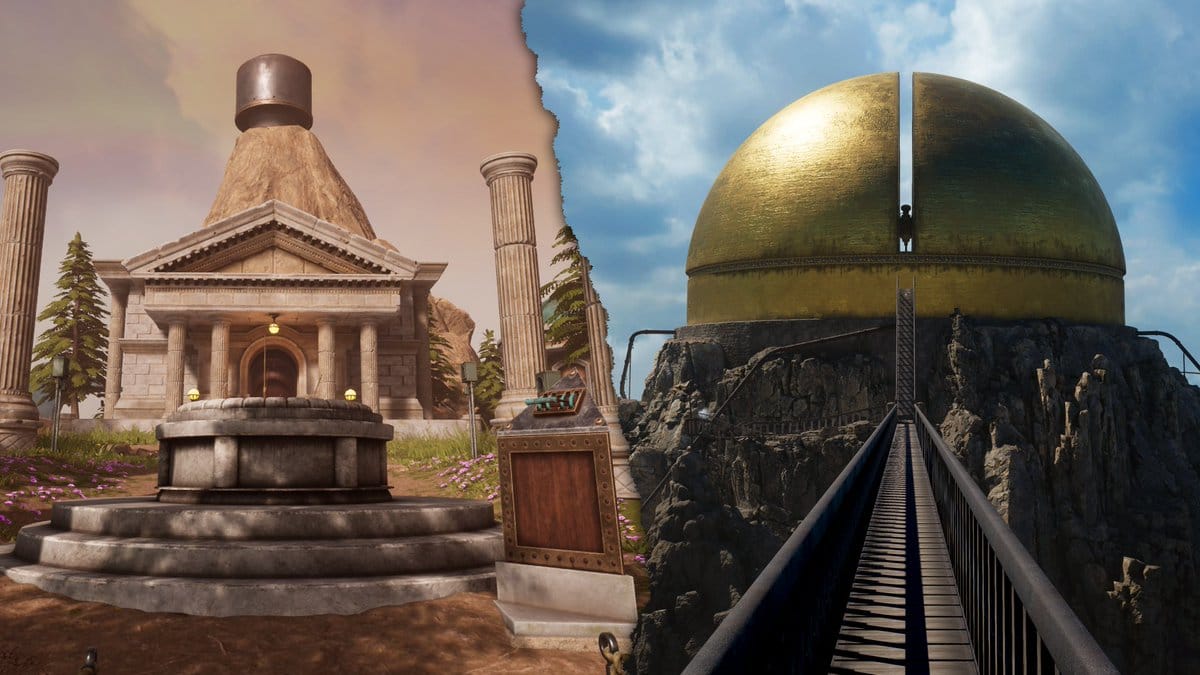
Cyan Worlds didn’t rebuild Myst (1993) and Riven (1997) from the ground up as VR-exclusive titles. Instead, they took their lovingly remastered flat-screen remakes and grafted full three-dimensional VR support onto them — a distinction that matters less than you’d think once the headset is on. The PSVR2 versions, launching this month, represent the newest platform arrival for both games, following successful debuts on PC VR (SteamVR) in 2023–2024 and Meta Quest 3 last year. The original Quest 2 versions exist but suffer noticeable visual downsampling; Quest 3 is the mobile option to consider. PC VR remains the high-fidelity ceiling for those with RTX 4070-tier GPUs or better.
Cyan Worlds’ VR credibility is solid — they developed Obduction, a puzzle-adventure that proved their philosophy works in immersive spaces. These aren’t lazy ports with bolted-on headset support. The games were engineered with VR interaction in mind: lever pulls have weight, puzzle mechanisms demand spatial reasoning, and the worlds scale to human proportions rather than remaining flat dioramas. Expect to spend 4–6 hours unraveling Myst’s Age-hopping mysteries and 8–12 hours in Riven’s brutal environmental logic puzzles, assuming you don’t consult a guide (and most players will, at some point).
The VR Experience: What Being Inside Age Island and Riven Actually Feels Like
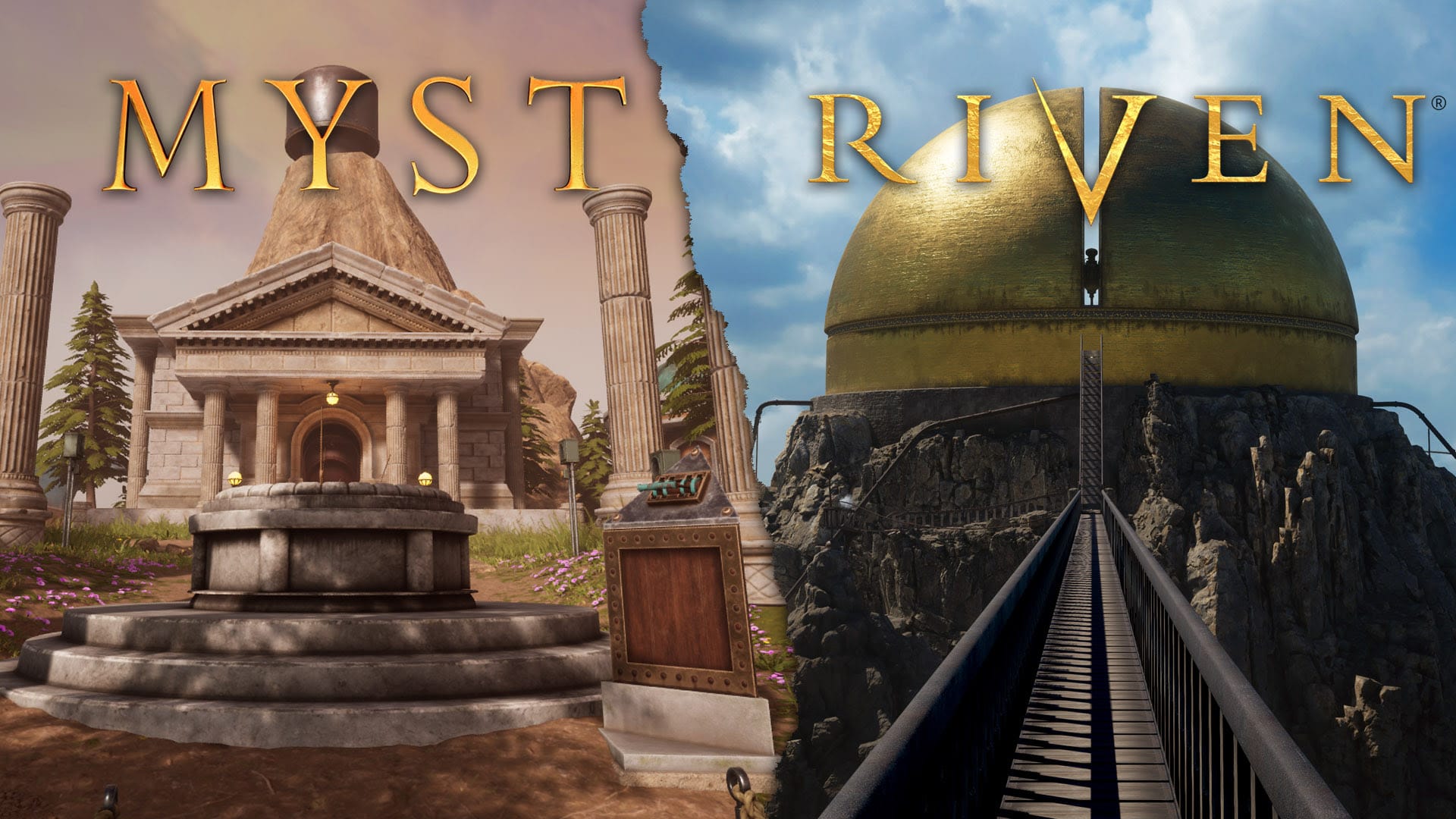
The Myst library, that iconic hub of still-frame artwork from 1993, becomes a tangible space. You stand inside it. The shelves loom at human height. The fireplace is a real corner of the room you can walk around, study from multiple angles, and approach close enough to feel the imagined heat. This transformation from diorama-clicking to embodied exploration is the core argument for VR — and it lands. Riven, already more visually ambitious than its predecessor, benefits even more profoundly from three-dimensional presence. The alien jungle doesn’t scroll past on a screen; it sprawls vertically above and below you, with bridges you can look down from and caverns that swallow you in shadow and spatial audio. A distant creature call doesn’t come from a speaker; it originates from a specific point in 3D space, making your chest tighten with genuine unease.
Spatial audio is the unsung star here. Myst’s subtle ambient soundtrack — that haunting harpsichord, the wind through stone — places itself in the environment rather than bathing you generically. In Riven, mechanical sounds pinpoint puzzle mechanisms across vast distances, guiding exploration without hand-holding. PSVR2’s HDR display and eye-tracked foveated rendering sharpen peripheral details — the texture of wood grain on a lever, the distant landscape beyond a window — without taxing the GPU. The most memorable VR moment in Myst is pulling that first lever and feeling the entire island shift. In Riven, it’s stepping onto a bridge suspended over a bottomless chasm and realizing your inner ear believes you’re standing on a ledge 300 feet high.
Gameplay Deep Dive: Puzzle Controls, Comfort Over Long Sessions, and Motion Sickness Risk
Both games employ point-to-point teleportation as the primary locomotion — you aim a reticle and snap to a new position. This is ideal for motion-sensitive players and eliminates the nausea vector entirely for most users. A smooth locomotion option exists on all platforms, but the teleport default is wise; Myst and Riven aren’t about fluid movement, they’re about deliberate positioning to examine puzzles. The PSVR2 Sense controllers’ haptic feedback transforms puzzle interaction from abstract clicking into tactile satisfaction. Pulling a lever produces subtle resistance; turning a dial has notches you feel in your fingertips; inserting a key clicks into place. This layer of haptic realism shouldn’t be underestimated — it deepens the “I solved this” dopamine hit considerably.
Comfort over extended play is excellent. Both games are cerebral, not kinetic. You’ll sit or stand in one spot for 15–20 minutes while solving a puzzle, then teleport to the next room. Sessions of 60–90 minutes are sustainable without eye strain or controller fatigue. The games naturally encourage breaks; you reach a logic wall, remove the headset, pace around, return refreshed. No combat, no fast movement, no heights-induced vertigo (though Riven’s bridges come close). Accessibility is genuinely high. The caveat: puzzle difficulty is unchanged from the originals. Riven especially is notoriously opaque — its alien logic puzzles have no in-game hints. New players without external guidance will hit walls. The VR immersion doesn’t make the puzzles easier to solve; it just makes the solving more tactilely rewarding.
PSVR2 vs PC VR vs Quest: Which Version of Myst and Riven Should You Play?
PSVR2 emerges as the best console VR option and rivals mid-range PC VR setups. The HDR display produces deeper blacks in Riven’s caverns and more vibrant colors in Myst’s ages. Eye-tracked foveated rendering keeps the peripheral vision sharp without sacrificing frame rate — a technical advantage neither Quest nor base PC VR can match. The Sense controller haptics are PSVR2-exclusive and genuinely add value. Load times from the PS5’s SSD are near-instantaneous; you teleport between puzzle chambers with negligible stuttering. The trade-off: PSVR2 is the priciest entry point if you don’t already own the headset ($549 US, often bundled with games). If you do own PSVR2, these remakes are the definitive console versions.
PC VR on SteamVR offers a higher resolution ceiling for high-end GPU owners (RTX 4070 or better can push 4K per eye at 90 Hz), but the price-to-performance ratio is steeper, and you’ll need $1,500+ in hardware. Quest 3 is the accessibility winner — $399, standalone, wireless to PC if desired — but the visual fidelity loss is noticeable. Environments feel slightly softer, textures less detailed, and the HDR advantage gone. Quest 2 should be skipped; the visual compromise is too severe for atmospheric games that live on environmental storytelling. Skip entirely if you’ve already played both games on PC VR or Quest 3 with no appetite for graphical polish; the puzzles are identical, and the solutions don’t change.
| Headset | Visual Quality | Price (Game Only) | Exclusive Features | Verdict |
|---|---|---|---|---|
| PSVR2 | Excellent (HDR, foveated rendering) | $29.99 | Haptic feedback, eye tracking, fast loading | 🏆 Best console option |
| PC VR (SteamVR) | Excellent (4K capable, high refresh) | $34.99 | Highest resolution ceiling, mod support | 🏆 Best for high-end GPU owners |
| Quest 3 | Good (lower resolution, no HDR) | $29.99 | Portability, wireless PC streaming | ✅ Best for accessibility |
| Quest 2 | Fair (significant downsampling) | $29.99 | None (older hardware) | ❌ Skip if possible |
Verdict: Are the Myst and Riven Remakes Worth Adding to Your PSVR2 Library?
Myst in VR is a 7.5/10 experience — beautiful, meditative, and worth the immersion upgrade if you’ve never played it. But at 4–6 hours for $29.99, the price-to-content ratio is tight unless bundled with Riven. The game’s age shows in pacing; long stretches involve reading notes and clicking through logic that feels slower in VR than it did on a flat screen. Riven is the stronger VR remake, a 8.5/10 that justifies its $29.99 price tag with 8–12 hours of genuinely challenging, spatially complex puzzle design. The alien architecture demands exploration; the environmental storytelling is world-class. Together, as a bundle, both games are worth the $59.98 investment for PSVR2 owners who crave slow, cerebral experiences and don’t mind the lack of combat or action.
Replay value is limited — puzzle solutions don’t randomize, and once you’ve solved Riven’s brutal logic, revisits are about atmosphere, not discovery. However, both games reward revisits months or years later; the worlds are dense enough that you’ll spot details you missed. If you own PSVR2 and love environmental storytelling, buy both. If you’re primarily an action VR player (Half-Life: Alyx, Contractors), wait for a sale. If you’ve already completed both games on PC VR or Quest 3 and have no interest in visual upgrades, skip entirely. For newcomers to these classics, VR is genuinely the best way to experience them — the sense of presence transforms pointing-and-clicking into embodied exploration.
Myst VR: 7.5 / 10
Riven VR: 8.5 / 10
Buy on PSVR2 if: You own PSVR2, haven’t played these games before, and want the best console VR versions. Wait for a sale if: You’re price-sensitive or prefer action-heavy VR games. Skip if: You’ve already played both on PC VR or Quest 3 with no appetite for graphical polish.
Best For: Puzzle enthusiasts and atmospheric adventure fans who value presence and environmental storytelling over action and speed.
Frequently Asked Questions
Do the Myst and Riven remakes work on standard PS5 without PSVR2?
No. The PSVR2 versions are VR-exclusive and require the PSVR2 headset. There is no flat-screen PS5 port of these remakes. If you want to play Myst or Riven on a standard PS5 with a TV, your only option is to purchase the original remastered editions on other platforms (PC, Mac, mobile) or the legacy versions available on GOG. The VR versions are built exclusively for headset play and cannot be downgraded to a flat-screen experience.
How bad is the motion sickness in Myst and Riven on PSVR2?
Motion sickness risk is extremely low — rated at 1–2 out of 10 for most players. Both games use point-to-point teleportation as the default locomotion method, which eliminates the primary nausea trigger (continuous movement through space). There is no spinning, no fast camera pans, and no heights-induced vertigo (though Riven’s bridges may cause mild psychological unease, not physical sickness). A smooth locomotion option exists for players who prefer it, but it can cause mild discomfort in sensitive users over extended sessions. Stick with teleport if you’re motion-prone. The games are among the safest VR experiences available, designed with accessibility in mind.
Are the Myst and Riven PSVR2 versions better than the Quest 3 versions?
Yes, PSVR2 is the superior console VR experience. The PSVR2 versions feature HDR color depth (Quest 3 lacks HDR), eye-tracked foveated rendering for sharper peripheral vision, and haptic feedback in the Sense controllers that Quest 3 cannot match. Load times are also faster due to the PS5’s SSD. Visually, textures are crisper, and environments feel more detailed. The trade-off: PSVR2 costs $549 US (if purchased separately), while Quest 3 is $399 and portable. If you already own PSVR2, buy these versions. If you don’t own either headset and want to play Myst and Riven, PSVR2 is the better choice for visual and tactile quality, but Quest 3 is the more budget-friendly entry point. PC VR (SteamVR) offers the highest visual ceiling for high-end GPU owners but requires $1,500+ in hardware.