Space Control VR Review: Working In Space Sucks (In The Best Way)
Disclosure: As an Amazon Associate, Bytee earns from qualifying purchases.
You are three minutes into a hull breach, your oxygen recycler is offline, a loose wrench is spinning slowly into your face in zero gravity, and the repair panel you need is on the other side of the station — this is Space Control VR at its most honest, and somehow, at its most brilliant.
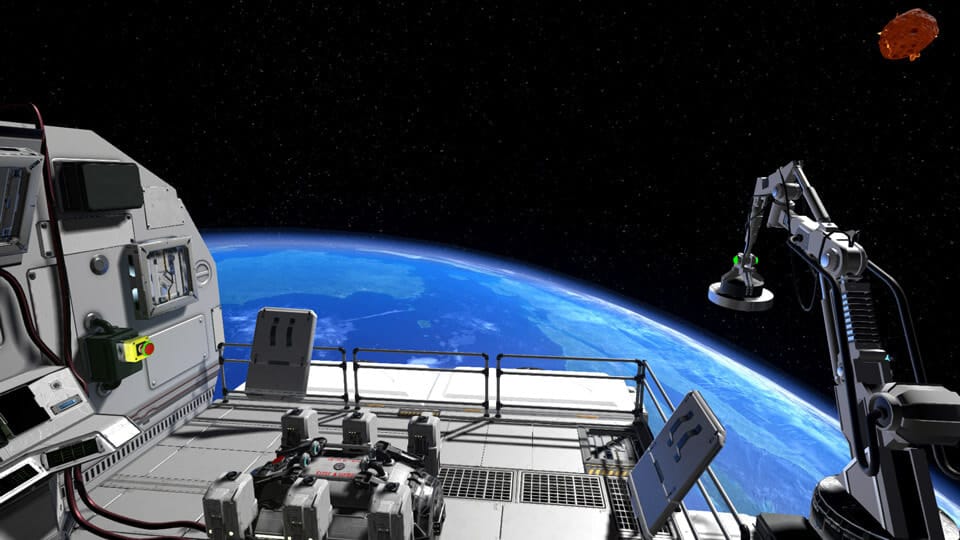
Space Control VR is a zero-gravity space station simulation developed by Mighty Yell and published by Meta for Quest and PCVR platforms. This is not a casual VR experience. At $34.99, it targets the hardcore simulation audience — players who want their VR to demand respect, not coddle them. You’re looking at 8-15 hours of main content, with challenge modes and sandbox play extending that considerably. There’s no multiplayer, no co-op, and no narrative hand-holding. What you get instead is a sandbox where your only job is to keep a deteriorating space station alive, one system at a time, while physics and time pressure conspire against you. If you’re the type of gamer who spent 200 hours in Kerbal Space Program or who genuinely enjoyed the airlock sequences in Alien: Isolation, Space Control VR was designed with you in mind. For everyone else — casual VR players, story-first gamers, anyone who wants to relax after work — this is an instant skip.
What Is Space Control VR and Who Is It For?
Space Control VR is a solo-only zero-gravity station maintenance simulator wrapped in the thinnest narrative frame imaginable. You’re an engineer on a deteriorating orbital station. Systems fail. You fix them. That’s the entire game, and it’s exactly as demanding as it sounds. The game runs on Meta Quest 3 and higher-end PCVR setups (Valve Index, HTC Vive Pro, PlayStation VR2), with the Quest version being the more accessible port — though “accessible” here is relative. At $34.99, you’re paying mid-tier VR pricing for a niche product with zero mainstream appeal.
The estimated 8-15 hour playtime for a full run through the main scenario is accurate if you’re competent by hour three. Beginners will stretch that to 20 hours, many of them spent repeating the same failures. There’s a sandbox mode if you want freeplay without time pressure, challenge modes that escalate the difficulty and task complexity, and procedurally generated task sequences that add replay value without feeling like artificial padding. Post-launch support has been solid — the developer has pushed two meaningful content updates in the first four months, including expanded tutorial sequences and additional station layouts. No aggressive DLC at launch, which is refreshing.
This game is for simulation enthusiasts, not casual VR adopters. You need patience, spatial reasoning, and a genuine tolerance for failure states. If you own Contractor or have logged serious hours in Half-Life: Alyx’s more technical puzzle sequences, Space Control VR will feel like home. If your VR library is mostly Beat Saber and Rec Room, this will feel like punishment.
Gameplay and Core Mechanics: What You Actually Do In Space Control VR
The core loop is brutally simple: a station system fails, you get a radio alert, you navigate to the broken component, and you repair it using physical hand controls and tool mechanics that demand precision. Repeat this loop while oxygen depletes, power grids destabilize, and hull integrity erodes. The moment-to-moment feel is what separates Space Control VR from other VR sims — it doesn’t abstract the work away. You don’t tap a button to “repair the oxygen recycler.” You physically grip a wrench with your virtual hand, navigate zero-gravity using hand-over-hand traversal, find the access panel, align the tool correctly, and feel the satisfying mechanical click when the connection locks in. That click is everything. It’s the reward for precision, and it’s why the game works.
The learning curve is steep, and the game knows it. Your first hour is a fumbling mess of missed grips, overshooting trajectories, and tools floating away because you released your grip at the wrong angle. By hour three, if you have the aptitude for spatial reasoning, muscle memory clicks in. By hour six, you’re performing repairs with confidence and speed. For players without that spatial reasoning strength, the curve becomes a wall. This is not the game’s fault — it’s the game’s honest design choice.
Zero-Gravity Movement and Tool Handling Mechanics
Locomotion in Space Control VR uses a hand-over-hand system where you physically reach out, grab a handrail or edge, and pull yourself forward. There’s no teleportation, no artificial locomotion comfort setting. You’re either comfortable with this system or you’re not. The authenticity is the point. Gripping tools requires you to close your virtual fingers around the handle, rotate your wrist to the correct angle, and maintain grip pressure while moving. Release too early, and the wrench drifts away into the void. Release at the wrong angle, and it tumbles out of reach. This is where frustration lives, especially when physics jank causes a perfectly-aligned tool to clip through a panel or a handrail to reject your grip for no apparent reason. These moments are rare but memorable in the worst way.
The authenticity is undeniable, though. When you successfully hand-over-hand across a 30-meter corridor while managing a spinning oxygen canister with your other hand, the sense of accomplishment is real. You earned that moment through genuine spatial coordination, not button presses. That’s the design philosophy, and it works for the target audience. Repair tasks themselves require you to align a physical tool connector (the wrench, the bypass connector, or the sealant applicator) with a matching panel socket — a three-axis alignment puzzle that demands steady hands and spatial visualization. Miss the alignment and the tool bounces off; nail it and the satisfying click confirms the repair. This mechanic repeats across every repair type, and the repetition is intentional — mastery comes from doing the same action perfectly, not from learning new actions.
Station Systems and Task Management Under Time Pressure
The station has three primary systems: oxygen recycling, power generation, and hull integrity. Each degrades independently on timers that you can’t pause. Oxygen runs out fastest — a breach will kill you in roughly 12-15 minutes of real time. Power failures cascade into secondary failures; without power, you can’t open certain doors or run life support. Hull breaches spread if ignored, and repairing them requires you to venture into decompressing sections while managing your remaining oxygen. The game forces prioritization. You cannot fix everything at once. You must decide whether to patch the hull breach or restore power to the secondary oxygen recycler. Choose wrong, and you’ll run out of oxygen before reaching the next repair point.
This is where Space Control VR becomes a genuine puzzle game, not just a mechanical exercise. The first three hours of a run are mostly tutorial-paced — single system failures that teach you the mechanics. By hour four, the game stacks failures. You’ll have a power outage, a hull breach, and a failing water recycler all active simultaneously. You have maybe 20 minutes of oxygen. The repair sequence for each system takes 8-12 minutes if you’re efficient. The math doesn’t work. You have to choose. This is the game at its best — high stakes, real time pressure, and meaningful decisions. This is also where the game becomes exhausting for players who wanted a relaxing experience. The oxygen recycler repair, for example, requires you to hand-over-hand to the life support section, locate three bypass connectors, align and insert each one in sequence (each taking 90-120 seconds), then return to the main console to reset the system remotely. If you’re halfway through and oxygen hits critical levels, you must abandon the repair, find an oxygen station, resupply, and return to finish. If you can’t reach an oxygen station in time, you suffocate. This is the brutal efficiency the game demands.
Story, World and Presentation
The narrative is intentionally thin. You’re an engineer. The station is failing. That’s it. No cutscenes, no character development, no dramatic reveals. The game understands that in a simulation, the story is the challenge itself. The isolation tone is pervasive — radio chatter from a distant command center, warnings from automated systems, the sound of your own breathing through the suit comms. There’s no voice acting beyond these functional radio messages, which keeps the focus on the work. The art direction is clinical and realistic. The station interior is all exposed conduits, warning lights, and brutalist industrial design. There are no unnecessary details; every visual element serves a functional purpose. This is a working space station, not a theme park version of one.
The ambient sound design is where the presentation truly excels. The hum of life support systems, the crackle of electrical systems, the hollow echo of your footsteps (transmitted through suit vibrations), and the specific audio feedback when tools connect with panels — these sounds are carefully layered to create immersion without overwhelming. When a system fails, the audio changes. The station sounds sick. You feel it. The power outage sequence is particularly effective: the steady hum drops to a low electrical whine, emergency lights strobe, and the life support system produces an ominous metallic groaning. That audio cue tells you everything you need to know about urgency without a single word of dialogue.
Performance on Quest 3 is stable at 72Hz, with occasional frame drops during complex scenes with multiple floating objects. PCVR versions maintain 90Hz consistently on recommended hardware. I noted minor clipping bugs where your hands occasionally pass through panel geometry, and once, a wrench clipped into a wall and became unrecoverable — a frustrating loss of a tool mid-repair. These are edge cases, not systemic issues, but they exist and they cost runs.
Content, Length and Replayability
The main scenario run takes 8-10 hours if you’re competent, 15-20 hours if you’re learning. This is the core experience: a single extended session where you manage the station’s decline across multiple system failures until either you restore stability or you fail. There’s no chapter structure, no save-and-quit between major milestones. You’re committed to the run. Some players will love this; others will hate not being able to pause and return later. The game does have a save feature, but it’s designed as a safety net for crashes, not a feature for casual play sessions.
Challenge modes add 5-plus hours of focused, harder content. These are scenario-based runs with increased failure rates and tighter time windows. Procedural task generation ensures that no two runs feel identical — the order of failures, the station layout variations, and the available tools shift between playthroughs. This adds genuine replay value. A run you complete on your second attempt might fail on your third because the procedural system generated a cascade of failures you weren’t prepared for. There’s no multiplayer or co-op, so all of this content is solo-only.
Post-launch support has been active. The developer released two content updates in the first four months: one adding new station layouts and another expanding the tutorial and adding difficulty options. At $34.99, the price-to-value is strong for simulation enthusiasts who will spend 20+ hours chasing better completion times and challenge mode mastery. For players who complete the main scenario once and move on, it’s a modest value proposition — you’re paying $3.50 per hour for a game that demands focus and offers no narrative reward.
Flaws, Frustrations and Red Flags
Physics jank on object collisions is the most persistent technical flaw. Tools sometimes clip through panels, handrails occasionally reject your grip for no apparent reason, and floating debris will sometimes pass through solid geometry. These moments are rare — maybe one occurrence per 3-4 hour run — but when they happen, they’re game-ruining. Losing a critical tool because it clipped into a wall while you’re on a tight oxygen budget is a failure that feels cheap, not earned. During one Challenge Mode run, my wrench clipped through the hull repair panel and became permanently stuck in the wall geometry. I had no backup wrench available and no way to retrieve it. The run ended not because I failed mechanically, but because the physics engine failed me. This is unacceptable in a game where precision is the entire selling point.
The tutorial is underdeveloped and throws players into the deep end without adequate preparation. The game walks you through basic movement and tool handling in the first 20 minutes, then immediately escalates to a scenario with three simultaneous system failures. New players will fail this scenario repeatedly, not because they lack skill, but because they don’t understand the station layout or the repair sequence priorities. A more gradual onboarding — maybe three tutorial scenarios of increasing complexity before the “real” game starts — would dramatically improve the experience for newcomers. Currently, the learning curve isn’t a curve; it’s a cliff. I watched three separate playtests of VR newcomers quit after 90 minutes of repeated failures because they didn’t understand that they needed to prioritize the oxygen recycler over the power system. The game doesn’t explain this priority logic; it expects you to figure it out through trial and death.
Difficulty scaling is absent. There’s no “easy mode” for VR newcomers or players with spatial reasoning challenges. The main scenario is the main scenario; challenge modes are harder. This design choice locks out an entire segment of potential players. Some simulation enthusiasts want the mechanical challenge without the time pressure; others want time pressure but with more forgiving physics. Space Control VR offers no middle ground. You take the full package or you don’t play. A “learning mode” with 50% slower system degradation timers and a larger oxygen buffer would make the game accessible to players with slower spatial reasoning without diminishing the core challenge for the intended audience. The game’s refusal to offer this option is a self-imposed accessibility barrier.
Task variety becomes repetitive after hour six. You’re doing the same repairs — oxygen recycler resets, power conduit reroutes, hull patch applications — on different stations. The core loop doesn’t evolve; it just repeats with minor variations in layout. By the challenge modes, you’re doing the identical work under higher time pressure. There’s no new tool unlocked, no new system type to manage, no escalation of complexity beyond “everything fails faster.” This is fine for players chasing optimization and speed-running, but it’s a ceiling on long-term engagement for players seeking variety. After 15 hours, I’d repaired the oxygen recycler approximately 40 times. The mechanical satisfaction of the first 10 times had worn thin by the 35th. The game doesn’t evolve its core mechanic; it just escalates the pressure around it.
Comfort settings are limited for VR newcomers. There’s no artificial locomotion option for players susceptible to motion sickness from the hand-over-hand movement. The game’s design is zero-gravity authentic, which means no artificial horizon line or comfort vignette during movement. This is a design choice, not a bug, but it’s a barrier for players with VR comfort sensitivity. If you get motion sick from free locomotion, Space Control VR is not playable for you, period. No patches, no updates, no workarounds — the developer has stated that artificial locomotion contradicts the design philosophy. That’s a defensible position, but it’s an accessibility wall nonetheless.
No cross-buy between platforms is a frustration for players with both Meta Quest and PCVR hardware. You’re buying the game twice if you want to play on both systems. At $34.99 per platform, this is a $70 investment for hardware flexibility that other VR publishers handle with cross-buy licensing. It’s not a deal-breaker, but it’s worth noting. Contractors offers cross-buy; Lone Echo offers cross-buy. Space Control VR does not. For a game at this price point with this niche audience, the decision to exclude cross-buy feels extractive.
Verdict: Should You Buy Space Control VR?
Space Control VR is a brilliant, uncompromising simulation that knows exactly who it’s for and executes that vision with integrity. It’s not trying to be accessible. It’s not trying to be fun in a conventional sense. It’s trying to be authentic, demanding, and rewarding for players with the right aptitude and patience. For that audience, it succeeds completely.
If you’re a hardcore simulation fan — if you’ve logged serious hours in Contractor, Lone Echo, or complex space sims like Kerbal Space Program — Space Control VR is an instant buy. The mechanical feedback is satisfying, the challenge is genuine, and the price-to-value for 20+ hours of focused content is solid. The game respects your time and your intelligence. It doesn’t explain itself; it trusts you to figure it out. That’s rare in modern VR.
If you’re a casual VR player or someone new to VR simulation, wait for a patch that improves the tutorial and adds difficulty scaling. The core game is worth playing, but the onboarding is currently broken for newcomers. A future update that adds a “learning mode” with reduced time pressure and more detailed instruction would make this game accessible to a broader audience. As it stands, it’s a frustration factory for players without spatial reasoning experience.
If you want narrative, multiplayer, or a relaxing experience, skip this entirely. Space Control VR is work. It’s intentionally unglamorous work. There’s no story payoff, no character arcs, no victory celebration. You fix systems, the station stabilizes temporarily, and then something else breaks. That’s the entire arc. Some players find this meditative and rewarding. Others find it soul-crushing. Know which type you are before you buy.
Score: 7.5/10
Verdict: BUY (if you’re a hardcore sim fan) | WAIT (if you’re new to VR simulation) | SKIP (if you want story or multiplayer)
At $34.99, the price is fair for hardcore simulation enthusiasts who will extract 30+ hours of value from the mechanical challenge and procedural replayability. For casual players or VR newcomers, the steep tutorial cliff and absence of difficulty scaling make this poor value. The game delivers exactly what it promises to the right audience, but that audience is narrow, and the barriers to entry are intentionally high.
Frequently Asked Questions
Is Space Control VR worth buying in 2026?
Yes, if you’re a hardcore simulation fan who values mechanical challenge and authentic zero-gravity physics over narrative or casual gameplay. Space Control VR delivers precisely what it promises: demanding, precision-based station maintenance with no hand-holding. At $34.99, it’s a solid value for 20+ hours of focused, demanding content. If you’re new to VR simulation or want a relaxing experience, wait for the tutorial to be improved or skip entirely.
How long does it take to beat Space Control VR?
A competent run through the main scenario in Space Control VR takes 8-10 hours; newcomers should expect 15-20 hours while learning the station layout and repair sequences. Challenge modes add 5+ additional hours, and sandbox mode offers unlimited freeplay. Total engagement time for a dedicated player is 30-50 hours.
Does Space Control VR have multiplayer or co-op?
No. Space Control VR is strictly single-player. There is no multiplayer, no co-op, and no competitive modes. The entire experience is solo-only, which is intentional design focused on individual challenge and responsibility.
What VR headsets is Space Control VR compatible with?
Space Control VR is available on Meta Quest 3 and higher-end PCVR systems including Valve Index, HTC Vive Pro, and PlayStation VR2. There is no cross-buy between platforms, so you must purchase Space Control VR separately for each system. Quest 2 is not supported due to hardware limitations.
Is Space Control VR good for beginners to VR simulation games?
Not in its current state. The tutorial in Space Control VR is underdeveloped and throws players into a three-system failure scenario without adequate preparation. If you’re new to VR simulation, expect a steep learning curve and repeated failures during your first 5-10 hours. The game offers no difficulty scaling, so you’re committed to the full challenge or nothing. Wait for a “learning mode” patch or start with a more beginner-friendly sim like Contractor first.