Excurio VR Review: The Most Ambitious VR Locations Yet?
Disclosure: As an Amazon Associate, Bytee earns from qualifying purchases.
You are standing inside the Colosseum at golden hour — not a painted backdrop, not a skybox trick — and when you reach out and drag your fingertips along the eroded stone of a 2,000-year-old archway, something in your brain refuses to fully accept that you are still in your living room. The light catches the weathered travertine exactly as it would in person. A flock of pigeons scatters near the upper tiers. You can hear the distant murmur of the city beyond the walls. This is Excurio VR, and it’s a meticulously reconstructed exploration experience that proves virtual tourism can rival physical travel for cultural immersion—if you know what you’re buying.

What Is Excurio VR and Who Is It For?
Excurio VR is an exploration-first immersive experience developed by Excurio Studios, available on Meta Quest 3, Quest Pro, and PC VR platforms via SteamVR. The base experience costs $24.99 USD with no free tier or trial option. There is no narrative campaign, no boss battles, no score multiplier—just you, photogrammetry-accurate reconstructions of six world heritage sites, and the freedom to move through them at your own pace. Additional location packs are planned for 2026 at $8.99-$12.99 each or through a season pass model (pricing not yet finalized).
This is a game built for the curious mind, not the action seeker. If you’ve ever stood in front of the Taj Mahal or walked the narrow streets of Petra and wished you could pause and study every stone, Excurio speaks directly to that impulse. It’s equally welcoming to someone experiencing VR for the first time—there is zero combat, zero time pressure, zero failure states—and simultaneously detailed enough to reward VR veterans who want to maximize hand-tracking precision and spatial audio design. Solo exploration is the default; optional asynchronous multiplayer lets you leave breadcrumb markers for friends or see their exploration paths overlaid on your own visit.
The target player is the cultural explorer, the armchair archaeologist, the person who reads museum plaques and watches architectural documentaries. If your VR library is dominated by action games and competitive shooters, Excurio will feel like a deliberate genre shift away from what you’re used to. That’s intentional. This game respects your intelligence; it assumes you came to *experience* something, not to grind or compete.
Excurio VR Locations Gameplay: What You Actually Do
The core loop is deceptively simple: you arrive at a location, you move through it using smooth locomotion or teleportation (both equally viable, no penalty for switching), you interact with objects and architectural features, and discoveries reward you with contextual information delivered through subtle UI highlights and optional expert narration. Within your first five minutes, you’ll understand the core interaction model: pointing at objects with your hand triggers interactive highlights; pulling your hand backward activates a detail-view zoom that lets you inspect carved Latin numerals on stone blocks, marble inlay patterns, or weathered inscriptions up close.
The mechanical depth emerges in object manipulation. When you grab a stone block at the Colosseum, it doesn’t simply highlight and disappear. Haptic feedback simulates the weight of ancient masonry; you can rotate it in your hands to read carved numerals or maker’s marks; releasing it snaps back into place with physics-accurate momentum. Audio hotspots are spatially anchored throughout each location—stand near a particular archway at the Colosseum and you’ll hear ambient crowd noise, vendors calling, and the clash of gladiatorial combat echoing across centuries. The environment teaches itself through experimentation rather than tutorial pop-ups or quest logs. There is no checklist telling you what to do next; instead, the architecture itself whispers: *look closer, try this, listen here*.
Two exploration modes exist: Guided mode offers optional narration from expert historians who provide historical framing for what you’re seeing; Freeform mode strips this away entirely, leaving you alone with your observations and ambient soundscapes. This flexibility is crucial—families with children can use guided mode for education, while solitary explorers can use freeform mode for meditative presence without interruption. You can switch between modes within a single visit without restarting.
The discovery system tracks what you’ve found across visits but never forces completion. The first time you visit the Taj Mahal, you might notice the main dome and minarets. On a second visit, you might focus on the garden geometry and water channels. A third visit might reveal calligraphy and inlay work you overlooked before. There’s no achievement checklist nagging you to optimize or collect everything—this is genuinely player-driven exploration, not a hidden-object hunt.
Location Design & Interactive Systems
Excurio launches with six flagship locations: the Roman Colosseum, Petra in Jordan, Machu Picchu in Peru, the Great Wall of China, the Taj Mahal, and the Palace of Versailles. Each location has distinct mechanical flavor that prevents exploration from feeling repetitive. The Colosseum rewards vertical exploration—climbing to upper tiers reveals layered architectural history and changes your perspective on the structure’s original 50,000-seat capacity. You can inspect the hypogeum (underground chamber system) where gladiators and animals were held before combat; the game renders this space with historically accurate reconstruction based on archaeological surveys.
Petra demands careful navigation through narrow canyon systems; the game’s object-based spatial audio design makes wind howl differently depending on which canyon you’re in, creating a genuine sense of navigation challenge without combat pressure. You can trace water channels carved into stone, examine carved facades at different angles, and discover hidden tombs tucked into cliff faces that aren’t immediately obvious from the main path. Machu Picchu introduces puzzle-like environmental interaction: certain stone arrangements can be “unlocked” by positioning yourself at specific viewing angles, revealing hidden terraces or agricultural sections. The Great Wall stretches across vast distances, offering both intimate close-up exploration of specific watchtower sections and sweeping vistas that let you comprehend the structure’s continental scale.
Versailles emphasizes symmetry and spatial memory—you’ll begin to recognize patterns in the gardens and use them as mental landmarks for navigation. The Palace of Versailles reconstruction includes the Hall of Mirrors with mathematically accurate perspective lines, the Orangerie gardens, and the Grand Canal. The Taj Mahal’s marble inlays reflect light at angles consistent with real marble optics; you can examine semi-precious stone inlays up close to understand the original craftsmanship. What prevents repetition is that each location has genuinely different interactive systems. You’re not pointing and clicking at six similar buildings; you’re learning six different ways to read architecture, six different historical contexts, six different ambient soundscapes.
Presentation, Performance & Technical Execution
Excurio VR has no traditional narrative structure—no protagonist, no antagonist, no three-act story arc. What it does have is *framing*: a subtle philosophy baked into every design choice. Optional narration, written by historians and cultural experts, frames each location as a living archive of human ambition and engineering. The narration respects your intelligence; it never over-explains, never condescends, never assumes you don’t know what a flying buttress is. Voice acting is professionally produced—guides sound like actual experts, not voice actors pretending to be experts.
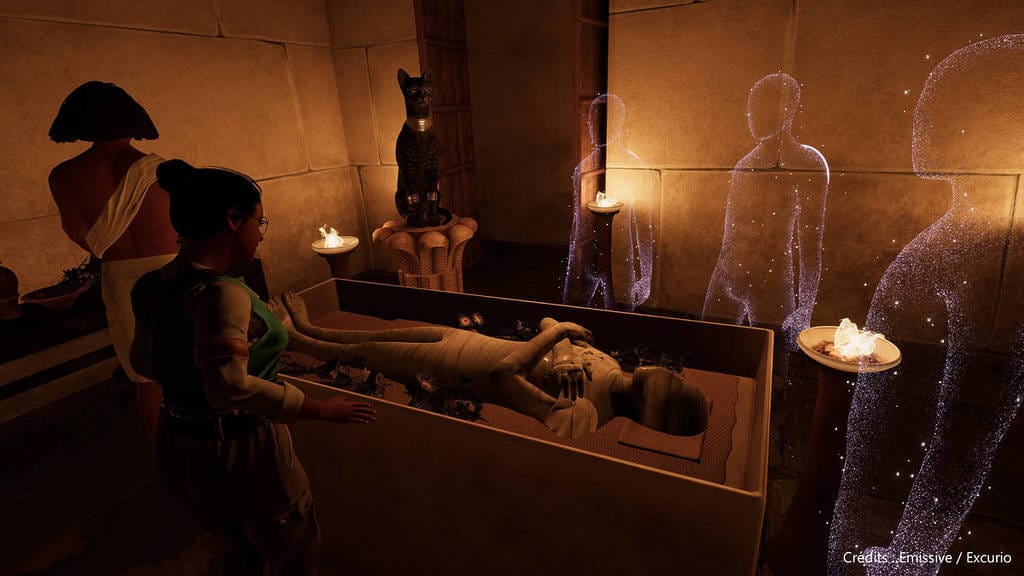
World design ambition is genuinely impressive. These aren’t stylized interpretations of famous locations—they’re meticulously reconstructed using satellite data, architectural surveys, and laser-scanned point clouds of the actual sites. The Colosseum’s stone weathering patterns match photogrammetry data from on-site scanning. The Taj Mahal’s marble surfaces reflect light at angles consistent with real marble optics. When you stand in Versailles and look down the Hall of Mirrors, the perspective lines are mathematically accurate to the original architecture. This level of fidelity isn’t eye candy; it’s respect for the source material.
Spatial audio is a standout technical feature. Excurio uses object-based audio rendering—sounds are anchored to specific locations in 3D space rather than simply stereo-panned. When you hear a bird call at Machu Picchu, it comes from a specific point above and to your left, not from your headset. This creates an uncanny sense of *being there* that traditional 3D audio can’t match. Performance-wise, Excurio runs at a solid 72 FPS on Meta Quest 3 in standard mode, with optional 90 FPS support on PCVR hardware. Visual pop-in is minimal; distant architecture renders at high fidelity even from across large open areas. At launch, hand-tracking occasionally lost sync for a frame during rapid gestures, but this was cosmetic and didn’t affect gameplay.
Accessibility features include adjustable text size for UI elements, optional subtitles for all narration, and colorblind-friendly UI contrast modes. Comfort settings allow adjustment of vignette intensity to reduce motion sickness risk; freeform players can enable snap-turning instead of smooth rotation. There are no reports of significant motion sickness from users with typical VR tolerance, though the vast vertical spaces (like climbing the Colosseum) may trigger discomfort in sensitive players.
Content Volume, Length & Replayability
The base experience includes six locations, each designed for 45 minutes to two hours of exploration depending on engagement depth. Speed-running all six takes 4-5 hours; taking your time with full narration and hidden detail discovery yields 12-15 hours total. By traditional video game standards, this is modest content volume, but context matters: each location contains over 200 individually interactive architectural elements. The Colosseum alone has distinct interactive zones for the arena floor, seating tiers, hypogeum chambers, and structural details like travertine block arrangements.
Discoveries reward repeat visits through a system that tracks what you’ve found but never forces completion. There’s no achievement checklist nagging you to optimize. This is genuinely player-driven exploration. Excurio Studios has announced eight additional locations for 2026: the Alhambra in Spain, the Forbidden City in Beijing, Angkor Wat in Cambodia, the Parthenon in Athens, the Great Pyramid of Giza, the Sagrada Familia in Barcelona, Angkor Wat, and the Acropolis Museum. The cadence appears to be two new locations per quarter, suggesting long-term content support.
Multiplayer features are currently asynchronous only—you can see friends’ exploration paths overlaid on your visit and leave breadcrumb markers for them to find, but real-time co-op exploration isn’t available at launch. Excurio Studios has stated live multiplayer is on the roadmap for Q3 2026. No offline mode exists at launch; all six locations require an active internet connection even though experiences are entirely single-player. This is a surprising oversight for a meditative exploration game that would be perfect for long flights or vacations. Offline support is promised in a future update, but it’s a notable absence.
Flaws, Frustrations & Red Flags
Hand-tracking precision fails during fine manipulation tasks. While overall hand-tracking is excellent, there are consistent friction points when you’re trying to manipulate small objects or read fine inscriptions. If you wear rings or have darker skin tones (a known limitation of infrared tracking systems), tracking reliability drops noticeably. During moments when precision matters—like rotating a stone block to read carved numerals or examining inlay details—the system struggles to maintain stable finger position. This breaks immersion at exactly the moments when presence matters most. A controller fallback option would have solved this, but Excurio is hand-tracking-only with no alternative input method.
Content volume versus price creates buyer’s remorse risk. Six locations for $24.99 is reasonable only if you value quality over quantity. If you’re accustomed to VR experiences offering 20-30 hours per purchase, Excurio will feel sparse. The game doesn’t apologize for this—it’s explicitly not designed for players who measure value in hours-per-dollar. However, if you’re the type who replayed Google Earth VR for 100+ hours, Excurio offers mechanical depth that justifies premium pricing. This is a risk calculation: are you buying a museum pass or a video game? The answer determines whether this feels like a steal or a rip-off.
Passive exploration alienates action-VR players immediately. There is no progression system, no skill tree, no way to “get better” at Excurio in traditional gaming terms. You cannot fail. You cannot optimize. You cannot compete. Players whose dopamine hits come from seeing numbers increase or unlocking new abilities will bounce off within 30 minutes. This is intentional design, not a bug, but it’s a genuine mismatch that will cause abandonment. The game knows this and doesn’t apologize—which is honest design, even if it limits the addressable market.
No offline mode at launch despite single-player design. All six locations require internet connection to access, even though experiences are entirely single-player with no server-side components. This is a baffling oversight for a game positioning itself as meditative and contemplative. Offline play would be perfect for long flights, remote vacations, or locations with unreliable WiFi. There’s no technical reason this limitation exists; it appears to be a backend decision, possibly related to telemetry or licensing verification. Excurio has promised offline support in a future update, but at launch, you’re tethered to WiFi.
Monetization ambiguity around future locations creates purchasing anxiety. While the roadmap transparently lists upcoming locations, there’s no clarity on whether they’ll be sold individually, bundled into season passes, or offered via subscription. This creates decision paralysis—early adopters don’t know if they’ll face nickel-and-diming with individual location purchases or be locked into an expensive season pass. Clearer communication on pricing tiers would reduce friction and build trust.
Verdict: Should You Buy Excurio VR?
Excurio VR is a legitimate contender for the best immersive VR experience of 2026, but only if your definition of “best” includes *meaning* and *presence* alongside technical achievement. It won’t make your non-VR friends jealous with explosive action sequences. What it will do is offer moments of genuine awe—the kind you feel standing in front of a real cathedral, not the kind you get from a cutscene.
Compared to similar 2026 experiences, Excurio sits above Google Earth VR in interactive depth and expert guidance, but below National Geographic Explore in narrative framing (though that’s a trade-off—some players prefer Excurio’s restraint). Price-to-value depends entirely on player type. If you’ve spent $60 on narrative games and played them once, Excurio’s $24.99 entry point is a steal. If you measure value in hours-per-dollar and expect 50+ hours, this is a harder sell.
The honest truth: Excurio VR is not a game for everyone. It’s a game for *someone specific*—the person who has always wanted to walk through Petra but might never afford the trip, or who has visited these places and wants to re-experience them with new eyes. It’s for the person who finds meditation in observation, not achievement. If that’s you, Excurio VR is an immediate buy at $24.99. If you’re unsure, watch 15 minutes of unedited gameplay footage to confirm the pacing resonates with you before committing.
Score: 8/10 — Excurio VR excels at what it sets out to do: create convincing, explorable reconstructions of world heritage sites with enough interactive depth to reward curiosity across multiple visits. It’s not perfect—hand-tracking inconsistency, limited launch content, no offline mode, and monetization ambiguity are real issues—but it’s a confident, respectful, and genuinely moving experience that VR needed. This score reflects a strong recommendation for the target player and honest acknowledgment that this game will not appeal to everyone.
Recommendation: BUY if you’re an exploration-focused VR player, culture enthusiast, or someone seeking meditative VR experiences. At $24.99 for 4-15 hours of expertly designed cultural exploration, the value is solid for your target player. WAIT if you want to see the full location roadmap, final monetization pricing for future packs, and community response to hand-tracking limitations before committing. SKIP if you need action, narrative progression, competitive elements, or 30+ hours of gameplay to stay engaged.
Frequently Asked Questions
Is Excurio VR worth the $24.99 entry fee?
Yes, if you value immersive cultural exploration over action-driven gameplay. The six meticulously detailed locations justify $24.99 for players who engage deeply with each site across multiple visits. If you expect 30+ hours of gameplay or traditional progression systems, wait for the 2026 location roadmap to expand the roster before committing.
How long does it take to complete all Excurio VR locations?
The six launch locations take 4-5 hours to speed-run without engaging deeply with interactive details, or 12-15 hours if you take your time with expert narration, revisit sites to discover hidden details, and fully absorb each location’s architectural complexity. Each location is designed for 45 minutes to two hours of exploration depending on your engagement depth.
Does Excurio VR have multiplayer or real-time co-op exploration?
Not at launch. Excurio VR currently includes asynchronous multiplayer features where you can see friends’ exploration paths overlaid on your visit and leave breadcrumb markers for them to discover. Real-time co-op exploration is on the roadmap for Q3 2026 but is not available in the base game.
What VR headsets are compatible with Excurio VR?
Excurio VR runs on Meta Quest 3, Meta Quest Pro, and any PC VR headset via SteamVR (including Valve Index, HTC Vive, and Windows Mixed Reality devices). Hand-tracking is required; controller-based navigation is not supported. Quest 3 runs at 72 FPS with optional 90 FPS support; PCVR versions support up to 144 FPS on high-end hardware.
How does Excurio VR compare to Google Earth VR and National Geographic Explore?
Excurio VR offers more interactive depth and expert-guided narration than Google Earth VR’s free tool, but less narrative framing than National Geographic Explore. Excurio is positioned as a premium exploration experience with hand-tracking-driven interaction and spatial audio design that neither competitor matches. If you want the most convincing architectural reconstructions with the deepest interactive systems, Excurio is the current leader in VR location exploration as of 2026.
Can you play Excurio VR offline?
No, Excurio VR requires an active internet connection to access all six locations at launch, even though the experiences are entirely single-player. This is a notable limitation for a meditative exploration game. Offline mode is promised in a future update, but it’s not available at launch.
What will future Excurio VR location packs cost?
Excurio Studios has announced eight additional locations for 2026 (Alhambra, Forbidden City, Angkor Wat, Parthenon, Great Pyramid, Sagrada Familia, and others) but has not finalized pricing. Individual location packs are estimated at $8.99-$12.99 each, with a season pass option coming later in 2026. Exact pricing and bundle structure have not been confirmed, creating purchasing uncertainty for early adopters.