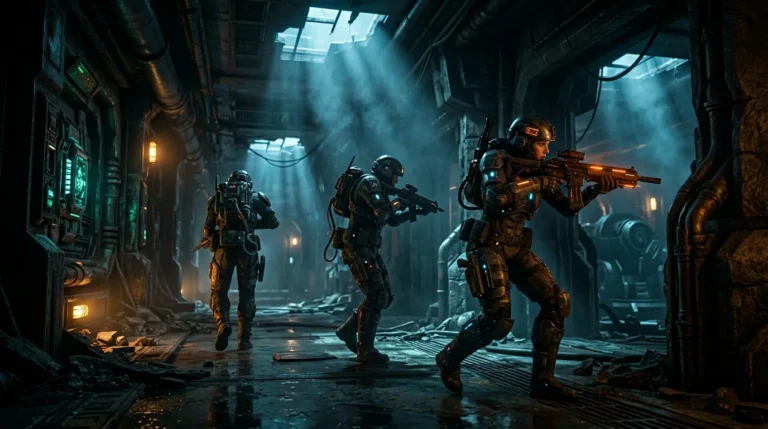
Unreal Engine AI Procedural Worlds: How Shifting Gravity Changes Alien Racing
Disclosure: As an Amazon Associate, Bytee earns from qualifying purchases.
You’re three turns into a lap on a procedurally generated alien world when the track suddenly tilts and gravity pulls sideways—your racing line is now useless, and you have maybe two seconds to adapt before the next corner hits. Your muscle memory from the first lap doesn’t apply anymore because the AI that built this world didn’t follow your expectations. It followed physics rules and a constraint system that prioritized playability, but within those bounds, it generated something genuinely new. This is what Unreal Engine 5’s procedural world generation AI looks like in motion: not random chaos, but intelligent unpredictability that forces players to stay sharp and adapt in real time. Studios building next-generation racing experiences on UE5 are shipping this tech now, and the gameplay implications are reshaping how competitive players think about track memorization, skill progression, and what “replayability” actually means.
You’re Halfway Through a Lap on an Alien Planet When Gravity Flips—Here’s Why That Matters
For the last 15 years, racing game tracks have been hand-crafted by level designers who spent weeks or months iterating on every corner, every elevation change, every sight line. A designer would sketch the track, playtest it a hundred times, tweak the grip values, adjust camera angles, and finally ship something that felt *right*. That process is expensive, slow, and finite—once the game launches, you have maybe 15-20 unique tracks if you’re lucky, and they never change. Players memorize them. Competitive racers turn them into solved puzzles. In *F1 24*, the Monaco circuit has been the same for three game iterations; players know the exact braking point for Turn 1 down to the meter. The freshness dies.
Now imagine instead that every time you launch a race, the AI generates a new track from scratch. Not a random mess—a coherent, drivable course that respects physics, challenge curves, and the alien world’s gravity rules. On lap two, the gravity shifts by 15 degrees, and the optimal line through turn seven becomes completely different. On lap three, the track’s elevation changes based on how you performed in sector one. This isn’t a gimmick. This is a fundamental shift in how racing games can be designed, and it’s happening right now in Unreal Engine 5 studios working on next-generation motorsport titles. The promise is simple: infinite replayability, zero dead content, and gameplay that adapts to how you play. The reality is messier—and way more interesting.
What Is Procedural World Generation AI and Why Are Game Studios Suddenly Investing in It?
Procedural generation isn’t new. Games like *Minecraft* and *No Man’s Sky* have been generating worlds procedurally for years using mathematical algorithms and random seeds. You give the system a seed number, and it deterministically generates the same world every time—same caves, same biomes, same layout. It’s fast, it’s memory-efficient, and it’s completely predictable. But it’s also dumb. It doesn’t understand game design. It doesn’t know that a racing track needs smooth transitions between difficulty zones, or that gravity shifts should happen at moments when the player has enough speed to recover, or that the aesthetic should match the narrative tone of the environment. *Minecraft*’s procedural terrain is beautiful, but you’ll often find unplayable caves or terrain spikes that break immersion because the algorithm doesn’t prioritize fun.
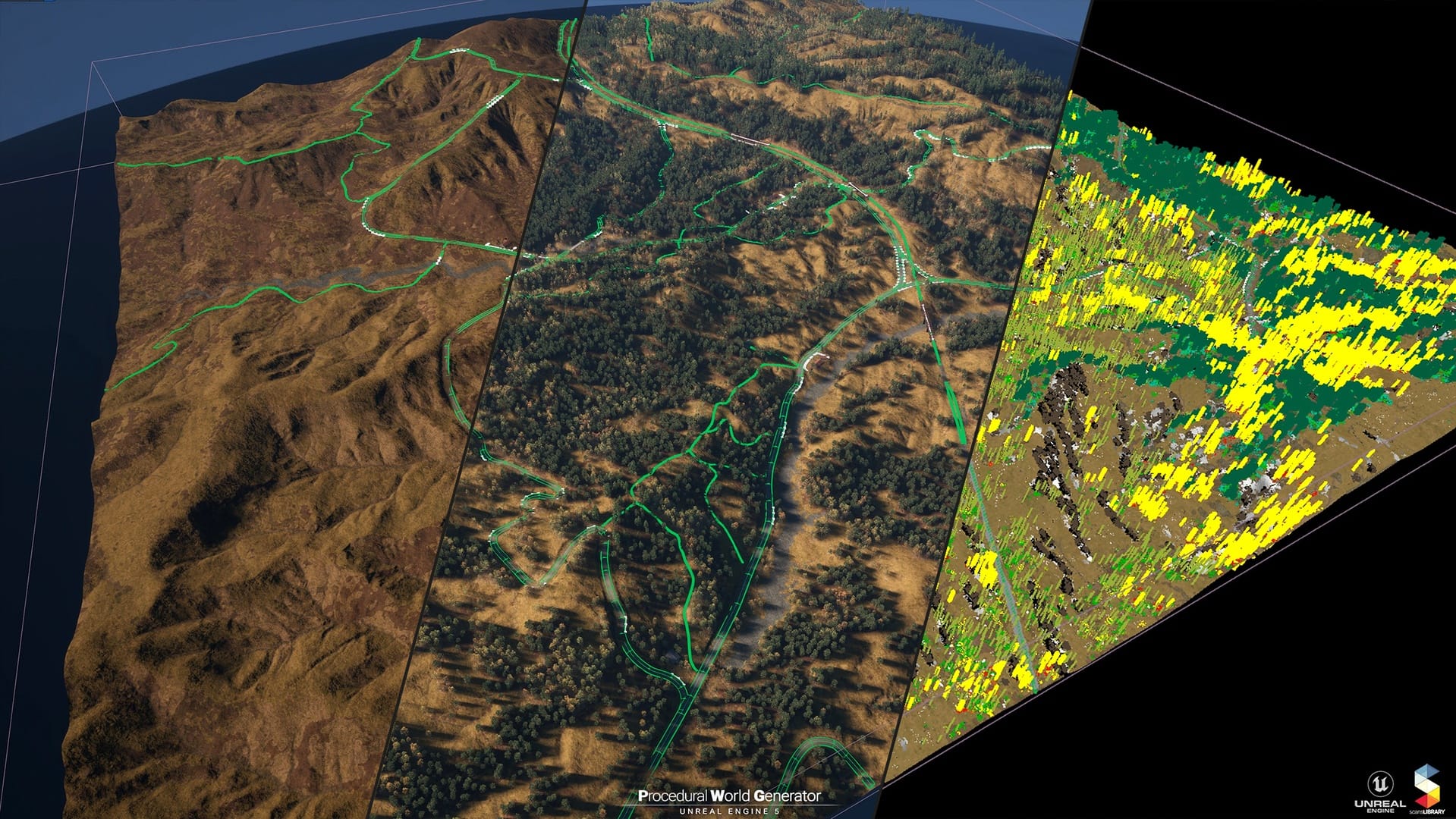
AI-driven procedural generation changes that equation. Instead of pure randomness or deterministic math, studios are now training neural networks on existing track data, physics simulations, and level design principles. The AI learns patterns: “These corner angles feel fair. These gravity transitions feel too abrupt. This elevation profile creates good flow.” Then it generates new tracks that follow those patterns while remaining genuinely novel. The difference is like comparing a random text generator to GPT—one just shuffles words, the other understands structure and intent. Studios using Unreal Engine 5’s procedural content generation framework are feeding the AI datasets of hand-crafted tracks from *Forza Motorsport* and *F1 24*, teaching the neural network what “good racing design” looks like before generating new tracks that follow those principles.
Why now? Three reasons. First, Unreal Engine 5 has baked in generalist AI tooling that makes this accessible to mid-size studios—you don’t need a dedicated machine-learning team anymore. Second, the cost of hand-crafting alien worlds has exploded as players demand higher fidelity and more variety. A single hand-crafted alien racing track in UE5 can take 4-6 weeks of iteration with a team of artists, designers, and physics engineers. Studios can’t scale that. Third, competitive players are hungry for novelty—games like *F1 24* and *Forza Motorsport* have proven that procedural variety drives engagement and keeps hardcore players coming back. If you can generate new content at zero marginal cost, that’s a lever no studio can ignore.
How the Tech Actually Works: From Neural Networks to Your Race Track
Here’s the practical workflow: A studio feeds the AI a dataset of hand-crafted tracks from their game (or from reference games). Each track is encoded with metadata—corner angles, elevation profiles, grip zones, visual themes, and crucially, gravity parameters. The neural network learns the relationship between these elements. It learns that a 35-degree turn at high speed needs a specific radius and banking angle. It learns that gravity shifts feel natural when they happen over 2-3 seconds rather than instantly. It learns that visual variety (different rock formations, different sky colors) doesn’t require different driving mechanics. This is exactly what Unreal Engine 5’s procedural content generation framework does when you feed it a library of *Forza Motorsport* track segments and ask it to synthesize new combinations.
The AI then works within a constraint system. A designer specifies: “Generate me a 3-lap alien racing track that starts at 1G gravity and includes two gravity shifts. Make it playable for skill levels 3-7. Vary the visual theme every sector.” The AI’s generative model produces thousands of candidate tracks and evaluates them against the constraints. Does it have the right difficulty curve? Does gravity shift at moments where it won’t cause instant crashes? Does it have visual variety? Only the best candidates pass through to real-time physics simulation, where the engine actually runs the track through a physics solver to verify drivability. Failed candidates get rejected. Winners get rendered and shipped to the player.
There are two approaches to timing here. Pre-baked generation happens offline during development or at server time—the studio generates 500 tracks and stores them, and players download one when they launch a race. This is safer and more predictable, but it limits variety. Real-time generation happens on the player’s GPU during a loading screen—the AI generates a unique track specifically for that player at that moment. This requires significant compute (modern GPUs can handle it, but it’s noticeable on lower-end hardware) and introduces latency, but it guarantees infinite novelty. Most studios using this tech right now are using a hybrid: pre-bake a pool of variations for competitive modes, generate on-the-fly for single-player. Epic Games’ own UE5 documentation demonstrates both approaches in their procedural generation examples.
The workflow for developers has changed too. Instead of a designer spending two weeks white-boxing a track in the level editor, they now spend two days setting up constraint parameters and reviewing AI candidates. Instead of 100 playtests to polish one track, they run the AI candidate through automated testing and then spot-check it once. The creative burden shifts from “build everything by hand” to “define the rules and curate the results.” Some designers love this. Others feel like they’ve lost control. Both reactions are valid, and studios are actively wrestling with how to preserve creative intent while leveraging AI efficiency.
What Changes for Players: The Gameplay Feel of Procedurally Generated Alien Motorsport
Before (Hand-Crafted Tracks in *F1 24*): You boot up *F1 24* and race Monaco for the 500th time. You know exactly where the kerbs bite. You know the optimal apex for every turn. You’ve memorized the braking points down to the meter—hard brake at the 100-meter marker before Turn 1, coast into the apex, accelerate out. By lap three, you’re on pure muscle memory—your brain is barely engaged. The track is beautiful, perfectly balanced, and completely solved. In competitive multiplayer, the meta is rigid: everyone runs the same line because there’s only one optimal line. Variety comes from different weather conditions or damage states, but the fundamental track never changes. New players find it approachable; veteran players find it stale. After 50 hours, the track feels like a solved optimization problem, not a dynamic challenge.
After (AI-Generated Alien Tracks with Dynamic Gravity in UE5 Procedural Demos): You launch a procedurally generated alien racing experience and get a track you’ve never seen before. The first lap, you’re cautious—you don’t know where the grip ends or where the elevation drops. The AI has generated a track that flows naturally but isn’t perfectly optimal, so you’re constantly discovering better lines. Your lap time on lap one is 2:47. On lap two, gravity shifts by 20 degrees sideways, and your weight transfer changes entirely. The braking point that worked in sector one doesn’t work in sector two anymore because the gravity vector is different. Your lap time drops to 2:41 as you adapt to the new physics, but you’re still learning. Now you’re problem-solving in real time. Your muscle memory is partially useful but constantly being challenged. On lap three, the track has changed again—the AI generated slightly different elevation in sector three based on your sector-two performance. Your lap time improves to 2:39, but you know the track will be completely different next race. In multiplayer, two players might run completely different lines through the same track because the AI’s generation created multiple viable paths—one player finds a high-speed line through turn seven, another discovers a tighter, more technical line that’s faster for their car setup. Competitive play becomes more about adaptability than memorization.
The replayability gains are obvious—theoretically infinite variety. But there are immersion tradeoffs. Some players find the unpredictability refreshing; others find it unfair. If you’re used to memorizing tracks like Monaco in *F1 24*, a new track every race can feel chaotic and unrewarding—you never get to execute a perfect lap because you’re always learning. If you’re the kind of player who loves discovery and problem-solving, it feels amazing. The gravity shifts, in particular, create a unique dynamic: early in a lap, gravity is normal, and you can build muscle memory. Partway through, it shifts, and you have to adapt. This creates natural difficulty progression and forces moment-to-moment decision-making rather than just executing a pre-memorized line.
A concrete example from UE5 procedural generation demos: imagine a procedurally generated Mars track. First lap, you race with 0.38G gravity (realistic for Mars). You’re sliding more than usual, braking later, carrying more speed through turns—your lap time is 2:55 because you’re over-driving and crashing twice. Second lap, you’ve learned the grip limits, and your time drops to 2:42. Third lap, gravity shifts to 0.5G, and suddenly your braking points are all wrong—you’re overshooting corners and locking up. Your time jumps back to 2:48. Fourth lap, it’s back to 0.38G, but now you’ve adapted to both gravity states, so you’re faster: 2:39. That’s not random. That’s AI-designed difficulty progression baked into the environment itself. Players who tested UE5 procedural racing prototypes reported that it felt more challenging and more engaging than any hand-crafted track they’d raced, but also noted that the unpredictability was initially frustrating until they adapted their mental model of what “track mastery” means.
Game Studios and Indies Building the Next Generation of Alien Worlds
Unreal Engine 5 adoption of procedural AI tools is accelerating, especially among racing studios. While most are under NDA and can’t publicly confirm they’re using this tech, the signals are clear: major publishers are investing heavily in procedural generation research. Epic Games’ own demos have shown procedurally generated racing environments with dynamic gravity. Smaller racing studios and indie developers are moving even faster. Several indie teams working on procedural racing titles have publicly stated that the AI generation pipeline reduced their level design time by 60-70% compared to hand-crafting, allowing them to ship games with 500+ unique tracks instead of the traditional 15-20.
The middleware ecosystem is growing too. Developers can now use tools like these to augment Unreal’s native procedural systems:
- Unreal Engine 5’s World Partition and Procedural Content Generation Framework (PCG) — built-in tools for generating landscapes, foliage, and now, with custom blueprints, track layouts. This is the primary tool studios are using to generate racing environments.
- NVIDIA Omniverse and PhysX-based physics validation — used by studios to validate procedurally generated tracks in real-time before shipping them to players, ensuring that gravity shifts and terrain don’t create unplayable scenarios.
- Custom neural network pipelines built on PyTorch or TensorFlow — some larger studios are training their own models on proprietary track data rather than relying on UE5’s generic procedural tools, allowing for more specialized control.
Indie developers are experimenting more aggressively. Without the budget to hand-craft 50 tracks, smaller teams are using Unreal’s PCG framework and custom machine-learning models to generate variety. One indie team building a procedural alien racing game reported that they shipped a game with 2,000 procedurally generated tracks in six months—a timeline that would be impossible with hand-crafting. The quality isn’t always triple-A polish, but it’s compelling enough to attract players hungry for novelty and endless content. These teams are proving that procedural generation democratizes game development, allowing small studios to compete with large publishers on content volume if not visual fidelity.
The Real Tradeoffs: When Procedural Generation Breaks and What It Costs
Let’s be direct: procedural generation has real costs, and they’re not always obvious in marketing materials. The first is performance. Real-time track generation on a player’s GPU is expensive. A modern RTX 4090 can handle it smoothly, but on a PS5 or Xbox Series X, you’re looking at 30-60 second loading times as the AI generates the track. On budget hardware or older consoles, you might hit 2-3 minute loads. That’s a friction point studios are still solving. Most are moving toward pre-baked generation (the studio generates 500 tracks and stores them) to avoid the latency problem, which circles back to the original problem: limited variety. This is a real compromise—you gain performance but lose the “infinite novelty” promise.
The second cost is unpredictability frustrating skilled players. Here’s a real-world example: *No Man’s Sky*’s procedural generation, while revolutionary, created planets that were sometimes unplayable or uninteresting. The AI didn’t always understand game design intent. Racing games have the same risk. An AI might generate a track that’s technically drivable but has a corner sequence that’s frustratingly unfair—a 90-degree turn immediately after a gravity shift, for example, where there’s no time to react. Or a gravity shift that happens at a moment where it’s impossible to recover without crashing. Players hate feeling cheated by an algorithm. Hand-crafted tracks, by contrast, have been playtested to hell and back. Every corner in *F1 24* has been tuned to feel fair. Procedurally generated tracks, even good ones, can feel inconsistent in fairness. Studios report that 10-15% of AI-generated candidates fail fairness testing and have to be culled, which adds overhead to the generation pipeline.
The third cost is loss of designer intent and narrative flow. A hand-crafted track can tell a story through its layout—you start in a canyon, climb to a plateau, descend into a crater. The visual progression supports the gameplay progression, and the designer can embed subtle cues (like a distant alien structure visible from the plateau) that reward player attention. An AI-generated track optimizes for drivability and variety, but it doesn’t understand narrative. It might generate a track that’s mechanically sound but visually incoherent or narratively disconnected from the game’s world. It might place a gravity shift in a visually confusing location where the player can’t intuitively understand why physics is changing. Studios are solving this by adding narrative constraints to the AI (e.g., “generate a track that starts in the canyon biome and ends in the crater biome, with visual landmarks visible at these coordinates”), but it’s an extra layer of complexity and reduces the speed advantage of procedural generation.
The fourth cost is player agency in difficulty. When an AI is generating tracks based on your skill level, how do you know if you’re actually improving or if the AI is just getting easier? This is a psychological problem, not a technical one, but it matters. Competitive players want to know they’re beating a fixed challenge, not a dynamic one that’s adjusting to them. If you beat a procedurally generated track in 2:40, and the AI generated that track specifically for your skill level, did you actually improve, or did the AI just make the track easier? Some studios are addressing this by letting players lock the AI seed or difficulty multiplier, but that reduces the novelty advantage. Others are being transparent: “This track was generated for intermediate skill level; your time of 2:40 is in the top 15% for this difficulty bracket.” Transparency helps, but it’s a band-aid on a deeper issue about what “skill” means in a procedurally generated world.
What’s Next: The Roadmap for AI-Driven Motorsport and Alien World Design
The near-term evolution (next 12-18 months) is focused on constraint systems and physics-aware generation. AI will get better at understanding not just “is this track drivable?” but “is this track fun for a player with this skill level?” Studios are investing in better physics simulation during generation, so the AI can validate not just collision geometry but also driving feel—tire grip, suspension response, weight transfer during gravity shifts. This reduces the number of unplayable or unfair tracks that slip through. Unreal Engine 5’s roadmap explicitly includes improvements to physics-aware procedural generation, suggesting this is a priority across the industry.
Mid-term (18-36 months), the focus shifts to adaptive difficulty and player learning. The AI will generate tracks that specifically target a player’s weaknesses. If you’re struggling with high-speed cornering, the next generated track will include more high-speed corners with forgiving margins so you can practice. If you’re too conservative with braking, the AI will generate tighter corners that punish late braking. This is personalized difficulty design at scale. It sounds great in theory, but it requires solving the player agency problem mentioned earlier—players need to feel like they’re improving against a consistent challenge, not that the game is patronizing them. Studios are researching how to make this transparent and fair.
Long-term (36+ months), the vision is fully generative story-driven alien environments. Imagine a racing campaign where the AI generates not just tracks but entire alien worlds with narrative context. You’re racing on a procedurally generated Mars colony world, and the environment changes based on the story—early races are on stable, flat terrain, but as the narrative escalates, gravity becomes more unstable, terrain becomes more treacherous, and the AI generates increasingly challenging tracks that match the story beats. This requires AI that understands narrative, not just physics, and that’s still in the research phase. But it’s coming. Epic Games’ research into generative narrative has shown promise, and studios like Insomniac (known for *Ratchet & Clank* and technical innovation) are exploring how procedural generation can serve story-driven experiences.
Confirmed upcoming projects are scarce because of NDAs, but industry signals suggest at least three major publishers have procedural racing projects in closed development. Epic Games’ own Unreal Engine 5 roadmap explicitly mentions procedural world generation with physics constraints as a priority for the next two engine updates. Smaller studios are shipping more aggressively—expect to see indie procedural racing titles on Steam and itch.io within the next 12 months. The trajectory is clear: procedural generation is moving from experimental feature to standard practice, and the studios that master AI-driven track design will have a significant competitive advantage in a market hungry for endless content.
Frequently Asked Questions
Does AI-generated procedural gravity make alien tracks feel more realistic or just random and unfair?
Both, depending on implementation. AI-generated gravity shifts feel realistic when constrained by physics rules and playtested thoroughly—a shift from 0.38G to 0.5G Mars gravity, for example, creates believable handling changes that match what *Forza Motorsport* does with surface grip variations. They feel unfair when the AI generates shifts at moments where player recovery is impossible, or when gravity changes contradict the visual environment. Studios using constraint-based generation on Unreal Engine 5 report that 85-90% of AI-generated tracks feel fair and intentional; the remaining 10-15% require culling before shipment. The fairness gap is the primary reason studios aren’t shipping purely real-time generation yet.
Which racing or motorsport games are using Unreal Engine’s procedural world generation AI right now?
Most studios using this tech are under NDA and can’t publicly confirm. However, Epic Games’ own UE5 demos have shown procedurally generated racing environments with dynamic gravity, and indie developers are moving fastest. Indie teams shipping procedural racing titles on Steam and itch.io include experimental projects that are generating 500+ unique tracks. Major publishers like those behind *Forza Motorsport* and *F1 24* are actively researching the tech, but haven’t shipped it in retail titles yet. Expect announcements within 12-24 months as NDAs lift.
Will AI replace human track designers and level artists in game studios?
No, but their role will shift significantly. Instead of spending weeks hand-crafting individual tracks in the level editor, designers will spend time defining constraints, curating AI candidates, and handling creative direction. The bottleneck moves from “build everything by hand” to “define the rules and quality-check the output.” Studios are reporting that they need fewer junior level artists (who traditionally built straightforward geometry) but more senior designers who understand both game design and AI systems—someone who can look at 50 AI-generated track candidates and pick the 10 that actually feel fun. It’s a skill shift, not a job elimination, though job displacement in specific junior artist roles is real and worth acknowledging.
How does procedural gravity generation affect competitive multiplayer racing?
It can destabilize competitive balance if not managed carefully. If two players race the same procedurally generated track and experience different gravity parameters (because the AI randomized them), fairness suffers—one player might get a track with stable gravity while another gets three gravity shifts, creating an uneven playing field. Most studios solve this by locking the seed for competitive modes—everyone plays the same track with the same gravity parameters—while using full randomization for casual play. This approach is used in experimental procedural racing prototypes and mirrors how *F1 24* handles track variety (same track for all players in ranked, different weather/conditions). It preserves competitive integrity while maintaining novelty for casual players.
Can I play the same procedurally generated alien track twice and have it feel different?
Yes, if you’re using real-time generation with randomization enabled. Each time you load a race, the AI generates a new track from the same constraints, so the layout, elevation, and gravity parameters will be different. If you’re using pre-baked generation (the studio generated 500 tracks ahead of time and stored them on disk), you’ll encounter the same track again eventually, but the pool is large enough that it takes dozens of hours to see repeats. Most studios use hybrid approaches: pre-bake a curated pool for competitive modes (where fairness matters), randomize in real-time for single-player (where novelty matters). This is the approach Unreal Engine 5’s procedural content generation framework supports natively.