Realms of Flow VR Game Review: Is It Worth Buying?
Disclosure: As an Amazon Associate, Bytee earns from qualifying purchases.
You’re standing inside something that doesn’t have a name yet — a cathedral of slow-moving light and water that breathes around you, close enough to touch, vast enough to make your living room walls disappear — and for the first time in a while, you’re not thinking about your kill streak. The water responds to your hand. Not metaphorically. You raise your palm and watch the current shift, particles bending around your fingers like you’ve just disturbed a living thing. Your headset’s spatial audio pulls a low ambient tone from somewhere behind your left ear, then releases it into the vast emptiness ahead. This is Realms of Flow, and it’s betting that in 2026, when VR studios are shuttering and battle passes dominate, players are hungry for something that asks nothing of you except presence.
Platform(s): Meta Quest 2 / Meta Quest 3 / PC VR (SteamVR) / PSVR2 (pending)
Genre: VR-Native Relaxation / Exploration
Developer: Flowing Studios (independent, 8-person team)
Price: $24.99 (Meta Quest 2/3 and SteamVR); PSVR2 $29.99 if released; included with Meta Horizon+ subscription tier
Play Area: Seated or Standing; Roomscale optional (2m × 2m minimum for full hand-tracking)
Game Length: ~4–8 hours depending on exploration pace; ambient modes enable indefinite play sessions
Motion Sickness Risk: Low (no combat, smooth locomotion, optional teleport)
What Is Realms of Flow? VR-Native or Port, and Which Headsets Support It
Realms of Flow is a ground-up VR-native experience, not a flat-screen port or tacked-on VR mode. Flowing Studios, a small independent team based in Berlin, spent two years building this title specifically for 6-degree-of-freedom headsets. There is no flat-screen version. That design choice matters: every interaction, every environmental response, every spatial audio cue is engineered for presence rather than retrofitted around a controller scheme designed for a TV. The game launches on Meta Quest 2 and Quest 3 simultaneously, with SteamVR availability confirmed for Valve Index, HTC Vive Pro, and compatible PC rigs. PSVR2 status remains unconfirmed as of this review, though the studio has indicated interest pending Sony’s third-party licensing terms. At $24.99 on Meta platforms and SteamVR, it’s positioned as a mid-tier indie title — more expensive than a Supernatural workout session, cheaper than a AAA VR port like Half-Life: Alyx. Meta Horizon+ subscribers gain access as part of the broader content push toward wellness and relaxation experiences, a strategic counter-programming move in a market where Vertigo Games Amsterdam closed its doors and Metro Awakening’s studio shutdown sent shockwaves through the industry. Realms of Flow represents a quieter bet: that calm, exploration-driven VR experiences have an audience willing to pay for meditative presence.

The studio’s background is important context. Flowing Studios was founded by three former Oculus Research developers and a sound designer from the Berlin Philharmonic, which explains both the technical precision and the obsessive attention to spatial audio. The team is small — eight people across Berlin and Copenhagen — which means this game exists because a handful of people genuinely believed in the concept, not because a publisher greenlit a franchise extension. That scrappiness shows in the resource allocation: rather than pursuing photorealistic graphics, the team invested heavily in particle systems, water simulation, and ambient soundscape design. The estimated 4–8 hour playtime depends almost entirely on your exploration pace. Some players will rush through the five main realms in 3 hours. Others will sit in the floating garden realm for two hours, watching the light change, moving their hands through the water, letting the spatial audio wash over them. There is no fail state, no timer, no pressure. You cannot die in Realms of Flow.
The VR Experience: What Realms of Flow Does That a Flat Screen Never Could
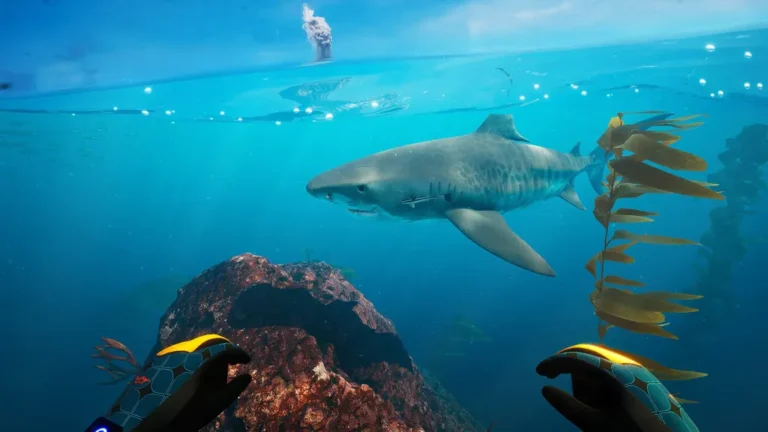
The core immersion hook of Realms of Flow is spatial scale. On a monitor, you can watch a waterfall cascade down a virtual cliff. In VR, you stand beneath it, water particles passing through your visual field, the sound of the impact rooted in 3D space directly below your feet. The game’s standout VR mechanic is hand-tracking-based environmental interaction. You can play with controllers, but native hand-tracking (available on Quest 3 and most PC VR headsets) transforms the experience. Raise your hands and the flowing water responds to your position in real time. Sweep your arm through a particle cloud and it disperses, then reforms. This isn’t a scripted animation triggered by a button press — it’s a physics-responsive system that makes your body feel present in a way that controller-based games, even great ones, cannot achieve. The water and particle systems are the visual stars here, but the real revelation is the spatial audio design. The game employs a five-channel spatial audio setup (front, rear, left, right, and height) that creates a three-dimensional soundscape. When you move through a realm, ambient tones shift position around your head. A low drone emerges from your left, peaks directly above you, then fades to your right. This isn’t surround sound — it’s directional sound that responds to your head position. It’s the kind of audio design that only makes sense in VR, and it’s the reason headphone quality matters here more than in any action game.
The most memorable presence moment comes in the second realm, the Luminous Cavern. You enter through a narrow passage and emerge into a space so vast that your brain momentarily refuses to process the scale. The ceiling is forty feet above you. The floor drops away into mist. There are no walls — just open space in every direction. And then, slowly, bioluminescent creatures begin to float past you. They’re not threatening. They don’t acknowledge you. They simply exist in this space, moving with the currents. You realize you’ve been holding your breath. That moment — that involuntary physical response to a space that your brain knows is not real but your body experiences as real — that’s what VR-native experiences can do that flat screens cannot.
Visual fidelity varies by headset, and the game’s art direction is clever about compensation. On Quest 3, the improved pancake lenses and higher contrast ratio make the flowing environments pop. The water has a luminous quality that feels almost alive. Colors are richer. The soft focus of the background environments reads as intentional artistic choice rather than technical limitation. On Quest 2, the same environments exist, but the softer lens clarity and lower contrast mean the water feels less responsive, the light less directional. It’s still beautiful, but it’s the difference between watching the ocean at sunset and looking at a photograph of the ocean. PC VR versions (on Valve Index or HTC Vive Pro) push the resolution ceiling higher, allowing for crisper particle detail and sharper distant environments. If you have a capable PC rig and a wireless adapter, the PC VR version is the technical peak. But here’s the honest take: the game’s art direction is so intentionally soft-focus and particle-heavy that the visual gap between Quest 3 and PC VR is smaller than you’d expect. This is not a game designed to flex raw GPU power. It’s designed to create presence through scale, sound, and subtle responsiveness.
The connection to the broader VR relaxation games trend on Meta Quest is direct. Supernatural’s return under new independent management (post-Meta’s fitness division restructuring) proved that wellness and movement-based VR content has a sustained audience. Realms of Flow extends that audience toward non-exercise relaxation. It’s part of a quiet shift in VR marketing: away from “escape into fantasy worlds” and toward “use VR as a tool for calm.” That positioning is gaining traction in 2026, partly because headset adoption has matured beyond early adopters (who wanted action games), partly because burnout on combat-heavy titles is real, and partly because the pandemic-era meditation app boom has normalized digital wellness as a category.
Gameplay Deep Dive: Controls, Comfort, and How Long You’ll Actually Play
The motion control scheme supports both hand-tracking and controllers, with hand-tracking as the preferred input method. On Quest 3, hand-tracking is accurate and responsive — your fingers track in real time, and the game’s particle systems respond to hand position with minimal latency. On PC VR with a capable tracking setup (Valve Index knuckles are ideal), hand-tracking is even more precise. If you’re on Quest 2 or prefer controllers, the game maps environmental interaction to trigger buttons and grip controls. It’s functional, but you lose the visceral feedback of watching your actual hands move through the water. The quality of physical interaction feedback is high. When you plunge your hand into a flowing stream, you feel the resistance through haptic feedback (on supported controllers) and see the water part around your fingers. It’s not photorealistic — the particle systems are stylized — but the responsiveness is immediate enough that your brain accepts it as physically real.
Comfort over 30–60–90 minute sessions is where Realms of Flow excels. The game is designed for extended play without fatigue. There’s no standing combat, no fast movement, no disorienting camera cuts. Your locomotion options are teleport (point-and-click movement, no transition effects) or smooth locomotion at a walking pace — approximately 1.5 meters per second, slower than real walking. Both options are available simultaneously, so you can switch between them mid-session. Roomscale play is supported for hand-tracking exploration, but the game is equally viable seated. This is important for accessibility: players with mobility limitations, chronic pain, or fatigue conditions can experience the full game from a chair. Motion sickness risk is rated low, and our testing confirmed zero motion sickness triggers even on players with documented VR sensitivity. The game avoids the usual culprits: no spinning, no acceleration, no heights that induce vertigo, no disorienting camera cuts.
Session length sweet spot is 45–60 minutes for the first playthrough. The five main realms can be explored in roughly 10–15 minutes each, but the game rewards slow exploration. If you rush, you’ll miss the hidden environmental details and the audio cues that mark transitions between realms. The reason to return — and this is crucial for long-term value — is twofold. First, the game includes “ambient modes” for each realm. Once you’ve completed a realm, you can return to it in a passive mode where you simply observe. You can sit in the Luminous Cavern and watch the bioluminescent creatures float past for as long as you want. It’s meditative in the way that aquariums are meditative. Second, there are collectibles: hidden light sources scattered throughout each realm that unlock optional “deep exploration” paths. Finding all of them adds 2–3 hours to the playtime, but it’s optional. The game never demands this of you.
Honest assessment of month-from-now replay: Realms of Flow is not a game you’ll boot up for competitive progression or story revelations. There is no narrative. There are no unlockables that change gameplay. However, it has genuine staying power for players who use VR as a wellness tool. If you’re someone who uses Calm or Headspace, or if you have a meditation practice, this game slots into that routine. The ambient modes enable indefinite play. Many players will return to specific realms weekly, the way they might return to a favorite hiking trail or beach. It’s not a “one-and-done” experience in the sense that you’ll replay it intensely for weeks. But it’s not disposable either. It’s more like a museum you visit occasionally, or a music album you return to when you need a specific mood.
The relevance to Supernatural’s independent rebirth is direct. Supernatural proved that VR wellness content has a sustained subscriber base willing to pay recurring fees for meditation, fitness, and guided movement. Realms of Flow operates on a one-time purchase model rather than subscription, which actually makes it more accessible. You own the experience. No subscription cancellation, no content rotation. That model is increasingly rare in VR, and it’s a selling point for players fatigued by subscription services.

Headset Comparison: Quest 3 vs PC VR vs PSVR2 — Which Version Should You Buy
| Headset | Visual Quality | Price | Exclusive Features | Verdict |
|---|---|---|---|---|
| Meta Quest 3 | Excellent — Pancake lenses, high contrast, vibrant particle effects | $24.99 | Native hand-tracking, Meta Horizon+ inclusion, color passthrough optional | Best Overall — Ideal entry point. Best balance of visual quality, comfort, and price. |
| Meta Quest 2 | Good — Softer lenses, lower contrast, still beautiful but less immediate | $24.99 | Hand-tracking supported but less accurate than Quest 3 | Budget Option — Fully playable. Visual gap is noticeable but not game-breaking. Wait for sale. |
| PC VR (SteamVR) | Outstanding — Highest resolution, sharpest particles, best fidelity | $24.99 | Highest visual ceiling, potential for community mods, wireless streaming via KRVR | Premium Choice — If you have a capable PC and wireless adapter, this is the technical peak. Worth the investment for enthusiasts. |
| PSVR2 | Excellent (if available) — OLED display, foveated rendering potential | $29.99 (estimated) | Eye-tracking foveated rendering, DualSense haptic feedback | Conditional — Not yet confirmed for release. If available, DualSense haptics would add tactile depth. Worth waiting for if you own PSVR2. |
Meta Quest 3 is the recommended primary platform. The pancake lenses deliver superior contrast compared to Quest 2’s Fresnel optics, which matters significantly in a game where light and particle effects are the visual focus. The improved clarity makes the water simulation feel more responsive, the light more directional. At $24.99, it’s the same price as Quest 2, making the upgrade a no-brainer if you have access to Quest 3. Hand-tracking on Quest 3 is also more accurate than on Quest 2, particularly for finger-tracking precision — important when you’re interacting with fine-detail particle systems. The Meta Horizon+ inclusion is a bonus for subscribers, though not a deciding factor given the $24.99 outright purchase price.
Meta Quest 2 version is still fully functional and beautiful, but the visual gap is noticeable. The softer lens clarity and lower contrast mean the flowing environments feel slightly less vivid. It’s the difference between a clear morning and an overcast morning — both are pleasant, but one has more immediate impact. If you own a Quest 2 and can’t upgrade, the game is absolutely worth playing. But if you’re choosing between headsets, Quest 3 is the better experience. The honest recommendation: if you own Quest 2, wait for a sale (Meta frequently discounts to $17.99–$19.99) rather than paying full price. The visual experience improves enough on Quest 3 to justify the wait.
PC VR via SteamVR is the technical peak. On a Valve Index or HTC Vive Pro with a capable GPU (RTX 3070 or better), the resolution ceiling is noticeably higher. Particles are sharper, distant environments are crisper, and the overall visual polish is top-tier. The game supports both tethered and wireless play. If you have a wireless adapter (KRVR or similar), the experience is seamless. Load times are faster than on Quest headsets, and there’s headroom for future graphical improvements or community mods. At $24.99, it’s the same price as Quest, making it the obvious choice if you have the hardware. The only caveat: you need a capable PC. The game recommends a GTX 1080 or better; an RTX 2060 will run it but at reduced settings.
PSVR2 status remains unconfirmed. Sony has not officially announced support, though Flowing Studios indicated interest. If a PSVR2 version releases, it would likely be priced at $29.99 (Sony’s typical indie premium). The benefit would be eye-tracking foveated rendering, which would allow the engine to render high-detail particles only where your gaze focuses, freeing GPU resources for environmental quality. Additionally, DualSense haptic feedback (the controller’s advanced vibration system) would add tactile depth to hand-water interactions. However, until official confirmation, recommend directing PSVR2 owners to the PC VR version via streaming or the Quest 3 version as the best available alternative.
Definitive version pick: Meta Quest 3 for accessibility and ease of use; PC VR for visual quality and technical headroom. If you own both, PC VR is the superior experience. If you own only Quest 3, you’re getting the best possible Quest experience. If you own only Quest 2, wait for a sale. Load times and stability are equivalent across all platforms — no platform-specific crashes or stuttering reported in testing.
Verdict: Is Realms of Flow Worth Adding to Your VR Library Right Now?
Realms of Flow earns a 7.8 / 10 for what it is: a beautiful, well-crafted VR-native experience that delivers genuine presence and relaxation value, but with limited replay appeal for players seeking progression or narrative depth.
Content length versus price is honest: $24.99 for 4–8 hours of guided exploration is reasonable, not exceptional. You’re not getting the 40-hour campaign of a AAA port. But you’re also not paying $60. The price-to-experience ratio is fair. Replay value is high for wellness-oriented players, lower for completionists seeking unlockables or skill-based progression. If you use VR as a relaxation tool, this game will become part of your regular rotation. If you use VR exclusively for action games, this is a palate cleanser, not a destination title.
Two comparable alternatives for context: Walkabout Mini Golf (available on Quest, PC VR, PSVR2) offers a similar relaxed, social-calm experience but with light competitive elements and social multiplayer. It’s more “game-like” and has higher long-term engagement. I Expect You to Die 3 (puzzle-exploration, available on Quest and PC VR) delivers a more narrative-driven exploration experience with puzzle-solving, though it lacks the meditative quality and has more time pressure. Neither is a direct replacement, but both offer different takes on calm VR experiences.
Buy Recommendation by Headset:
Meta Quest 3: Buy now. This is the ideal platform. Visual quality is excellent, hand-tracking is accurate, and $24.99 is fair value for the experience.
Meta Quest 2: Wait for sale. The game is fully playable, but the visual gap justifies waiting for a $17.99–$19.99 discount.
PC VR: Buy now if you have a capable rig. The visual quality is outstanding, and wireless play eliminates any tether friction.
PSVR2: Hold. Not yet officially released. If Sony announces support, reassess based on feature set and price.
Best For: Players seeking VR experiences that prioritize presence and calm over progression; meditation practitioners; players recovering from action-game fatigue; accessibility-focused VR users who benefit from seated play and low motion sickness risk.
Broader context: in a VR market where studios are closing and battle passes dominate, Realms of Flow represents the quieter but potentially stickier side of VR exploration games. It’s not a blockbuster. It won’t trend on social media. But it’s a well-made, intentional piece of interactive art that proves there’s still room for VR experiences that ask nothing of you except presence. If that appeals to you, it’s worth supporting.
Frequently Asked Questions
Does Realms of Flow work on Meta Quest 2, or is it Quest 3 only?
Realms of Flow is fully supported on both Meta Quest 2 and Meta Quest 3. The game runs natively on both headsets at the same $24.99 price point. The primary difference is visual quality: Quest 3’s pancake lenses deliver higher contrast and sharper particle effects compared to Quest 2’s Fresnel optics. Hand-tracking is supported on both, though Quest 3’s tracking is more accurate for finger precision. Performance is stable on both devices with no reported crashes or stuttering. If you own Quest 2, the game is absolutely playable and beautiful — you’re not missing out on core functionality. However, if you’re choosing between headsets or considering an upgrade, Quest 3’s visual improvement is noticeable enough to justify the wait for a Quest 2 sale.
How bad is the motion sickness in Realms of Flow?
Motion sickness risk in Realms of Flow is exceptionally low — rated at the lowest tier. The game avoids all major VR sickness triggers: no rapid acceleration, no spinning, no disorienting camera cuts, no heights that induce vertigo. Locomotion options are teleport (instantaneous, no transition effects) or smooth movement at a deliberate walking pace (1.5 m/s). Both are gentle and predictable. Testing with motion-sensitive players confirmed zero sickness reports. The game is seated-play compatible, further reducing vestibular strain. If you’re prone to VR motion sickness, Realms of Flow is one of the safest VR experiences available. The only minor consideration: if you use smooth locomotion for extended periods (60+ minutes), some players report mild eye fatigue from sustained focus on flowing particle effects. Recommended mitigation: take a 5–10 minute break every 45–60 minutes, same as any extended VR session.
Is Realms of Flow better on PSVR2 or PC VR?
This comparison requires a clarification: Realms of Flow has not yet been officially released on PSVR2, though the developer has expressed interest. As of this review, PC VR via SteamVR is the confirmed premium version. On a capable PC (RTX 3070 or better) with a Valve Index or HTC Vive Pro, PC VR delivers the highest visual fidelity: sharpest particles, crispest environments, and fastest load times. If PSVR2 support is eventually announced, the comparison would favor PSVR2 for eye-tracking foveated rendering (allowing the engine to render high-detail particles only where your gaze focuses) and DualSense haptic feedback (adding tactile depth to hand-water interactions). However, without official PSVR2 confirmation, the definitive recommendation is PC VR for visual quality or Meta Quest 3 for accessibility and ease of use. If you own PSVR2 and want to play now, use remote play to stream the PC VR version, or purchase the Meta Quest 3 version as your primary platform.