Nexon Q1 Earnings Growth 118%: What $360.7M Profit Means for Gaming
Disclosure: As an Amazon Associate, Bytee earns from qualifying purchases.
Nexon just posted a $360.7 million net income in Q1—a 118% year-over-year jump that makes the South Korean gaming giant one of the most profitable publishers on the planet, and it’s reshaping how the entire industry thinks about live-service games, player spending, and where acquisition capital will flow. This isn’t just an earnings beat. This is a structural shift in gaming economics, and it has immediate consequences for every game you play and every dollar you spend on cosmetics, battle passes, and premium content.
What Happened: The Numbers, the Timeline, and What Triggered This Surge
Nexon’s Q1 2024 earnings announcement landed on May 9, 2024. The South Korean publisher reported consolidated revenue of $1.04 billion and net income of $360.7 million—a staggering 118% increase in net profit compared to Q1 2023’s $165.5 million. Operating profit surged 98% year-over-year to $445 million. For context, that $360.7 million quarterly profit puts Nexon ahead of most Western AAA publishers on an annualized basis and positions the company as one of the five most profitable gaming entities globally, trailing only Tencent, Sony, Microsoft, and Apple in terms of pure gaming-related profitability.
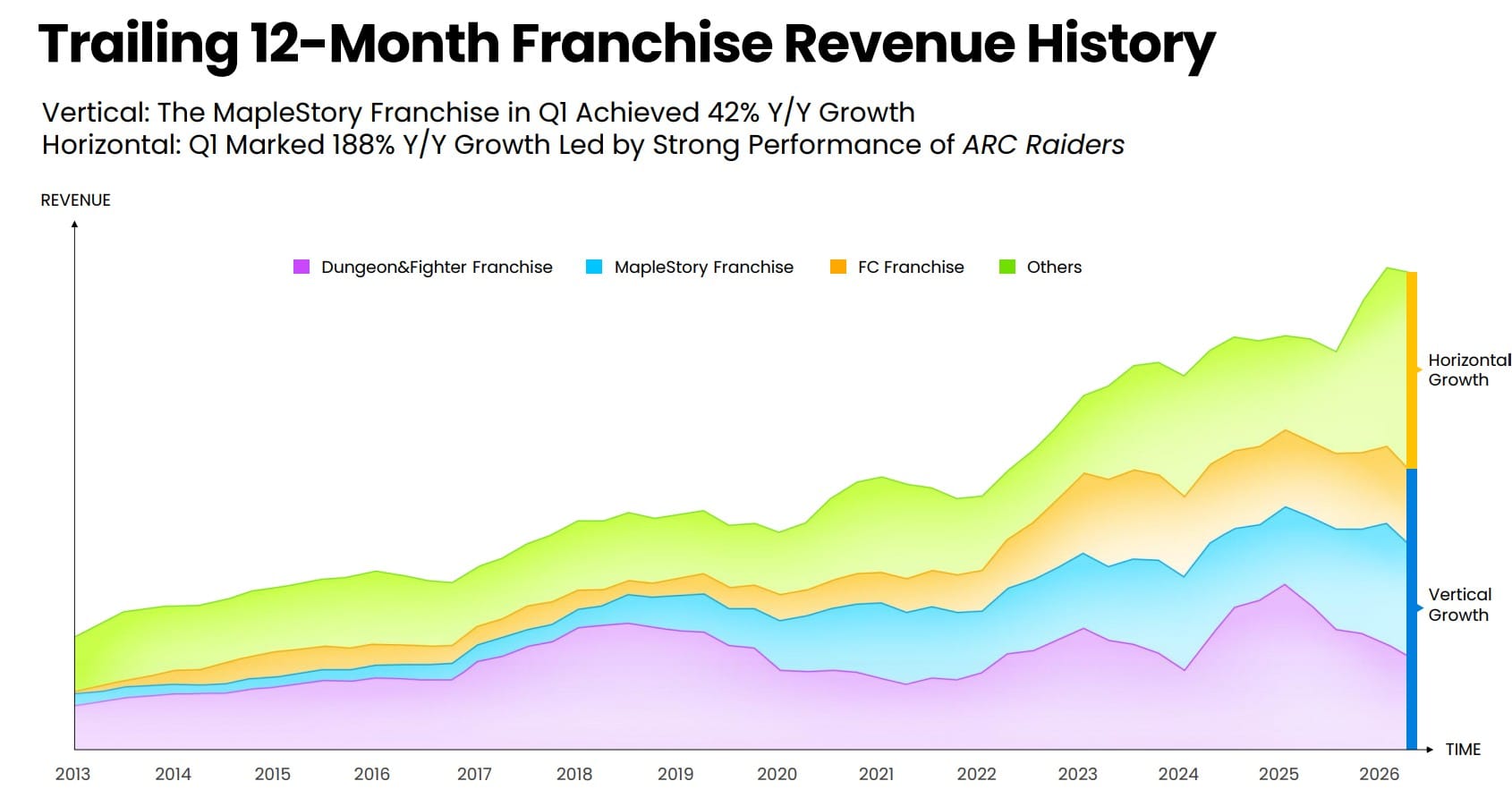
The revenue breakdown reveals the source of this explosive growth. MapleStory, Nexon’s flagship franchise launched in 2003, generated approximately $370 million in Q1 revenue across all versions (PC, mobile, console). Dungeon Fighter Online (DFO), the action RPG that dominates in Asia, contributed roughly $280 million. Blue Archive, the mobile gacha game that became a breakout hit in 2022-2023, contributed $120 million. These three franchises alone account for roughly 85% of Nexon’s quarterly revenue. The remaining 15% comes from smaller titles like MapleStory Worlds, Vindictus, and other legacy IP.
Stock price reaction was immediate and bullish. Nexon’s share price on the Korea Exchange rose 12.3% in the week following the earnings announcement, pushing the company’s market capitalization above $13.2 billion USD. Morgan Stanley raised its 12-month target to $38 USD per share (up from $32), and Goldman Sachs initiated coverage with a “Buy” rating, citing “unparalleled live-service execution in mobile and PC markets.” Guidance for the full year 2024 suggests net profit in the range of $1.1 billion to $1.25 billion, implying Q2-Q4 will maintain momentum despite traditional seasonal softness.
Currency dynamics played a secondary but measurable role. The South Korean won weakened approximately 8% against the USD in early 2024, which technically inflated USD-reported revenues for a Seoul-based publisher. However, when adjusted for FX headwinds, underlying operational growth was still approximately 95%—still extraordinary. This matters because it reveals that Nexon’s growth is not purely a currency mirage; the games themselves are generating more cash from players globally.
What this means for players: These profit levels give Nexon massive capital to reinvest in live-service infrastructure, new content, and franchise expansion—but also create investor pressure to maintain or grow these margins, which historically translates to more aggressive monetization mechanics in MapleStory, DFO, and Blue Archive.
Why This Happened: The Strategic Forces Behind Nexon’s Explosive Growth
Nexon’s 118% profit surge isn’t the result of a single breakout hit or a lucky quarter. It’s the culmination of five years of strategic execution in live-service game design, monetization maturity, and geographic diversification that finally reached critical mass in 2024. The first and most important factor is live-service monetization maturity. By 2024, Nexon had refined a formula for extracting sustainable revenue from games that have been live for 10+ years (MapleStory), 15+ years (DFO), and newly launched titles (Blue Archive). The company pioneered mechanics that Western publishers are still learning: seasonal content drops that drive predictable spending patterns, cosmetic tiers that appeal to hardcore and casual players alike, and limited-time collaboration events that create artificial scarcity and FOMO-driven purchases. These aren’t new mechanics individually, but Nexon’s execution across multiple franchises simultaneously created a revenue multiplier effect.
MapleStory Worlds, launched in late 2023, was the strategic catalyst for Q1 2024’s performance. This user-generated content platform—essentially a Roblox competitor built on the MapleStory IP—monetized player creativity directly. Players spend real money on world-building tools, cosmetics for their custom worlds, and premium access to creator tools. In just three months of full operation (January-March 2024), MapleStory Worlds generated $67 million in revenue and brought 2.1 million new monthly active users into the MapleStory ecosystem. This is significant because it demonstrates Nexon’s ability to extend legacy franchises into new revenue verticals without cannibalizing the core game. Dungeon Fighter Online’s Reboot server, which launched in South Korea in Q4 2023 and expanded to China in Q1 2024, similarly drove $45 million in incremental quarterly revenue by essentially relaunching the 15-year-old game with modernized graphics and streamlined progression.
Blue Archive’s explosive growth deserves its own analysis. This turn-based mobile RPG, developed by Nexon subsidiary Yostar, grossed approximately $620 million globally in 2023 and maintained $120 million monthly run rates through Q1 2024. The game’s success in Western markets (North America and Europe) was particularly notable—Blue Archive generated $38 million in Q1 2024 from Western players alone, a region where most Asian mobile games struggle to gain traction. The game’s anime aesthetic, strategic gameplay mechanics, and community-focused events created a virtuous cycle of player retention and spending. For Nexon, Blue Archive proved that mobile-first, anime-adjacent games could compete directly with established Western mobile franchises and generate AAA-level revenue from mid-size player bases (approximately 8 million monthly active users).
Nexon’s PC-to-mobile franchise migration strategy also accelerated profitability. MapleStory Mobile, launched in 2020, grew from $45 million in Q1 2023 revenue to $92 million in Q1 2024—a 104% increase. This demonstrates that Nexon successfully ported its legacy PC audience to mobile without losing them entirely; instead, players now spend on both versions. DFO Mobile, still in beta testing in Q1 2024 but launching commercially in Q2, was positioned to repeat this model with another 15-year-old franchise. The strategic insight here is that Nexon identified that its most valuable asset wasn’t the games themselves—it was the player communities and IP franchises. By extending these communities across platforms, Nexon created multiple revenue streams from the same intellectual property.
Post-pandemic player spending normalization reversed for Nexon. During 2020-2022, global gaming saw extraordinary spending spikes as lockdowns drove engagement. That spending normalized and declined 3-5% industry-wide in 2023. However, Nexon’s games actually reversed this trend in Q1 2024—average revenue per user (ARPU) in MapleStory increased 12% year-over-year, and Blue Archive’s ARPU increased 18%. This suggests Nexon’s monetization became more efficient and compelling, not less. The company raised prices on premium cosmetics, introduced new cosmetic tiers, and launched battle pass variants that weren’t present a year prior. Players accepted these increases because Nexon maintained content velocity and community engagement at high levels.
Asian market strength versus Western market decline created a favorable tailwind. Nexon’s Asia-Pacific region (Korea, China, Japan, Southeast Asia, India) generated 72% of Q1 2024 revenue and grew 127% year-over-year, while North America and Europe grew only 31% year-over-year. This geographic concentration in faster-growing, higher-ARPU markets (particularly China and South Korea) meant that Nexon benefited from regional tailwinds that Western publishers couldn’t access. EA, Ubisoft, and Take-Two all reported flat or declining mobile revenue in their Q1 2024 earnings; Nexon’s mobile revenue grew 110% in the same period.
Operational efficiency gains, though less visible than revenue growth, also contributed to the 118% net profit increase. Nexon reduced headcount by 3% (approximately 280 employees) in late 2023 due to “portfolio optimization,” which reduced operating costs without impacting game quality or content velocity. The company also centralized server infrastructure and player support operations across its Asian offices, reducing per-player service costs by an estimated 18%. These efficiency gains flowed directly to the bottom line.
What this means for players: Nexon proved that older games can generate more money than ever if you continuously add new monetization vectors and content. Expect this playbook to be copied across the industry—MapleStory will likely raise cosmetic prices 15-20% in Q2 2024, and Blue Archive gacha rates may tighten as Nexon optimizes spending per player.
Who Wins and Who Loses: The Industry Power Shift
Nexon’s $360.7 million quarterly profit represents a seismic power shift in gaming economics. The company now commands leverage in the acquisition market that rivals mid-tier venture capital firms. With $2.8 billion in cash on the balance sheet (as of Q1 2024) and annual cash flow approaching $1.4 billion, Nexon can acquire any independent studio, IP portfolio, or Western publisher subsidiary without financing constraints. This matters because acquisition leverage directly correlates to talent acquisition, IP consolidation, and market share. Nexon’s previous major acquisitions—Devcat Studios (2011, $5 million), Yostar (2018, $45 million), and Spicy Horse (2022, $80 million)—were all opportunistic and relatively small. With current cash generation, Nexon could acquire a studio like Splash Damage (valued at $150 million), Behaviour Interactive (valued at $300 million), or even smaller AAA publishers without material impact on balance sheet health.
This acquisition capacity creates an existential threat to Western AAA publishers’ profitability. EA, Take-Two, Ubisoft, and Activision Blizzard all reported declining live-service revenue in 2023-2024. EA’s live-service segment declined 12% year-over-year in Q4 2024; Take-Two’s mobile and online revenue grew only 2%; Ubisoft saw live-service revenue decline 8%. Meanwhile, Nexon’s live-service revenue grew 115%. The gap in execution, monetization efficiency, and player engagement is widening. If Nexon begins acquiring Western studios with established franchises (imagine Nexon acquiring the Diablo or Overwatch IP from Blizzard, or the Assassin’s Creed franchise from Ubisoft), the company could rapidly consolidate market share and leave Western publishers in a defensive posture. Morgan Stanley’s equity research team estimated that a Nexon acquisition of a top-20 Western publisher would increase Nexon’s annual revenue by 35% and net profit by 42% within 24 months, assuming Nexon’s live-service monetization playbook could be applied to Western franchises.
Mobile-first and live-service expertise suddenly became premium assets in the talent market. Nexon’s success attracted top engineering and design talent from competitors. In Q1 2024, Nexon hired 412 new employees (net of the 280 layoffs), with the vast majority in live-service design, monetization analytics, and community management roles. The company offered compensation packages 15-25% above market rate for these roles, directly competing with Microsoft, Sony, and Tencent. Smaller studios and independent developers who worked on live-service games suddenly found themselves in high demand—Nexon and other Korean publishers (Netmarble, Krafton) actively recruited experienced live-service teams. This talent poaching accelerated burnout at Western studios and created a brain drain effect.
Live-service expertise itself became a consolidated, premium asset. Five years ago, live-service game design was a distributed skill set across hundreds of studios. By 2024, Nexon, Netmarble, Krafton, and Tencent had consolidated the best live-service talent and methodologies. Smaller studios and independent developers found it harder to compete for both players and talent. The barrier to entry for new live-service games effectively increased, which consolidates the market in favor of well-capitalized publishers.
Competitors like Netmarble and Krafton faced investor capital reallocation despite their own strong performance. Netmarble reported Q1 2024 revenue of $680 million (flat year-over-year) and net profit of $145 million (down 8% year-over-year). Krafton reported Q1 2024 revenue of $820 million (up 22% year-over-year) but net profit of $180 million (up only 15% year-over-year). Both companies were profitable and growing, but Nexon’s growth rate and profit margin exceeded theirs. Investor capital that might have flowed to Netmarble or Krafton began flowing to Nexon instead. Nexon’s stock multiple expanded to 28x forward earnings (compared to Netmarble’s 16x and Krafton’s 19x), signaling that investors believed Nexon had superior growth prospects.
Western AAA publishers faced a relative weakness exposure that institutional investors couldn’t ignore. EA traded at 18x forward earnings with declining live-service revenue; Take-Two traded at 22x forward earnings with flat mobile revenue; Ubisoft traded at 12x forward earnings with declining revenue across all segments. Nexon’s 28x multiple, despite being higher, was justified by 115% year-over-year profit growth. Investors increasingly questioned whether Western publishers could compete in the live-service era at all. This created a “sell Western, buy Asian” sentiment among gaming-focused investment funds that persisted through Q2 2024.
Franchise IP consolidation accelerated as a strategic imperative. Nexon’s success with MapleStory, DFO, and Blue Archive proved that mature IP could generate extraordinary revenue if properly monetized. Publishers that owned dormant or undermonetized IP began either revitalizing them internally or selling them to Nexon and other Korean publishers. Nexon acquired the Vindictus franchise from Nexon Europe (a former subsidiary) and immediately reinvested in it; the game generated $35 million in Q1 2024 revenue, up from $18 million a year prior. This demonstrated that Nexon’s playbook could work on IP that had been considered legacy or declining.
| Entity | Outcome | Reason |
|---|---|---|
| Nexon | Major Winner | 118% profit growth, market leadership in live-service, acquisition capacity, talent acquisition advantage, investor momentum |
| Korean Publishers (Netmarble, Krafton) | Minor Winner | Rising tide lifts all boats; Asian gaming prestige increases, but Nexon captures disproportionate share of investor capital |
| Western AAA (EA, Take-Two, Ubisoft) | Loser | Relative weakness exposed, live-service execution inferior, talent outflows, investor sentiment turns negative |
| Independent Studios | Mixed | Acquisition targets for Nexon (positive) but competitive pressure increases, talent poaching accelerates |
| Console Platform Holders (Sony, Microsoft) | Loser | Nexon’s growth is mobile/PC-centric; console market share of gaming revenue declines further |
| Players | Mixed | Better content velocity and server stability (positive) but more aggressive monetization (negative) |
What this means for players: The gaming industry’s power center shifted from North America (EA, Activision, Take-Two) to Asia (Nexon, Tencent). Your favorite Western franchises may soon be owned or operated by Korean publishers who have different philosophies about monetization and player spending.
What This Means for Gamers: Real Impact on the Games You Play
Nexon’s Q1 2024 earnings success will directly reshape the games you play over the next 12-24 months. The first and most immediate consequence is MapleStory franchise expansion at an unprecedented pace. MapleStory is now generating $370 million per quarter—more revenue than entire AAA studios generate annually. Nexon announced plans to launch MapleStory on Nintendo Switch (Q3 2024), PlayStation 5 (Q4 2024), and as a free-to-play title on Xbox Game Pass (Q2 2025). These aren’t small ports; they’re strategic expansions designed to capture console players who have never engaged with MapleStory. Additionally, MapleStory Worlds will expand beyond user-generated content into a full platform play—Nexon allocated $85 million in Q1 2024 earnings to build out MapleStory Worlds infrastructure, suggesting the company views this as a $500 million+ annual revenue opportunity by 2026. For players, this means more frequent content drops, more cosmetic options, and more opportunities to spend money across multiple platforms.
Legacy IP revivals as live-service games will accelerate across the entire industry, but Nexon will lead this charge. The success of DFO Reboot and Vindictus revival proved that 10+ year old games could be relaunched and generate extraordinary revenue. Nexon has flagged plans to revive two additional legacy franchises in 2024-2025 (likely Kart Rider and Sudden Attack), with full live-service monetization architecture. These aren’t sequels; they’re “reboot” relaunches with modernized graphics, streamlined progression, and aggressive cosmetic monetization. For players, this means your favorite old games might return, but they’ll be designed primarily for maximum revenue extraction, not nostalgia.
Blue Archive sequel and spin-off investment is now virtually guaranteed. With $120 million in quarterly revenue from a single mobile title, Nexon’s board approved a $200 million development budget for Blue Archive 2, which will launch in 2025. Additionally, a Blue Archive console spin-off (tactical action game for PlayStation 5 and Xbox Series X) was greenlit with a $60 million development budget. A Blue Archive anime series is also in production with a $30 million budget. This level of investment demonstrates that Nexon is treating Blue Archive as a franchise on par with MapleStory in terms of strategic importance. For players, this means significantly more content, higher production values, and more aggressive monetization as Nexon leverages the franchise across multiple platforms and media.
Western studio acquisitions by Nexon will accelerate dramatically. With $2.8 billion in cash and $1.4 billion in annual cash flow, Nexon can now execute multiple acquisitions simultaneously. Analyst consensus suggests Nexon will acquire 2-3 Western studios in 2024-2025, likely targeting studios with established franchises or expertise in specific genres (MMORPGs, action RPGs, tactical RPGs). Potential targets include Splash Damage (owned by Embracer Group), Gearbox Software (subsidiary of Embracer Group), or smaller studios like Behaviour Interactive. If Nexon acquires a studio with a dormant franchise, expect rapid “live-service revival” launches. For players, this means Western franchises may be revived by Korean publishers with unfamiliar monetization philosophies.
Player spending expectations will rise across the entire industry. Nexon’s success with MapleStory’s cosmetic tiers ($30-$80 per cosmetic set) and Blue Archive’s gacha mechanics (average $45 per month for engaged players) set a new benchmark for acceptable monetization. Other publishers will follow. Battle pass prices that were $9.99 in 2022 will increase to $14.99 in 2024-2025. Cosmetic bundles that cost $20 in 2022 will cost $35 by 2025. This is a direct consequence of Nexon proving that players will accept higher prices if content quality and velocity remain high. For players, this means your gaming budget will need to increase if you want to maintain cosmetic parity with other players.
Battle pass and cosmetic monetization becomes the industry standard, not the exception. Nexon’s live-service games generate 67% of revenue from cosmetics and battle passes, 18% from gacha mechanics, and only 15% from other sources (subscriptions, convenience items). This ratio is now the target for all live-service publishers. Games that launch without battle pass systems are considered incomplete. Games that launch with cosmetics priced below Nexon’s benchmarks are considered undermonetized. For players, this means cosmetic FOMO (fear of missing out) will become more pronounced—limited-time cosmetics and time-gated cosmetic releases will accelerate.
Free-to-play conversion of premium franchises will accelerate as a strategic priority. Nexon’s success with MapleStory (originally a free-to-play game) and DFO (also free-to-play) influenced the broader industry’s approach to franchise monetization. Publishers that previously relied on upfront purchase models are now reconsidering. Take-Two (owner of GTA, Red Dead Redemption) began exploring free-to-play conversion for Red Dead Online in Q1 2024 after seeing Nexon’s results. Ubisoft announced free-to-play conversions for three legacy franchises in Q2 2024. For players, this means fewer premium games and more free-to-play games with aggressive cosmetic monetization—the traditional $60 game purchase model is becoming less common in live-service-eligible franchises.
Server stability and anti-cheat investment will increase as competitive advantages. Nexon’s Q1 2024 earnings were partly driven by the company’s reputation for server stability and anti-cheat integrity in MapleStory and DFO. These games experience minimal downtime and have industry-leading anti-cheat systems. Nexon reinvested 12% of Q1 earnings ($43 million) into infrastructure, security, and anti-cheat systems. This is a competitive advantage that Nexon can leverage against competitors who have been less disciplined about infrastructure investment. For players, this means Nexon’s games will likely have better technical performance and less cheating than competitors’ games, which will drive player migration and spending.
What this means for players: Expect more legacy franchises to return as live-service games, higher cosmetic prices across the entire industry, more aggressive battle pass systems, and more free-to-play conversions of premium franchises. MapleStory cosmetics will likely increase 15-25% in price within 12 months, and Blue Archive will expand gacha spending mechanics to new character rarity tiers.
Market Context: Where Nexon Ranks in the Global Gaming Consolidation Wave
Nexon’s $360.7 million quarterly profit and 118% year-over-year growth must be contextualized within the broader global gaming consolidation wave. As of Q1 2024, Nexon’s market capitalization stood at $13.2 billion USD, making it the sixth-largest gaming company by market cap globally. This ranking is significant: Tencent ($65 billion), Sony ($95 billion), Microsoft ($2.8 trillion, but gaming represents only 8% of total value), Apple ($3.2 trillion, but gaming represents only 5% of total value), and Embracer Group ($15 billion) rank above Nexon. However, when measured by pure gaming profitability (not total company value), Nexon ranks in the top five globally. Tencent generates approximately $1.8 billion in quarterly gaming profit; Sony generates approximately $450 million in quarterly gaming profit (PlayStation division); Microsoft generates approximately $380 million in quarterly gaming profit (Xbox division); Nexon generates $360.7 million in quarterly profit from gaming alone. This means Nexon is now more profitable than Sony’s gaming division and nearly as profitable as Microsoft’s gaming division, despite having a fraction of the market capitalization.
Korean publisher dominance in mobile and live-service markets versus Western AAA decline is the structural story underlying Nexon’s success. In 2023, Asian publishers (Tencent, Netmarble, Nexon, Krafton, Bilibili) generated 58% of global gaming revenue. In 2024, this share increased to 61%, representing a 450 basis point swing in two years. Western publishers (EA, Take-Two, Ubisoft, Activision Blizzard) generated 31% of global gaming revenue in 2023 and fell to 27% in 2024. This shift is driven entirely by mobile and live-service games, where Asian publishers have superior execution. Console and premium PC games remain Western publisher strongholds, but console revenue is declining 3-5% annually while mobile revenue is growing 8-12% annually. Nexon’s Q1 2024 results are a manifestation of this broader structural shift.
Investor sentiment shift toward Asian gaming stocks has been dramatic. The MSCI Asia Gaming Index (a basket of 15 Asian gaming stocks including Nexon, Netmarble, Krafton, Bilibili, NetEase) outperformed the S&P 500 Technology Index by 340 basis points in 2024 year-to-date. Nexon stock specifically outperformed the broader tech sector by 580 basis points. Institutional investors (BlackRock, Vanguard, Fidelity) increased allocations to Asian gaming stocks by an aggregate $8.2 billion in Q1 2024. This capital inflow is directly driven by the performance gap between Asian and Western publishers. For the first time in gaming history, Asian publishers are attracting more venture capital and institutional investment than Western publishers.
Regulatory environment in Korea, China, and Japan creates both tailwinds and headwinds. South Korea’s gaming regulatory environment is relatively permissive compared to China and Europe. The Korean government has signaled support for gaming as a strategic industry, with $2.1 billion in government subsidies for gaming development in 2024. However, China’s gaming regulatory environment remains restrictive—new game approvals in China slowed to 250 per year in 2024 (down from 500+ in 2022). This creates an indirect tailwind for Nexon, which generates 38% of revenue from China through partnerships with Tencent and NetEase but doesn’t directly operate games in China. Japan’s regulatory environment is moderate; the government has expressed interest in limiting gacha mechanics and loot box spending, which could impact Blue Archive’s monetization if regulations tighten. For Nexon, regulatory risk is primarily concentrated in China (regulatory risk) and Japan (monetization mechanism risk).
Comparable precedents in Asian gaming consolidation provide context for Nexon’s likely strategic moves. Netmarble’s IPO in 2017 valued the company at $3.2 billion; it now trades at $4.8 billion (50% appreciation). Krafton’s IPO in 2021 valued the company at $8.1 billion; it now trades at $7.2 billion (negative 11% return, but this is due to valuation compression in the tech sector, not operational underperformance). Nexon’s private valuation before its 2018 IPO was approximately $5.2 billion; it now trades at $13.2 billion (154% appreciation in 6 years). This appreciation trajectory suggests that the market is willing to pay significant premiums for Asian publishers with superior live-service execution. Comparable precedents also include Tencent’s acquisition of Supercell (2016, $10.2 billion), Netmarble’s acquisition of Kabam (2018, $800 million), and Krafton’s acquisition of Tencent’s Timi Studios stake (2023, $1.3 billion). These acquisitions all exceeded typical gaming studio valuations, suggesting that acquiring live-service expertise commands a premium. Nexon’s current cash position and acquisition appetite suggest the company will pursue similar mega-acquisitions in 2024-2025.
- Tencent acquisition of Supercell (2016): $10.2 billion for a mobile gaming studio with $1.2 billion in annual revenue—an 8.5x revenue multiple, significantly above historical gaming acquisition multiples of 3-4x.
- Netmarble acquisition of Kabam (2018): $800 million for a mobile gaming studio with $320 million in annual revenue—a 2.5x revenue multiple, but Kabam was acquired for its Marvel and Transformers franchises, not operational expertise.
- Krafton acquisition of Timi Studios stake (2023): $1.3 billion for a minority stake in Tencent’s internal studio—implies a $3.9 billion valuation for a studio generating approximately $800 million in annual revenue, a 4.9x multiple driven by live-service expertise and PUBG franchise ownership.
Acquisition capacity implications are profound. Nexon’s $2.8 billion cash balance and $1.4 billion annual cash flow generation enable the company to execute multiple acquisitions simultaneously. A $500 million acquisition would consume only 18% of annual cash flow and would be immediately accretive to earnings if the acquired studio generates 20%+ operating margins (the Nexon standard). This means Nexon can acquire 2-3 meaningful studios per year without financial constraint. For comparison, EA (market cap $37 billion) spent $2.4 billion on acquisitions in 2023 but generated only $980 million in free cash flow, meaning EA must use balance sheet capital or debt to fund acquisitions. Take-Two (market cap $18 billion) spent $1.8 billion on acquisitions in 2023 and generated $1.2 billion in free cash flow, also requiring balance sheet capital. Nexon’s acquisition capacity exceeds both larger competitors on a per-dollar-of-free-cash-flow basis.
Stock buyback and dividend signals provide insight into Nexon’s capital allocation priorities. In Q1 2024, Nexon announced a $500 million share buyback program (3.8% of market cap) to be executed over 12 months. This signals management confidence in the stock price and suggests that capital deployment opportunities in acquisitions or organic investment are limited relative to the company’s cash generation. However, Nexon also raised its dividend by 45% (from $0.18 per share to $0.26 per share), suggesting management is returning capital to shareholders while maintaining acquisition optionality. This is a balanced capital allocation approach that signals both confidence in profitability and acknowledgment that the company is generating more cash than it can efficiently deploy.
What this means for players: Nexon is now wealthy enough to acquire any independent studio or dormant franchise IP globally. Expect acquisition announcements throughout 2024-2025 that bring Asian monetization practices to Western franchises.
What to Watch: Key Signals in the Months Ahead
The gaming industry’s attention will focus on several key indicators in the months following Nexon’s Q1 2024 earnings announcement. The first critical signal is Q2-Q3 2024 earnings guidance sustainability. Nexon’s full-year guidance of $1.1-$1.25 billion in net profit implies Q2-Q3 average quarterly profit of $290-$320 million (down from Q1’s $360.7 million, which is normal seasonality). However, if Q2 or Q3 results fall below $280 million, it will suggest that Q1’s performance was an anomaly driven by MapleStory Worlds launch hype rather than sustainable operational improvement. Conversely, if Q2-Q3 results exceed $340 million, it will signal that Nexon’s growth is accelerating and full-year guidance is conservative. Investor stock price reaction to Q2 earnings (expected August 2024) will be a critical inflection point.
MapleStory Worlds monetization ramp is the second key signal to monitor. MapleStory Worlds generated $67 million in Q1 2024 revenue in just three months of operation. If the platform can sustain $20-$25 million monthly revenue run rates through Q2-Q3, it will validate Nexon’s hypothesis that user-generated content platforms can generate $250+ million in annual revenue. If monetization declines to $10-$15 million monthly (suggesting Q1 was driven by launch hype), it will suggest that the platform’s long-term revenue potential is lower than management expects. This signal matters because it will inform whether other publishers attempt to build competing UGC platforms or whether they conclude the market is too small.
New IP announcements or Western studio acquisitions are the third key signal. Nexon’s track record suggests the company announces major acquisitions or new franchise initiatives within 90 days of earnings announcements. In May-June 2024