The Amusement Review: A Poignant VR Story or Thin Puzzles?
Disclosure: As an Amazon Associate, Bytee earns from qualifying purchases.
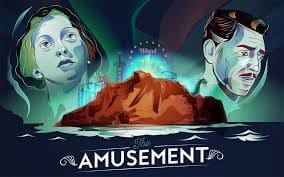
There’s a particular kind of VR experience that doesn’t want to be a game so much as it wants to be a feeling. The Amusement falls squarely into that category — and depending on your expectations walking in, that’s either going to be its greatest strength or its most frustrating limitation. Developed by a small indie team and landing on the Meta Quest platform at a launch price of $14.99, The Amusement positions itself as an emotional, story-driven roomscale puzzle experience set inside a surreal, decaying carnival.
It’s melancholic, it’s beautifully crafted in places, and it absolutely has something genuine to say. But it’s also undeniably thin, occasionally frustrating in its lack of interactivity, and over before it really hits its stride. So is it worth your time and your fifteen bucks? Let’s break it all down.
Platform Availability & Price
The Amusement is currently available exclusively on Meta Quest 2, Quest 3, and Quest 3S as a standalone VR title. There is no PC VR version via Steam or the Oculus PC app at launch, no PS5 PSVR2 port, no Xbox, no Switch — just the Quest ecosystem. At $14.99, it’s priced firmly in the “impulse buy” territory, which is probably the right call given the runtime. There are no microtransactions, no DLC, no battle pass, and no post-launch monetization hooks of any kind. You pay your fifteen dollars, you get the complete experience.
That kind of clean, honest transaction deserves recognition in an era where even indie titles try to squeeze extra revenue out of players. The Amusement respects your wallet. Whether it fully respects your time is a more complicated answer.
Story & Narrative — The Heart of the Experience
Here’s where The Amusement genuinely earns its place in the VR catalog. The story centers on a nameless figure who finds themselves inside an abandoned amusement park — a carnival frozen in time, draped in rust, overgrown with weeds, and haunted by ghostly echoes of laughter and music. Through environmental storytelling, scattered journal pages, and a quietly devastating narration delivered by a single voice actress, the game unspools a story about grief, memory, and the complicated love between a parent and a child.
It doesn’t hit you over the head with its themes. There’s no melodramatic cutscene where a character wails about loss. Instead, The Amusement trusts you to piece things together — a child’s drawing pinned to a ticket booth, a music box that plays a half-remembered lullaby, a carousel horse with a name scratched into its side. The environmental narrative design is genuinely excellent, and the voice performance anchoring it all is understated and quietly heartbreaking in the best possible way. By the time the experience reaches its conclusion, it lands an emotional gut-punch that I didn’t fully see coming, and that stuck with me longer than I expected from a fifteen-dollar VR title.
If you’ve played Unseen Diplomacy 2 or Interlocked: Puzzle Islands, you know that VR can deliver wildly different emotional registers — from spy-thriller adrenaline to zen-like calm. The Amusement is operating in a completely different emotional lane, closer to something like walking through an interactive short film than playing a traditional game. That’s worth understanding before you buy.
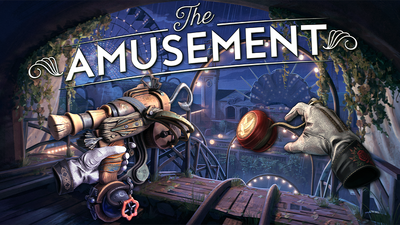
Let me be direct: if you’re coming to The Amusement for meaty puzzle gameplay, you are going to be disappointed. The roomscale puzzles here are functional but shallow. You’ll rotate carnival game mechanisms to align symbols, physically reach into diorama-style scenes to trigger story beats, crank handles to reveal hidden compartments, and occasionally piece together torn photographs or notes. None of it is particularly challenging — even the most complex puzzle in the game took me under three minutes to solve — and the difficulty curve is essentially nonexistent.
The developers clearly made a deliberate choice here: the puzzles exist to give your hands something to do while the story washes over you, not to challenge your problem-solving skills. I respect the intentionality, but I also think they could have threaded the needle better. Bootstrap Island proved that VR mechanics and emotional storytelling don’t have to be mutually exclusive. People of Note found ways to make its interactive elements feel genuinely integrated with its themes. The Amusement’s puzzles, by contrast, feel bolted on rather than woven in. They don’t deepen the narrative — they just pace it.
The roomscale design is solid, at least. The game makes good use of physical space, encouraging you to crouch down to peer into small dioramas, reach above your head to grab hanging objects, and physically walk between carnival stalls. On Quest 3 specifically, the spatial awareness feels tight and well-calibrated. There were no moments where I clipped through geometry or lost tracking, which is more than I can say for plenty of bigger-budget VR titles.
Graphics, Audio & Presentation
For a standalone Quest title developed by a small team, The Amusement looks genuinely impressive in places. The art direction is the real star — a muted, desaturated color palette punctuated by warm, amber-tinted lighting that gives the abandoned carnival an almost dreamlike quality. Individual set pieces, like a crumbling funhouse mirror maze or a flooded bumper car arena, are rendered with real care and atmosphere. Character models are minimal to nonexistent (this is an environmental experience, not a character-driven one), which keeps the polygon budget manageable and lets the scenery shine.
On Quest 3, textures hold up well at close inspection — important in a roomscale title where you’re constantly leaning in to examine objects. Quest 2 users will notice some texture compression and slightly muddier shadows, but the art direction carries it. Performance was smooth throughout my playthrough on Quest 3, holding a stable frame rate without any hitching or judder. Motion sickness risk is low — locomotion is limited to short teleport hops between fixed play areas, and there’s no artificial smooth locomotion at all. Comfort settings are minimal but the design philosophy itself is comfort-forward.
The audio design deserves special mention. The sound of wind through carnival bunting, the creak of a rusted Ferris wheel, the distant and distorted echo of carousel music — it’s all meticulously layered and spatially positioned in a way that genuinely rewards a good pair of headphones. The voice narration is mixed beautifully, feeling intimate and close, like someone whispering a confession directly into your ear. It’s the kind of audio work that elevates the entire experience by several notches.
VR Comfort & Platform-Specific Performance
As noted, The Amusement is currently a Quest-exclusive experience. On Quest 3, it runs beautifully — crisp, smooth, and with excellent hand tracking support as an alternative to controllers (though controller play is the default and slightly more reliable). On Quest 2, performance is still solid, though some of the finer lighting effects are visibly toned down. The game’s play area requirements are modest — you can realistically play it in about a 6×6 foot guardian space, which is accessible for most home VR setups.
There are no seated mode options officially listed, but the game can be played seated with minor limitations — a few interactions require you to reach slightly above standing height, which can be awkward from a chair. The developers would benefit from adding an explicit seated comfort mode in a future update. Headset weight and extended play aren’t concerns given the short runtime — you’re not going to be strapping in for a multi-hour session here.
Value Proposition — Is $14.99 the Right Price?
Here’s the honest math: The Amusement will take most players between 60 and 90 minutes to complete. There is essentially zero replayability — once you know the story beats and puzzle solutions, there’s no mechanical reason to return. There are no collectibles beyond what the story requires, no alternate endings, no difficulty modes. It is a linear, single-playthrough experience.
At $14.99, that works out to roughly ten to fifteen dollars per hour of engagement, which is on the higher end of the indie VR spectrum. Compare that to Legendary Tales: Dawn of History, which offers dozens of hours of dungeon-crawling content at a comparable price point, or even Hozy, which provides a more extended relaxation experience. The Amusement is pricing itself like a premium short film rather than a game, and that’s a legitimate creative choice — but it’s one you need to be consciously okay with before purchasing.
I’ll say this: the emotional impact is genuine, the craft is evident, and it doesn’t waste a single minute of its runtime. If you’ve ever paid fifteen dollars to see an indie short film at a festival, The Amusement offers comparable value. If you need mechanical depth or extended playtime to feel like a purchase is justified, look elsewhere.
Final Verdict
The Amusement is a small, sincere, and genuinely moving VR experience that succeeds more as interactive emotional art than as a puzzle game. Its roomscale mechanics are too thin to stand on their own, but they serve as an effective delivery mechanism for a story that earns its emotional payoff. The presentation is polished well beyond what the price point would suggest, the audio design is exceptional, and it runs smoothly on the Quest platform. It won’t appeal to players seeking mechanical challenge or extended content, and the short runtime at $14.99 will feel steep to value-focused buyers. But if you’re looking for a VR experience that actually has something to say — and says it with quiet, aching honesty — The Amusement is worth stepping inside.
Score: 7.5 / 10
A poignant, beautifully crafted emotional short that asks more from your heart than your brain. Thin on puzzles, rich on feeling.
FAQ
Is The Amusement worth full price at $14.99?
If you’re comfortable paying for a premium emotional experience in the 60-90 minute range — yes. If you need mechanical depth or long playtime to justify a purchase, it’s a harder sell. Wait for a sale if you’re on the fence.
How long does it take to beat The Amusement?
Most players will complete it in 60 to 90 minutes. Thorough explorers who read every journal page and examine every environmental detail might stretch it to two hours, but not beyond that.
Are there any game-breaking bugs?
None encountered during review on Quest 3. The experience is short and linear enough that catastrophic bugs would be immediately obvious — and none surfaced during multiple playthroughs.
Are there any pay-to-win elements, microtransactions, or DLC?
Absolutely none. $14.99 gets you the complete experience. No additional purchases of any kind are available or anticipated at this time.
What platforms is The Amusement available on?
Currently exclusive to Meta Quest 2, Quest 3, and Quest 3S. No PC VR, PSVR2, or flat-screen versions are available at launch.
Is The Amusement comfortable for VR beginners?
Yes — teleport-only locomotion, a short runtime, and a stationary play style make it one of the more comfort-friendly VR experiences available. Nausea risk is very low.
How does it compare to other VR story experiences?
It sits comfortably alongside titles like Interlocked: Puzzle Islands in tone and approach, but with a stronger narrative payoff. Less mechanically engaging than Unseen Diplomacy 2 or Bootstrap Island, but more emotionally resonant than either.